Department of Medicine, Centre for Heart Lung Innovation, Providence Health Care Research Institute at St. Paul's Hospital, University of British Columbia Vancouver, BC, Canada.
Front Cell Dev Biol. 2015 Feb 2;3:3. doi: 10.3389/fcell.2015.00003. eCollection 2015.
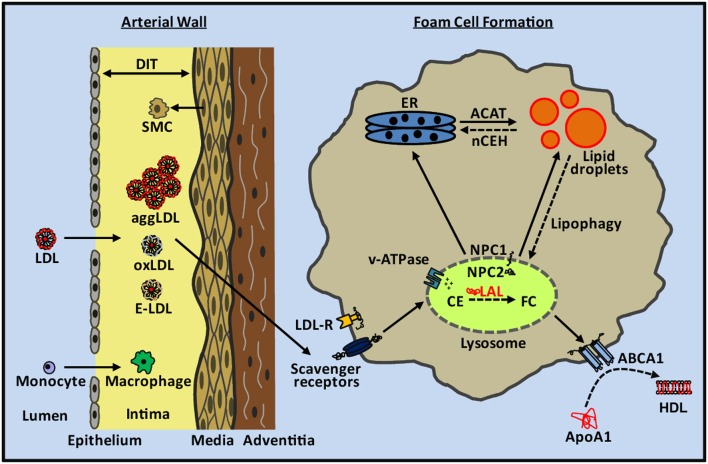
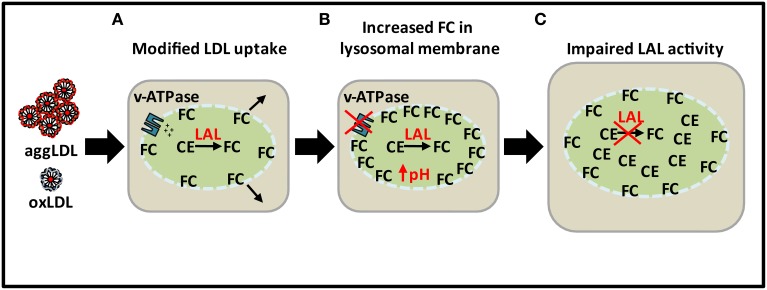
Unregulated cellular uptake of apolipoprotein B-containing lipoproteins in the arterial intima leads to the formation of foam cells in atherosclerosis. Lysosomal acid lipase (LAL) plays a crucial role in both lipoprotein lipid catabolism and excess lipid accumulation as it is the primary enzyme that hydrolyzes cholesteryl esters derived from both low density lipoprotein (LDL) and modified forms of LDL. Evidence suggests that as atherosclerosis progresses, accumulation of excess free cholesterol in lysosomes leads to impairment of LAL activity, resulting in accumulation of cholesteryl esters in the lysosome as well as the cytosol in foam cells. Impaired metabolism and release of cholesterol from lysosomes can lead to downstream defects in ATP-binding cassette transporter A1 regulation, needed to offload excess cholesterol from plaque foam cells. This review focuses on the role LAL plays in normal cholesterol metabolism and how the associated changes in its enzymatic activity may ultimately contribute to atherosclerosis progression.
未调节的细胞摄取富含载脂蛋白 B 的脂蛋白在动脉内膜中导致泡沫细胞形成在动脉粥样硬化中。溶酶体酸性脂肪酶(LAL)在脂蛋白脂质代谢和脂质积累过多中起着至关重要的作用,因为它是水解来自低密度脂蛋白(LDL)和 LDL 修饰形式的胆固醇酯的主要酶。有证据表明,随着动脉粥样硬化的进展,溶酶体中过量游离胆固醇的积累导致 LAL 活性受损,导致胆固醇酯在溶酶体以及泡沫细胞的细胞质中积累。溶酶体中胆固醇的代谢和释放受损可导致下游三磷酸腺苷结合盒转运蛋白 A1 调节缺陷,需要从斑块泡沫细胞中卸载过量胆固醇。本综述重点介绍了 LAL 在正常胆固醇代谢中的作用,以及其酶活性的相关变化如何最终导致动脉粥样硬化的进展。