Department of Anesthesiology and Medical Crisis Management, Nagoya City University Graduate School of Medical Sciences, Nagoya, 467-8601 Japan.
Laboratory of Analytical and Bio-Analytical Chemistry, School of Pharmaceutical Sciences, University of Shizuoka, 52-1 Yada, Suruga-ku, Shizuoka, 422-8526 Japan.
J Intensive Care. 2013 Dec 20;1(1):15. doi: 10.1186/2052-0492-1-15. eCollection 2013.
Dexmedetomidine is a highly selective central α2-agonist with anesthetic and analgesic properties for patients in intensive care units. There is little information about the relationship between dosage and plasma concentration during long drug infusions of dexmedetomidine in critically ill patients, especially in Asians. In addition, the administration of dexmedetomidine with a dosage of 0.2-0.7 μg/kg/h in Japan is different from that with a dosage of 0.2-1.4 μg/kg/h in European countries and the USA. There has been concern about obtaining an effective concentration with a small dosage and estimating the relationship between dosage and plasma concentration. We conducted a prospective, observational, cohort study measuring plasma dexmedetomidine concentrations.
Plasma dexmedetomidine concentrations of 67 samples from 34 patients in an intensive care unit for 2 months were measured by ultra performance liquid chromatography coupled with tandem mass spectrometry using single-blind method, and the correlation coefficient between dosages and plasma concentrations was estimated. Exclusion criteria included young patients (<16 years) and samples obtained from patients in which the dosage of dexmedetomidine was changed within 3 h.
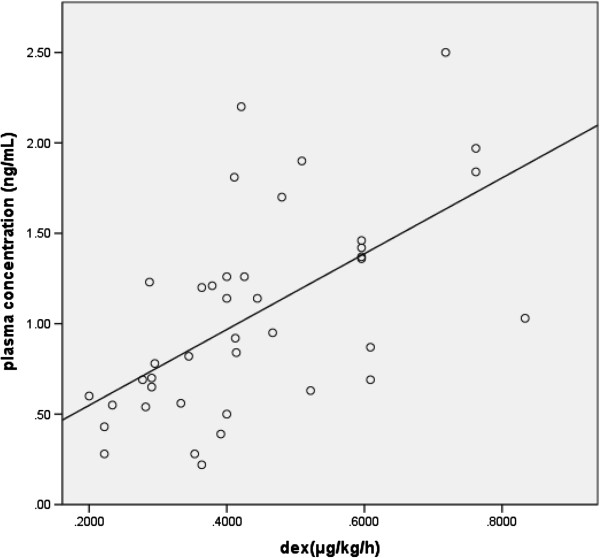
Among the patients, 20 (58.8%) of the 34 received dexmedetomidine at 0.20-0.83 μg/kg/h, and in 40 of the 67 samples for which dexmedetomidine had been administered, this occurred for a median duration of 18.5 h (range, 3-87 h). The range of the dexmedetomidine plasma concentration was 0.22-2.50 ng/ml. By comparison with other studies, with a dosage of 0.2-0.7 μg/kg/h, the patients in this setting could obtain an effective dexmedetomidine concentration. The plasma dexmedetomidine concentration was moderately correlated with the administered dosage (r = 0.653, P < 0.01). The approximate linear equation was y = 0.171x + 0.254. The range of Richmond Agitation-Sedation Scale was 0 to -5.
We concluded that, with a dosage of 0.2-0.83 μg/kg/h, the patients in this setting could obtain an effective dexmedetomidine concentration of 0.22-2.50 ng/ml. In addition, the plasma dexmedetomidine concentration was moderately correlated with the administered dosage (r = 0.653, P < 0.01).
University Hospital Medical Information Network Clinical Trials Registry (UMIN-CTR) UMIN000009115.
右美托咪定是一种高度选择性的中枢α2-激动剂,具有麻醉和镇痛作用,可用于重症监护病房的患者。关于重症患者长时间输注右美托咪定的剂量与血浆浓度之间的关系,尤其是在亚洲人群中,相关信息较少。此外,日本给予右美托咪定的剂量为 0.2-0.7μg/kg/h,与欧洲国家和美国的 0.2-1.4μg/kg/h 不同。人们一直担心使用小剂量获得有效浓度,并估计剂量与血浆浓度之间的关系。我们进行了一项前瞻性、观察性、队列研究,测量了血浆右美托咪定浓度。
采用超高效液相色谱-串联质谱法(UPLC-MS/MS),对 2 个月内在重症监护病房的 34 名患者的 67 个样本进行血浆右美托咪定浓度的单盲测量,并估计剂量与血浆浓度之间的相关系数。排除标准包括年龄较小的患者(<16 岁)和右美托咪定剂量在 3 小时内发生变化的患者的样本。
在 34 名患者中,有 20 名(58.8%)接受了 0.20-0.83μg/kg/h 的右美托咪定治疗,在接受右美托咪定治疗的 67 个样本中,中位持续时间为 18.5 小时(范围为 3-87 小时)。右美托咪定的血浆浓度范围为 0.22-2.50ng/ml。与其他研究相比,在此设置中,以 0.2-0.7μg/kg/h 的剂量,患者可以获得有效的右美托咪定浓度。右美托咪定的血浆浓度与给予的剂量中度相关(r=0.653,P<0.01)。近似线性方程为 y=0.171x+0.254。里士满躁动-镇静量表的范围为 0 至-5。
我们得出结论,在此设置中,以 0.2-0.83μg/kg/h 的剂量,患者可以获得有效的右美托咪定浓度为 0.22-2.50ng/ml。此外,右美托咪定的血浆浓度与给予的剂量中度相关(r=0.653,P<0.01)。
大学医院医疗信息网络临床试验注册(UMIN-CTR)UMIN000009115。