Zhou Cong, Zhang Peng, Xu Guang-Chao, Wu Dong-Ming, Liu Ru-Yan, Zeng Qi, Wang Chun-Ting
State Key Laboratory of Biotherapy and Cancer Center, West China Hospital, West China Medical School, Sichuan University, Chengdu, P. R. China.
Oncol Res. 2015;22(2):93-103. doi: 10.3727/096504014X14146137738583.
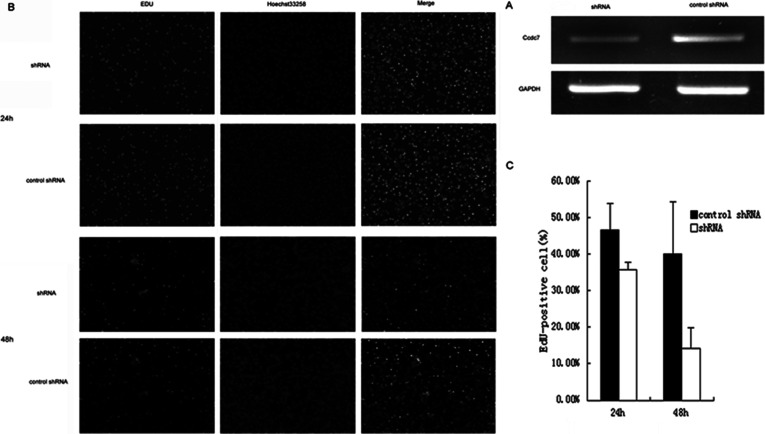
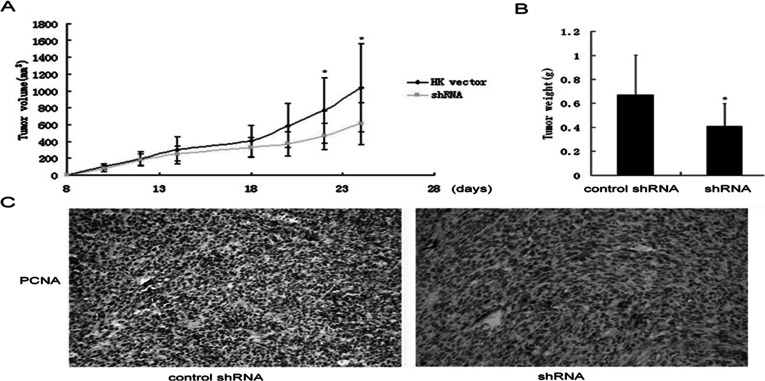
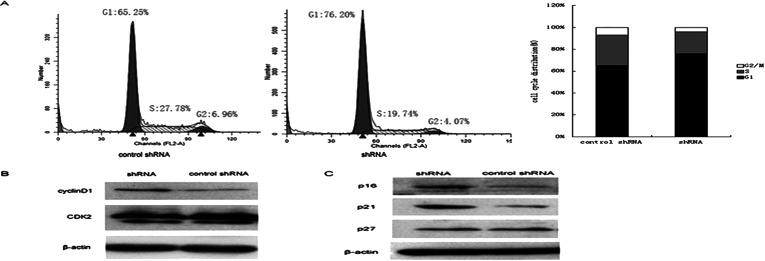
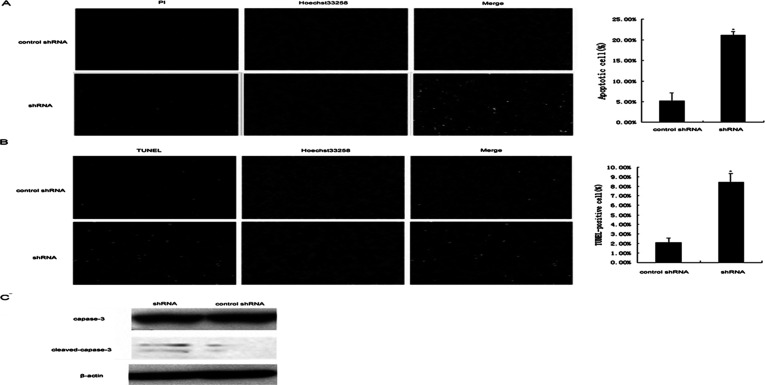
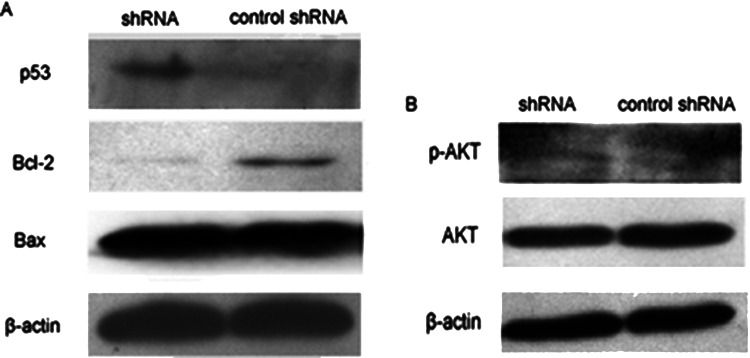
Biot2 is a tumor-associated antigen, and it is a novel gene (GenBank EF100607) that was first identified with the SEREX technique and named by our laboratory. It is highly expressed in cancer cells and testis, with low or no expression in normal tissues. In our previous study, RNA interference of human Biot2 can inhibit tumor cell growth, and it is associated with poor prognosis of patients in clinical study; however, the mechanism of Biot2 that effects tumor growth is not yet clear. Here, in this study, we explore further the mechanism of Biot2 by silencing Biot2 in CT26 cells. It provides some theoretical basis for Biot2 as a new target for gene therapy. In CT26 cells, the expression of Biot2 was downregulated by Biot2-shRNA. It also promoted G1 phase arrest, the expression of p16 and p21, and cell apoptosis. In the mouse model, the tumor volume and the expression of PCNA of the Biot2-shRNA group significantly decreased. These results suggest that silencing Biot2 in CT26 cells by RNA interference can inhibit cell growth in vitro and in vivo. It also induces cell cycle arrest in the G1 phase and apoptosis throughout regulation of p16 and p21. Taken together, our data demonstrate that Biot2 can be a potential target of gene therapy.
Biot2是一种肿瘤相关抗原,是通过SEREX技术首次鉴定并由我们实验室命名的一个新基因(GenBank登录号为EF100607)。它在癌细胞和睾丸中高表达,在正常组织中低表达或不表达。在我们之前的研究中,对人Biot2进行RNA干扰可抑制肿瘤细胞生长,临床研究表明其与患者预后不良有关;然而,Biot2影响肿瘤生长的机制尚不清楚。在此研究中,我们通过在CT26细胞中沉默Biot2进一步探索其机制。这为Biot2作为基因治疗的新靶点提供了一些理论依据。在CT26细胞中,Biot2-shRNA下调了Biot2的表达。它还促进了G1期阻滞、p16和p21的表达以及细胞凋亡。在小鼠模型中,Biot2-shRNA组的肿瘤体积和PCNA表达显著降低。这些结果表明,通过RNA干扰在CT26细胞中沉默Biot2可在体外和体内抑制细胞生长。它还通过对p16和p21的调控诱导细胞周期阻滞在G1期并引发细胞凋亡。综上所述,我们的数据表明Biot2可能是基因治疗的一个潜在靶点。