Marrache Sean, Dhar Shanta
NanoTherapeutics Research Laboratory, Department of Chemistry, University of Georgia, Athens, GA 30602.
NanoTherapeutics Research Laboratory, Department of Chemistry, University of Georgia, Athens, GA 30602 ; Department of Physiology and Pharmacology, University of Georgia, Athens, GA 30602 ; Regenerative Bioscience Center, University of Georgia, 425 River Road, Athens, GA 30602.
Chem Sci. 2015 Mar;6(3):1832-1845. doi: 10.1039/C4SC01963F.
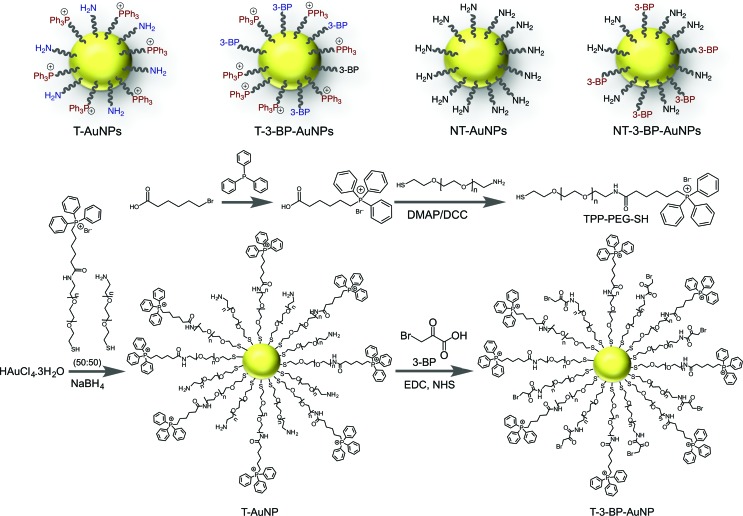
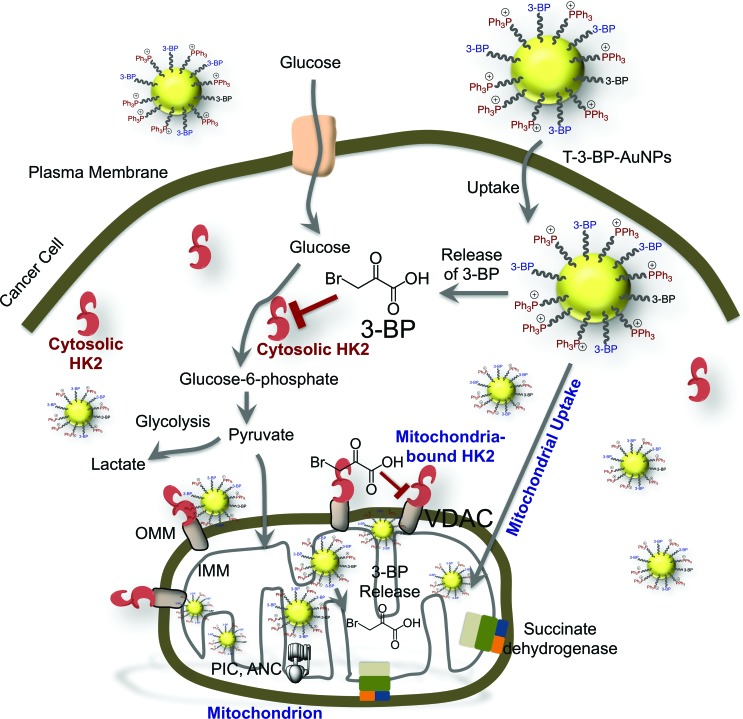
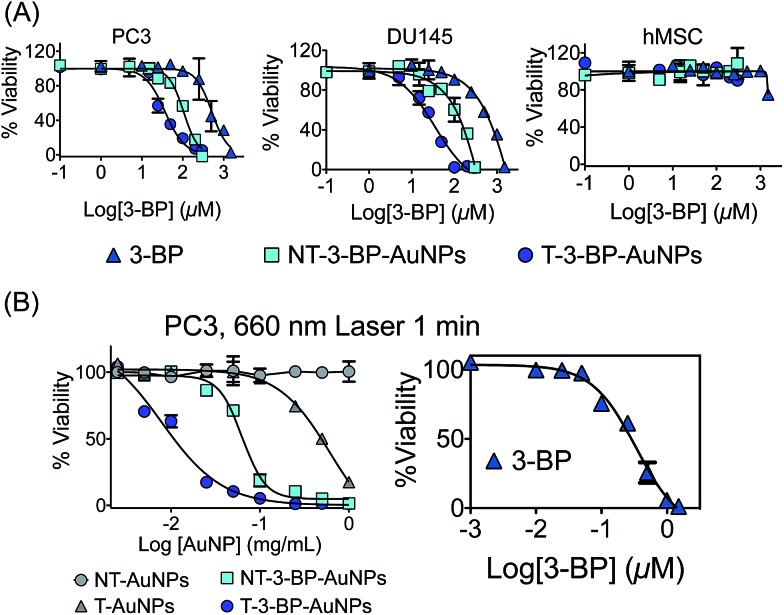
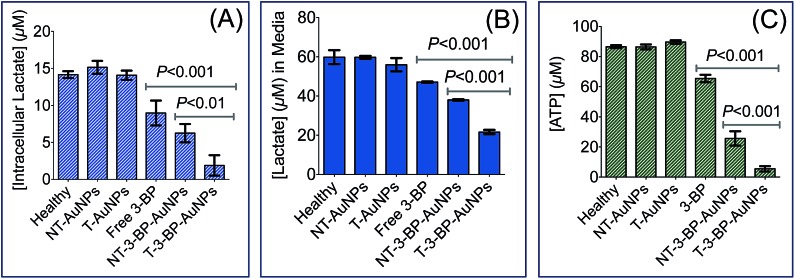
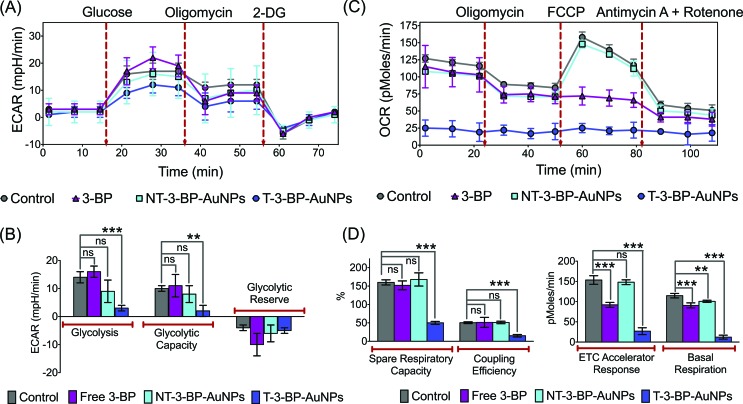
A key hallmark of many aggressive cancers is accelerated glucose metabolism. The enzymes that catalyze the first step of glucose metabolism are hexokinases. High levels of hexokinase 2 (HK2) are found in cancer cells, but only in a limited number of normal tissues. Metabolic reprogramming of cancer cells using the energy blocker, 3-bromopyruvate (3-BP) that inhibits HK2 has the potential to provide tumor-specific anticancer agents. However, the unique structural and functional characteristics of mitochondria prohibit selective subcellular targeting of 3-BP to modulate the function of this organelle for therapeutic gain. A mitochondria targeted gold nanoparticle (T-3-BP-AuNP) decorated with 3-BP and delocalized lipophilic triphenylphosphonium cations to target the mitochondrial membrane potential (Δ) was developed for delivery of 3-BP to cancer cell mitochondria by taking advantage of higher Δ in cancer cells compared to normal cells. studies demonstrated enhanced anticancer activity of T-3-BP-AuNPs compared to the non-targeted construct NT-3-BP-AuNP or free 3-BP. The anticancer activity of T-3-BP-AuNP was further enhanced upon laser irradiation by exciting the surface plasmon resonance band of AuNP and thereby utilizing a combination of 3-BP chemotherapeutic and AuNP photothermal effects. The less toxic behavior of T-3-BPNPs in normal mesenchymal stem cells indicated that these NPs preferentially kill cancer cells. T-3-BP-AuNPs showed enhanced ability to modulate cancer cell metabolism by inhibiting glycolysis as well as demolishing mitochondrial oxidative phosphorylation. Our findings demonstrated that concerted chemo-photothermal treatment of glycolytic cancer cells with a single NP capable of targeting mitochondria mediating simultaneous release of a glycolytic inhibitor and photothermal ablation may have promise as a new anticancer therapy.
许多侵袭性癌症的一个关键特征是葡萄糖代谢加速。催化葡萄糖代谢第一步的酶是己糖激酶。癌细胞中发现了高水平的己糖激酶2(HK2),但仅在少数正常组织中存在。使用抑制HK2的能量阻断剂3-溴丙酮酸(3-BP)对癌细胞进行代谢重编程,有可能提供肿瘤特异性抗癌药物。然而,线粒体独特的结构和功能特性使得无法将3-BP选择性地靶向亚细胞来调节该细胞器的功能以获得治疗效果。通过利用癌细胞与正常细胞相比更高的线粒体膜电位(Δ),开发了一种用3-BP修饰并带有离域亲脂性三苯基膦阳离子以靶向线粒体膜电位的线粒体靶向金纳米颗粒(T-3-BP-AuNP),用于将3-BP递送至癌细胞线粒体。研究表明,与非靶向构建体NT-3-BP-AuNP或游离3-BP相比,T-3-BP-AuNPs的抗癌活性增强。通过激发AuNP的表面等离子体共振带,在激光照射下T-3-BP-AuNP的抗癌活性进一步增强,从而利用3-BP化疗和AuNP光热效应的组合。T-3-BPNPs在正常间充质干细胞中较低的毒性行为表明这些纳米颗粒优先杀死癌细胞。T-3-BP-AuNPs通过抑制糖酵解以及破坏线粒体氧化磷酸化,显示出更强的调节癌细胞代谢的能力。我们的研究结果表明,用一种能够靶向线粒体并同时释放糖酵解抑制剂和进行光热消融的单一纳米颗粒对糖酵解癌细胞进行协同化学-光热治疗,可能有望成为一种新的抗癌疗法。