Kodiha Mohamed, Wang Yi Meng, Hutter Eliza, Maysinger Dusica, Stochaj Ursula
1. Department of Physiology, McGill University, Montreal, Canada;
2. Department of Pharmacology & Therapeutics, McGill University, Montreal, Canada.
Theranostics. 2015 Jan 21;5(4):357-70. doi: 10.7150/thno.10657. eCollection 2015.
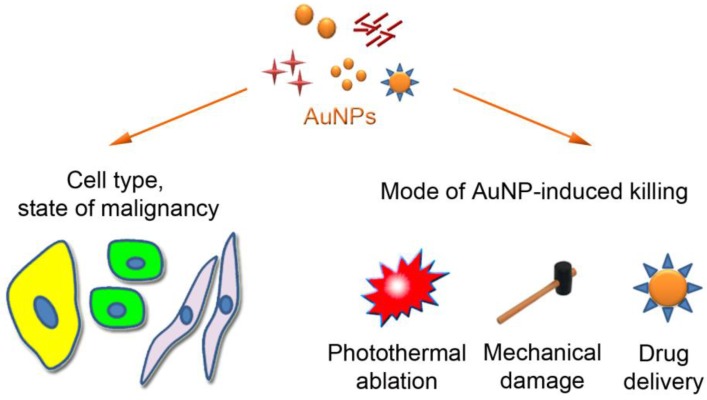
Gold nanoparticles (AuNPs) are excellent tools for cancer cell imaging and basic research. However, they have yet to reach their full potential in the clinic. At present, we are only beginning to understand the molecular mechanisms that underlie the biological effects of AuNPs, including the structural and functional changes of cancer cells. This knowledge is critical for two aspects of nanomedicine. First, it will define the AuNP-induced events at the subcellular and molecular level, thereby possibly identifying new targets for cancer treatment. Second, it could provide new strategies to improve AuNP-dependent cancer diagnosis and treatment. Our review summarizes the impact of AuNPs on selected subcellular organelles that are relevant to cancer therapy. We focus on the nucleus, its subcompartments, and mitochondria, because they are intimately linked to cancer cell survival, growth, proliferation and death. While non-targeted AuNPs can damage tumor cells, concentrating AuNPs in particular subcellular locations will likely improve tumor cell killing. Thus, it will increase cancer cell damage by photothermal ablation, mechanical injury or localized drug delivery. This concept is promising, but AuNPs have to overcome multiple hurdles to perform these tasks. AuNP size, morphology and surface modification are critical parameters for their delivery to organelles. Recent strategies explored all of these variables, and surface functionalization has become crucial to concentrate AuNPs in subcellular compartments. Here, we highlight the use of AuNPs to damage cancer cells and their organelles. We discuss current limitations of AuNP-based cancer research and conclude with future directions for AuNP-dependent cancer treatment.
金纳米颗粒(AuNPs)是癌细胞成像和基础研究的优良工具。然而,它们在临床应用中尚未发挥出全部潜力。目前,我们才刚刚开始了解AuNPs生物学效应背后的分子机制,包括癌细胞的结构和功能变化。这些知识对纳米医学的两个方面至关重要。首先,它将在亚细胞和分子水平上定义AuNP诱导的事件,从而有可能识别出新的癌症治疗靶点。其次,它可以提供新的策略来改善基于AuNP的癌症诊断和治疗。我们的综述总结了AuNPs对与癌症治疗相关的特定亚细胞器的影响。我们重点关注细胞核及其亚结构以及线粒体,因为它们与癌细胞的存活、生长、增殖和死亡密切相关。虽然非靶向AuNPs可以损伤肿瘤细胞,但将AuNPs集中在特定的亚细胞位置可能会提高对肿瘤细胞的杀伤效果。因此,通过光热消融、机械损伤或局部药物递送,它将增加对癌细胞的损伤。这个概念很有前景,但AuNPs要执行这些任务还必须克服多个障碍。AuNP的大小、形态和表面修饰是其递送至细胞器的关键参数。最近的策略探讨了所有这些变量,并且表面功能化对于将AuNPs集中在亚细胞区室中已变得至关重要。在这里,我们强调了AuNPs对癌细胞及其细胞器的损伤作用。我们讨论了基于AuNP的癌症研究当前的局限性,并以基于AuNP的癌症治疗的未来方向作为总结。