Mo Jin-A, Lim Ju-Hee, Sul Ah-Ram, Lee Min, Youn Young Chul, Kim Hee-Jin
National Evidence-Based Health Care Collaborating Agency, Seoul, Korea; Department of Nursing, Inha University College of Medicine, Incheon, Korea.
National Evidence-Based Health Care Collaborating Agency, Seoul, Korea.
PLoS One. 2015 Feb 24;10(2):e0116802. doi: 10.1371/journal.pone.0116802. eCollection 2015.
The purpose of this study was to carry out systematic review of the literature and meta-analysis to evaluate the diagnostic utility of cerebrospinal fluid (CSF) levels of the 42 amino acid form of amyloid-beta (Aβ1-42) as a biomarker for differentiating Alzheimer's disease (AD) from non-AD dementia.
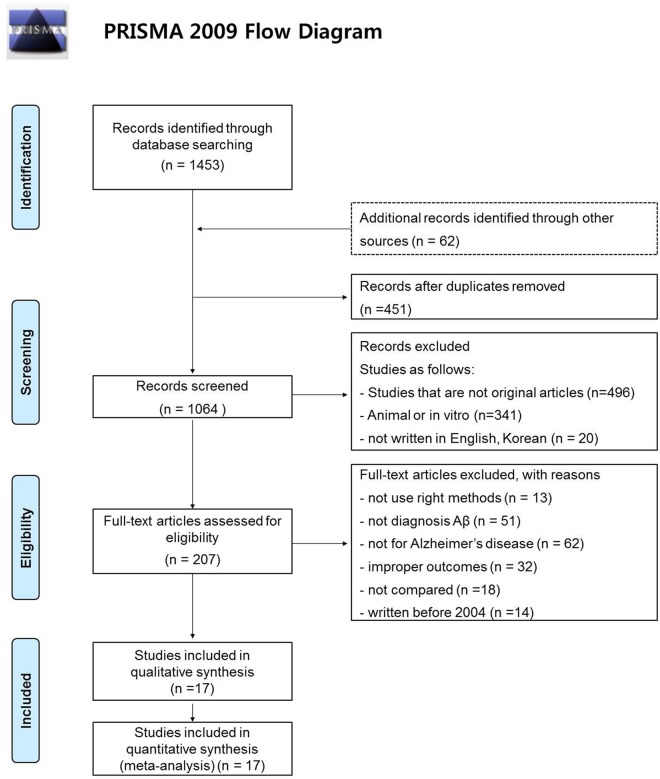
Design. Systematic literature review was used to evaluate the effectiveness of the Aβ for the diagnosis of AD. The Scottish Intercollegiate Guidelines Network (SIGN) tool was used to evaluate independently the quality of the studies. Data sources. The literature review covered from January 1, 2004, to October 22, 2013, and searched eight domestic databases including Korea Med and international databases including Ovid-MEDLINE, EMBASE, and Cochrane Library. Data Extraction and Synthesis. Primary criteria for inclusion were valid studies on (i) patients with mild cognitive impairment with confirmed or suspected AD and non-AD dementia, and (ii) assessment of Aβ1-42 levels using appropriate comparative tests.
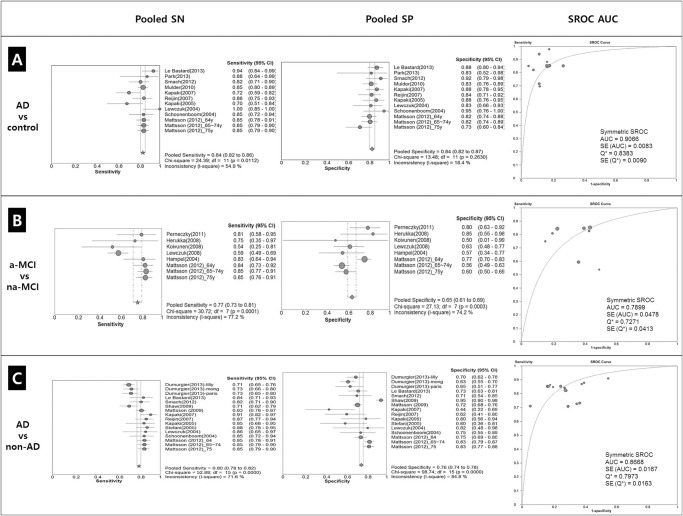
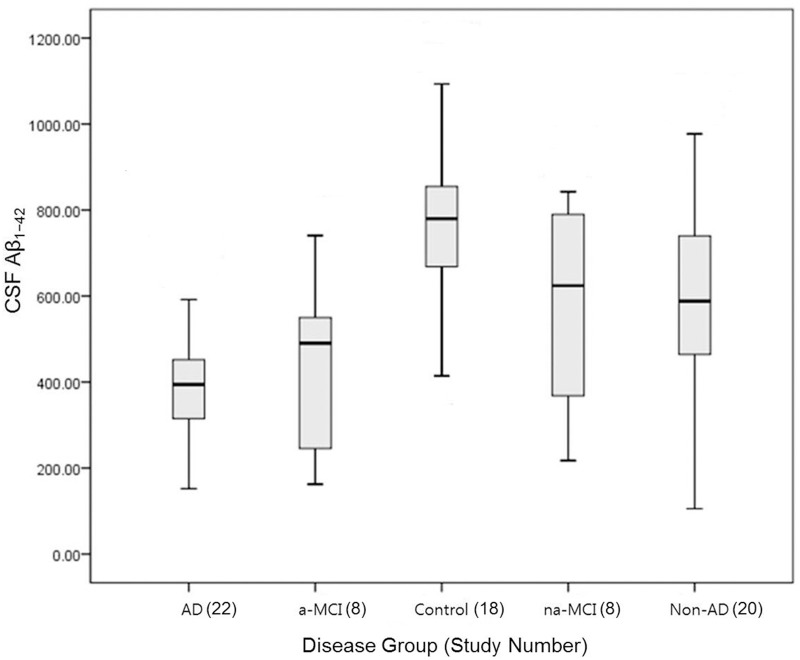
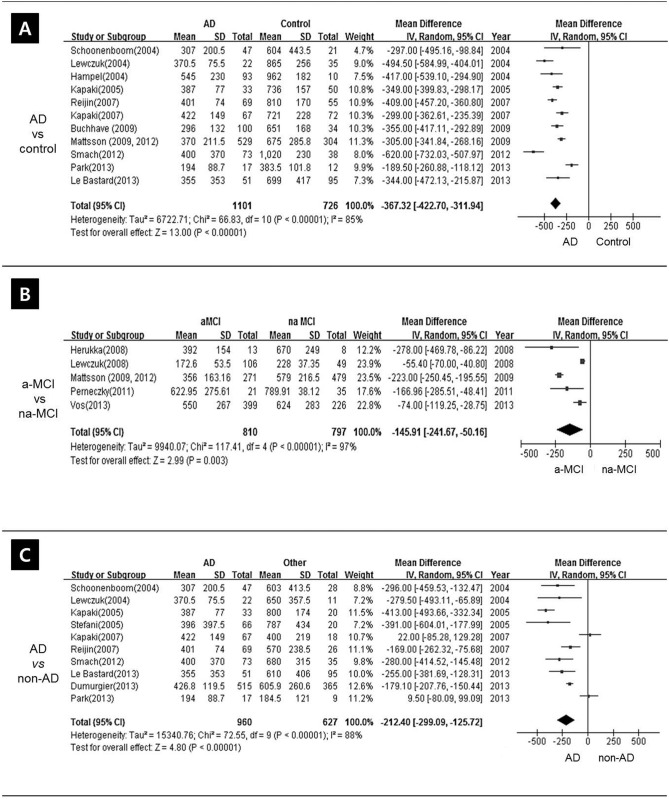
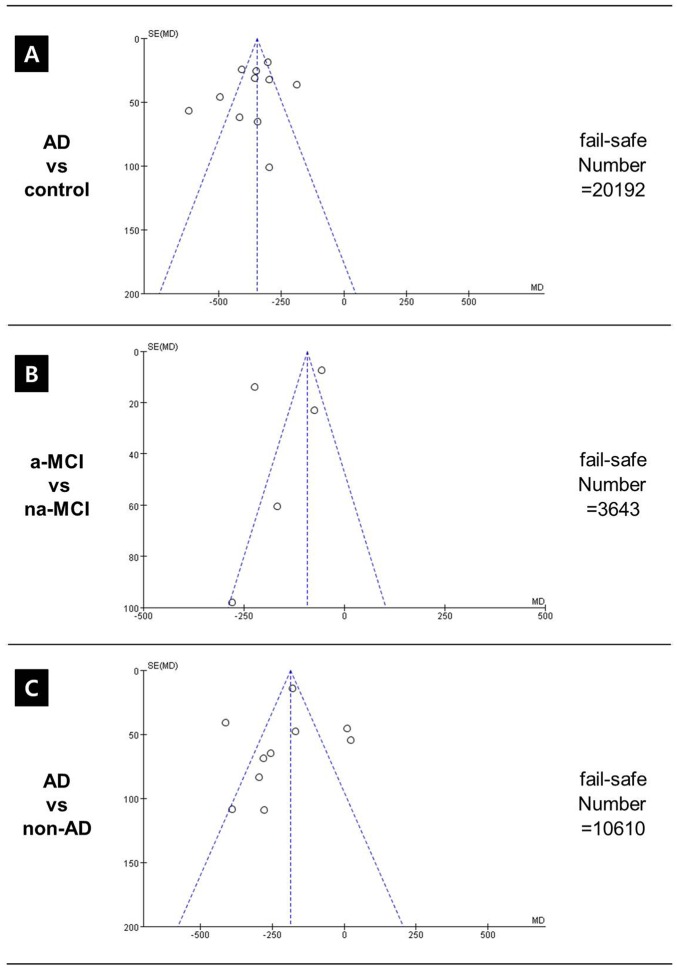
A total of 17 diagnostic evaluation studies were identified in which levels of CSF Aβ1-42 were assessed. Meta-analysis was performed on 11 robust studies that compared confirmed AD (n = 2211) with healthy individuals (n = 1030), 10 studies that compared AD with non-AD dementias (n = 627), and 5 studies that compared amnestic mild cognitive impairment (n = 1133) with non-amnestic type subjects (n = 1276). Overall, the CSF Aβ1-42 levels were reduced in AD compared to controls or non-AD dementia. The effectiveness of test was evaluated for diagnostic accuracy (pooled sensitivity, 0.80 (95% CI 0.78-0.82); pooled specificity, 0.76 (95% CI 0.74-0.78).
Reduced CSF Aβ1-42 levels are of potential utility in the differential diagnosis of AD versus non-AD dementias and controls. Diagnostic accuracy was high in AD versus healthy controls. However, differential diagnosis for MCI or non-AD might be evaluated by other biomarkers.
本研究旨在进行文献系统综述和荟萃分析,以评估脑脊液(CSF)中42氨基酸形式的β淀粉样蛋白(Aβ1-42)水平作为区分阿尔茨海默病(AD)与非AD痴呆的生物标志物的诊断效用。
设计。采用系统文献综述来评估Aβ对AD诊断的有效性。使用苏格兰校际指南网络(SIGN)工具独立评估研究质量。数据来源。文献综述涵盖2004年1月1日至2013年10月22日,检索了包括韩国医学数据库在内的八个国内数据库以及包括Ovid-MEDLINE、EMBASE和Cochrane图书馆在内的国际数据库。数据提取与综合。纳入的主要标准为关于以下方面的有效研究:(i)患有经确诊或疑似AD及非AD痴呆的轻度认知障碍患者,以及(ii)使用适当的比较测试评估Aβ1-42水平。
共确定了17项诊断评估研究,其中评估了脑脊液Aβ1-42水平。对11项比较确诊AD患者(n = 2211)与健康个体(n = 1030)的可靠研究、10项比较AD与非AD痴呆患者(n = 627)的研究以及5项比较遗忘型轻度认知障碍患者(n = 1133)与非遗忘型受试者(n = 1276)的研究进行了荟萃分析。总体而言,与对照组或非AD痴呆相比,AD患者的脑脊液Aβ1-42水平降低。评估了该测试对于诊断准确性的有效性(合并敏感度,0.80(95%CI 0.78 - 0.82);合并特异度,0.76(95%CI 0.74 - 0.78))。
脑脊液Aβ1-42水平降低在AD与非AD痴呆及对照组的鉴别诊断中具有潜在效用。AD与健康对照组相比诊断准确性较高。然而,对于轻度认知障碍或非AD的鉴别诊断可能需要通过其他生物标志物进行评估。