Legionella Pathogenesis Group, International Center for Infectiology Research, Université de Lyon Lyon, France ; INSERM U1111 Lyon, France ; Ecole Normale Supérieure de Lyon Lyon, France ; Centre International de Recherche en Infectiologie, Université Lyon 1 Lyon, France ; Centre National de la Recherche Scientifique, UMR5308 Lyon, France.
Front Microbiol. 2015 Feb 10;6:87. doi: 10.3389/fmicb.2015.00087. eCollection 2015.
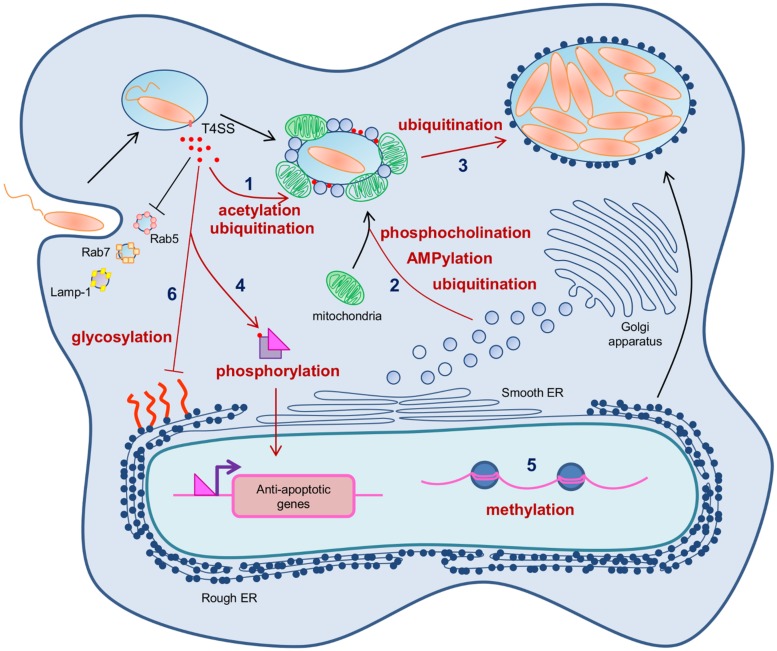
Post-translational modifications (PTMs) are widely used by eukaryotes to control the enzymatic activity, localization or stability of their proteins. Traditionally, it was believed that the broad biochemical diversity of the PTMs is restricted to eukaryotic cells, which exploit it in extensive networks to fine-tune various and complex cellular functions. During the last decade, the advanced detection methods of PTMs and functional studies of the host-pathogen relationships highlight that bacteria have also developed a large arsenal of PTMs, particularly to subvert host cell pathways to their benefit. Legionella pneumophila, the etiological agent of the severe pneumonia legionellosis, is the paradigm of highly adapted intravacuolar pathogens that have set up sophisticated biochemical strategies. Among them, L. pneumophila has evolved eukaryotic-like and rare/novel PTMs to hijack host cell processes. Here, we review recent progress about the diversity of PTMs catalyzed by Legionella: ubiquitination, prenylation, phosphorylation, glycosylation, methylation, AMPylation, and de-AMPylation, phosphocholination, and de-phosphocholination. We focus on the host cell pathways targeted by the bacteria catalyzed PTMs and we stress the importance of the PTMs in the Legionella infection strategy. Finally, we highlight that the discovery of these PTMs undoubtedly made significant breakthroughs on the molecular basis of Legionella pathogenesis but also lead the way in improving our knowledge of the eukaryotic PTMs and complex cellular processes that are associated to.
翻译后修饰(PTMs)被真核生物广泛用于控制其蛋白质的酶活性、定位或稳定性。传统上,人们认为PTMs广泛的生化多样性仅限于真核细胞,真核细胞在广泛的网络中利用它来微调各种复杂的细胞功能。在过去十年中,PTMs的先进检测方法以及宿主-病原体关系的功能研究表明,细菌也开发了大量的PTMs,特别是为了将宿主细胞途径颠覆为其所用。嗜肺军团菌是严重肺炎军团病的病原体,是高度适应的液泡内病原体建立复杂生化策略的典范。其中,嗜肺军团菌进化出类似真核生物的、罕见/新颖的PTMs来劫持宿主细胞过程。在这里,我们综述了军团菌催化的PTMs多样性的最新进展:泛素化、异戊二烯化、磷酸化、糖基化、甲基化、AMP化和去AMP化、磷酸胆碱化和去磷酸胆碱化。我们关注细菌催化的PTMs所靶向的宿主细胞途径,并强调PTMs在嗜肺军团菌感染策略中的重要性。最后,我们强调,这些PTMs的发现无疑在嗜肺军团菌发病机制的分子基础上取得了重大突破,也为提高我们对真核生物PTMs以及与之相关的复杂细胞过程的认识指明了方向。