Björklund Glenn, Holmberg Hans-Christer, Stöggl Thomas
Department of Health Sciences, Swedish Winter Sports Research Centre, Mid-Sweden University, 831 25 Östersund, Sweden.
Department of Health Sciences, Swedish Winter Sports Research Centre, Mid-Sweden University, 831 25 Östersund, Sweden ; Swedish Olympic Committee, Stockholm, Sweden.
Springerplus. 2015 Feb 1;4:40. doi: 10.1186/s40064-015-0796-y. eCollection 2015.
To investigate the influence of prior high intensity double poling (DP) on physiological and biomechanical responses during subsequent diagonal stride (DIA).
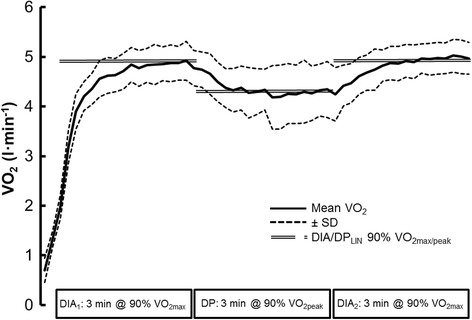
Eight well-trained male cross-country skiers (age 22 ± 3 yr; VO2max 69 ± 3 ml · kg(-1) · min(-1)) roller-skied on a treadmill sequentially for 3 min at 90% DIA VO2max (DIA1), 3 min at 90% DP VO2peak and 3 min at 90% DIA VO2max (DIA2). Cardio-respiratory responses were monitored continuously and gases and metabolites in blood from the a. femoralis, v. femoralis and v. subclavia determined. Pole and plantar forces and EMG from 6 lower- and upper-body muscles were measured.
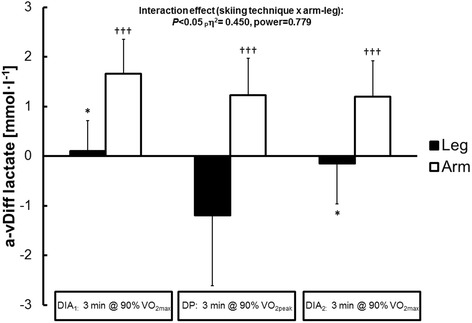
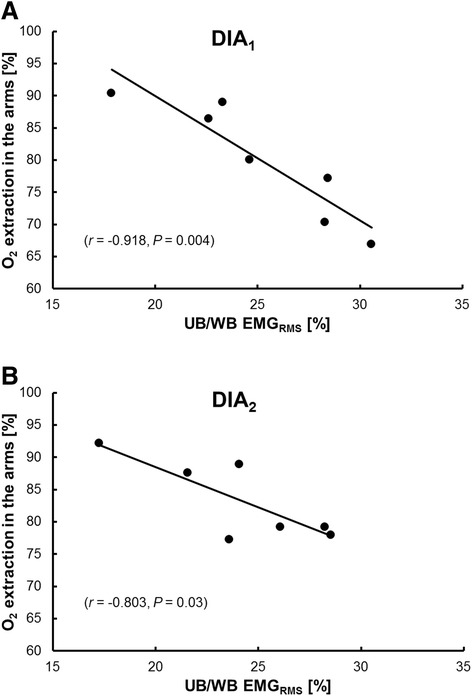
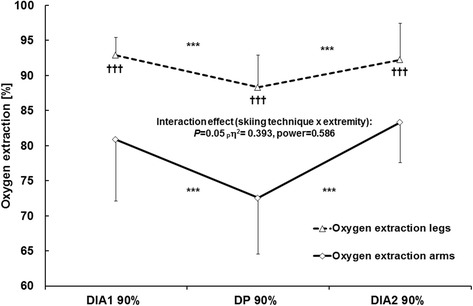
VO2 decreased from DIA1 to DP and increased again to DIA2 (both P < 0.05), with no difference between the DIA sessions. Blood lactate rose from DIA1 to DP to DIA2. O2 extraction was attenuated during DP (P < 0.05), but was the same during DIA1 and DIA2. EMGRMS for arm muscles during poling phase, as well as peak pole force and cycle rate were higher, while leg muscle activity was lower during DP than both sessions of DIA (all P < 0.05). The ratio of upper-/whole-body EMGRMS correlated negatively with O2 extraction in the arms during both sessions of DIA (P < 0.05).
In well-trained skiers skiing at high-intensity DP prior to DIA did not influence VO2, muscle activation or forces in the latter. At race intensity DP does not influence the distribution of work between upper- and lower-body during a subsequent bout of DIA. O2 extraction is coupled to technical skills during skiing.
研究先前的高强度双杖滑雪(DP)对随后的对角步幅(DIA)期间生理和生物力学反应的影响。
八名训练有素的男性越野滑雪运动员(年龄22±3岁;最大摄氧量69±3 ml·kg⁻¹·min⁻¹)在跑步机上进行轮滑,依次以90% DIA最大摄氧量滑3分钟(DIA1)、以90% DP峰值摄氧量滑3分钟、以90% DIA最大摄氧量滑3分钟(DIA2)。持续监测心肺反应,并测定股动脉、股静脉和锁骨下静脉血液中的气体和代谢物。测量双杖力、足底力以及来自6块上下身肌肉的肌电图。
从DIA1到DP,最大摄氧量下降,然后再次上升至DIA2(两者P<0.05),两次DIA期间无差异。血乳酸从DIA1到DP再到DIA2升高。在DP期间,氧提取减弱(P<0.05),但在DIA1和DIA2期间相同。在撑杖阶段,手臂肌肉的肌电图均方根值、峰值双杖力和蹬冰频率更高,而在DP期间腿部肌肉活动低于两次DIA期间(所有P<0.05)。在两次DIA期间,上身/全身肌电图均方根值的比率与手臂的氧提取呈负相关(P<0.05)。
在训练有素的滑雪运动员中,在DIA之前进行高强度DP滑雪不会影响后者的最大摄氧量、肌肉激活或力量。在比赛强度下,DP不会影响随后一次DIA期间上下身之间的工作分配。滑雪过程中氧提取与技术技能相关。