Department of Biological Sciences, University of Pittsburgh, Pittsburgh, PA 15260, USA
Department of Biological Sciences, University of Pittsburgh, Pittsburgh, PA 15260, USA.
AoB Plants. 2015 Feb 27;7:plv014. doi: 10.1093/aobpla/plv014.
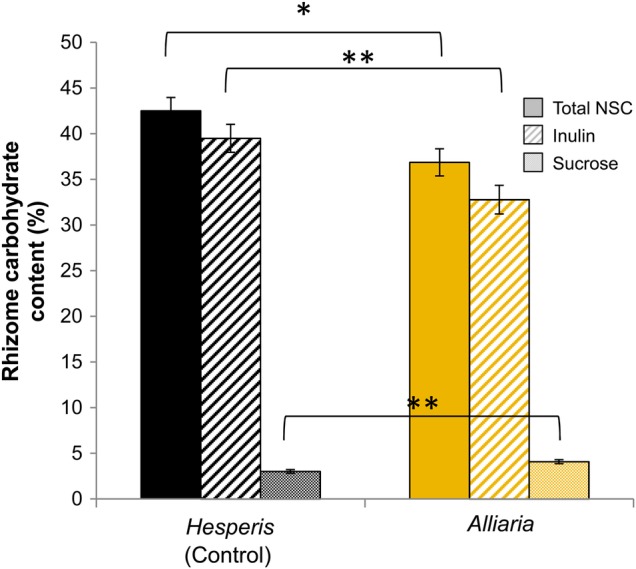
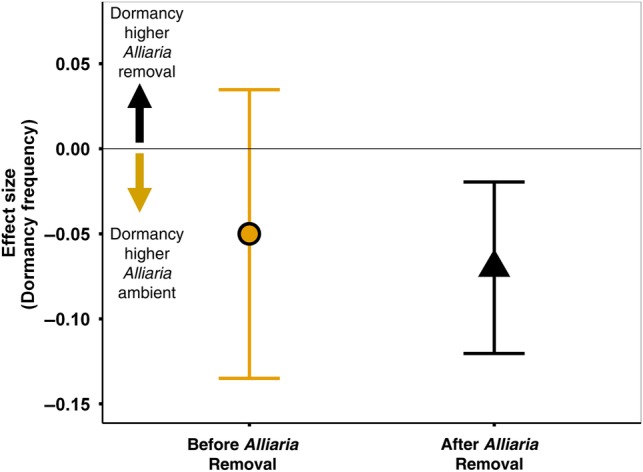
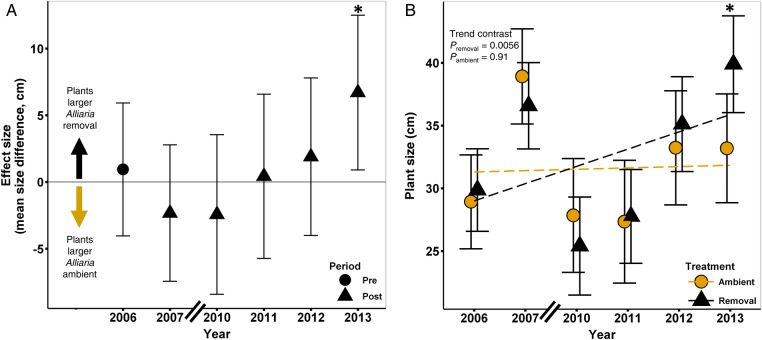
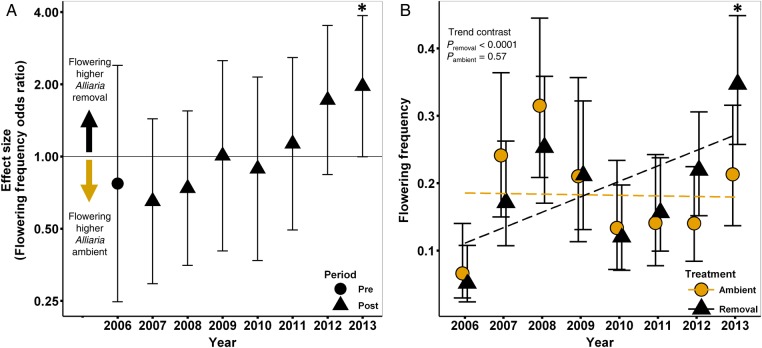
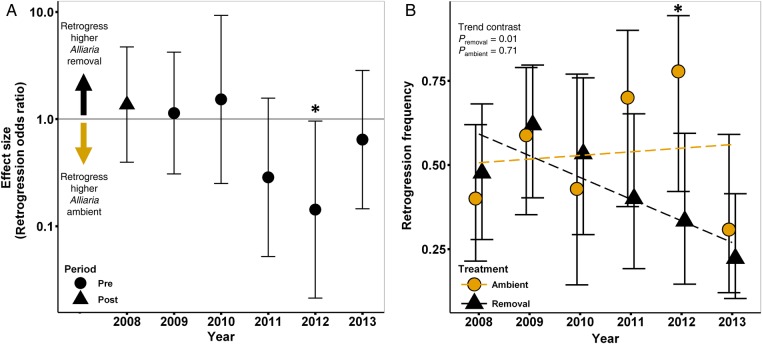
Invasive plants can negatively affect belowground processes and alter soil microbial communities. For native plants that depend on soil resources from root fungal symbionts (RFS), invasion could compromise their resource status and subsequent ability to manufacture and store carbohydrates. Herbaceous perennials that depend on RFS-derived resources dominate eastern North American forest understories. Therefore, we predict that forest invasion by Alliaria petiolata, an allelopathic species that produces chemicals that are toxic to RFS, will diminish plant carbon storage and fitness. Over a single growing season, the loss of RFS could reduce a plant's photosynthetic physiology and carbon storage. If maintained over multiple growing seasons, this could create a condition of carbon stress and declines in plant vital rates. Here we characterize the signals of carbon stress over a short timeframe and explore the long-term consequence of Alliaria invasion using Maianthemum racemosum, an RFS-dependent forest understory perennial. First, in a greenhouse experiment, we treated the soil of potted Maianthemum with fresh leaf tissue from either Alliaria or Hesperis matronalis (control) for a single growing season. Alliaria-treated plants exhibit significant overall reductions in total non-structural carbohydrates and have 17 % less storage carbohydrates relative to controls. Second, we monitored Maianthemum vital rates in paired experimental plots where we either removed emerging Alliaria seedlings each spring or left Alliaria at ambient levels for 7 years. Where Alliaria is removed, Maianthemum size and vital rates improve significantly: flowering probability increases, while the probability of plants regressing to non-flowering stages or entering prolonged dormancy are reduced. Together, our results are consistent with the hypothesis that disruption of a ubiquitous mutualism following species invasion creates symptoms of carbon stress for species dependent on RFS. Disruption of plant-fungal mutualisms may generally contribute to the common, large-scale declines in forest biodiversity observed in the wake of allelopathic invaders.
入侵植物会对地下过程产生负面影响,并改变土壤微生物群落。对于依赖根真菌共生体(RFS)土壤资源的本地植物来说,入侵可能会危及它们的资源状况以及随后制造和储存碳水化合物的能力。依赖 RFS 衍生资源的草本多年生植物在北美东部森林的林下占主导地位。因此,我们预测,Alliaria petiolata 的森林入侵,这种植物会产生对 RFS 有毒的化学物质,会减少植物的碳储存和适应性。在一个生长季节内,RFS 的丧失可能会降低植物的光合作用生理和碳储存。如果在多个生长季节内维持这种情况,可能会导致植物处于碳胁迫状态,并降低植物的关键生活率。在这里,我们在短时间内描述了碳胁迫的信号,并通过依赖 RFS 的森林林下多年生植物 Maianthemum racemosum 来探索 Alliaria 入侵的长期后果。首先,在温室实验中,我们用来自 Alliaria 或 Hesperis matronalis(对照)的新鲜叶片组织处理盆栽 Maianthemum 的土壤,为期一个生长季节。Alliaria 处理的植物表现出总非结构性碳水化合物的显著整体减少,与对照相比,储存的碳水化合物减少了 17%。其次,我们在配对的实验地块中监测了 Maianthemum 的重要生命指标,在这些实验地块中,我们要么每年春天去除新出现的 Alliaria 幼苗,要么让 Alliaria 保持在环境水平 7 年。在去除 Alliaria 的地方,Maianthemum 的大小和重要生命指标显著改善:开花概率增加,而植物退化到非开花阶段或进入长时间休眠的概率降低。总的来说,我们的结果与以下假设一致:随着物种入侵,普遍的共生关系被破坏,这会给依赖 RFS 的物种带来碳胁迫的症状。植物-真菌共生关系的破坏可能会普遍导致在化感入侵后观察到的森林生物多样性的大规模减少。