Department of Ecology and Evolutionary Biology, University of Tennessee, Knoxville, Tennessee, 37996, USA.
U.S. Geological Survey, Fort Collins Science Center, Fort Collins, Colorado, 80526, USA.
Ecology. 2021 Jan;102(1):e03201. doi: 10.1002/ecy.3201. Epub 2020 Nov 4.
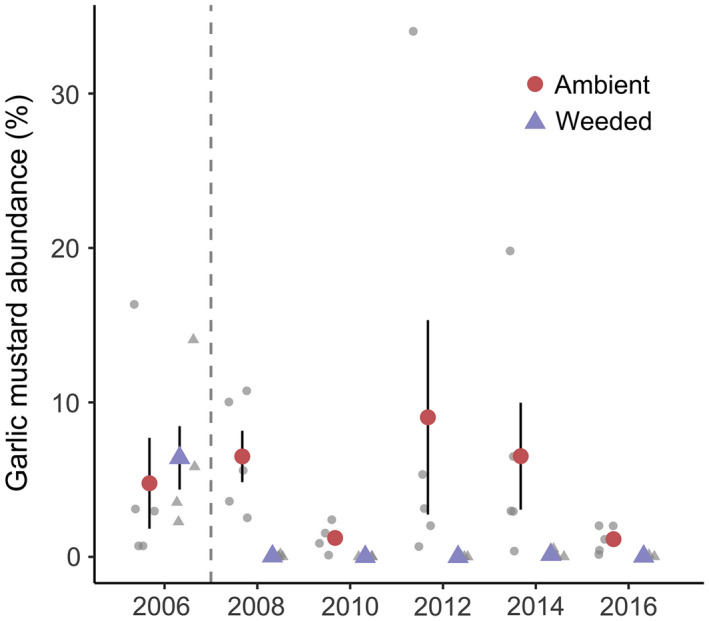
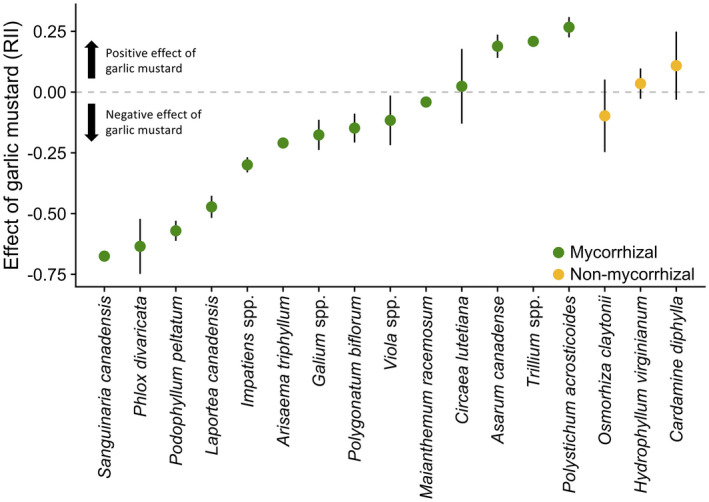
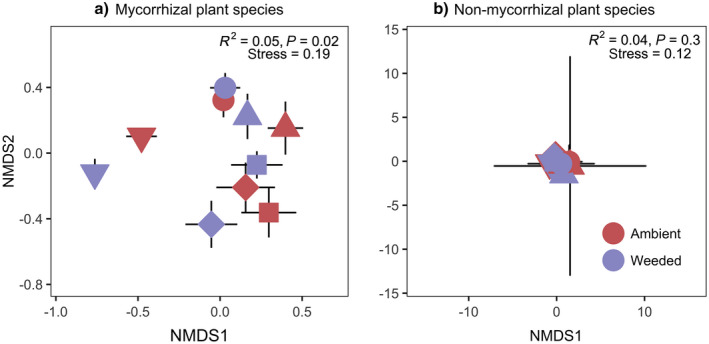
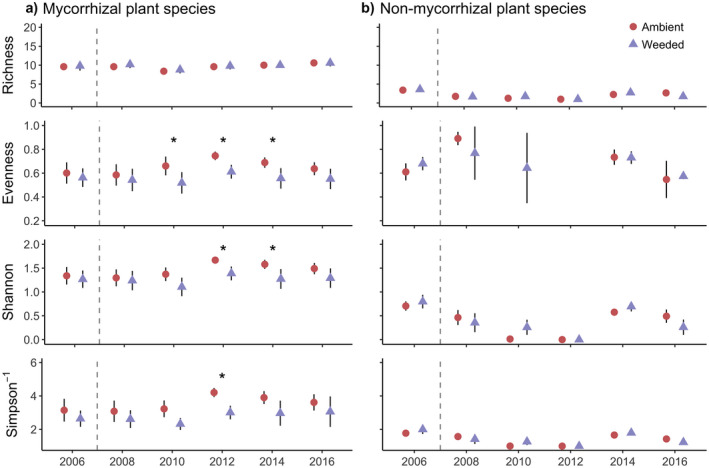
The mechanisms causing invasive species impact are rarely empirically tested, limiting our ability to understand and predict subsequent changes in invaded plant communities. Invader disruption of native mutualistic interactions is a mechanism expected to have negative effects on native plant species. Specifically, disruption of native plant-fungal mutualisms may provide non-mycorrhizal plant invaders an advantage over mycorrhizal native plants. Invasive Alliaria petiolata (garlic mustard) produces secondary chemicals toxic to soil microorganisms including mycorrhizal fungi, and is known to induce physiological stress and reduce population growth rates of native forest understory plant species. Here, we report on a 11-yr manipulative field experiment in replicated forest plots testing if the effects of removal of garlic mustard on the plant community support the mutualism disruption hypothesis within the entire understory herbaceous community. We compare community responses for two functional groups: the mycorrhizal vs. the non-mycorrhizal plant communities. Our results show that garlic mustard weeding alters the community composition, decreases community evenness, and increases the abundance of understory herbs that associate with mycorrhizal fungi. Conversely, garlic mustard has no significant effects on the non-mycorrhizal plant community. Consistent with the mutualism disruption hypothesis, our results demonstrate that allelochemical producing invaders modify the plant community by disproportionately impacting mycorrhizal plant species. We also demonstrate the importance of incorporating causal mechanisms of biological invasion to elucidate patterns and predict community-level responses.
导致入侵物种产生影响的机制很少经过实证检验,这限制了我们理解和预测入侵植物群落后续变化的能力。外来种对本地互利共生关系的破坏是一种预期会对本地植物物种产生负面影响的机制。具体来说,破坏本地植物-真菌共生关系可能会使非菌根植物的入侵种相对于菌根本地植物具有优势。入侵种大蒜芥(Alliaria petiolata)会产生次生化学物质,这些物质对土壤微生物(包括菌根真菌)有毒,并且已知会引起生理胁迫并降低本地森林林下植物物种的种群增长率。在这里,我们报告了一项为期 11 年的可重复森林斑块的野外操纵实验,以检验是否可以通过去除大蒜芥来验证植物群落对整个林下草本植物群落中互利共生关系中断假说的影响。我们比较了两个功能群的群落响应:菌根植物社区与非菌根植物社区。我们的研究结果表明,大蒜芥除草会改变群落组成,降低群落均匀度,并增加与菌根真菌相关的林下草本植物的丰度。相反,大蒜芥对非菌根植物社区没有显著影响。与互利共生关系中断假说一致,我们的研究结果表明,产生化感物质的入侵种通过不成比例地影响菌根植物物种来改变植物群落。我们还证明了将生物入侵的因果机制纳入其中对于阐明模式和预测群落水平响应的重要性。