Torday John S
Department of Pediatrics, Harbor-UCLA Medical Center, 1124 W.Carson Street, Torrance, California 90502-2006, USA.
Trends Dev Biol. 2014;8:17-37.
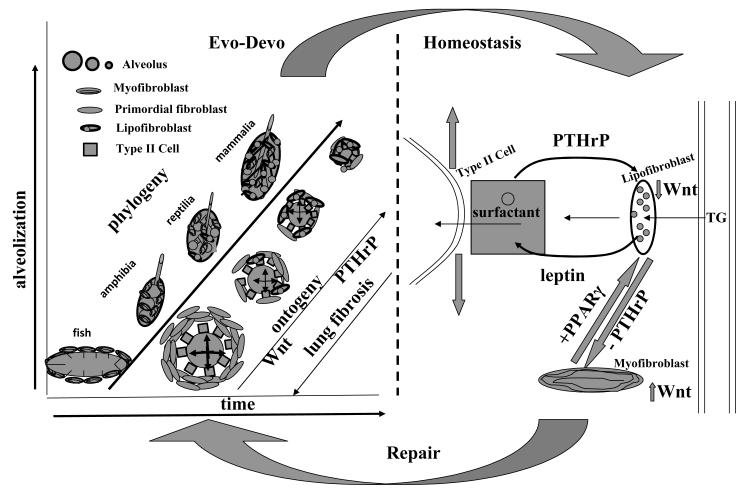
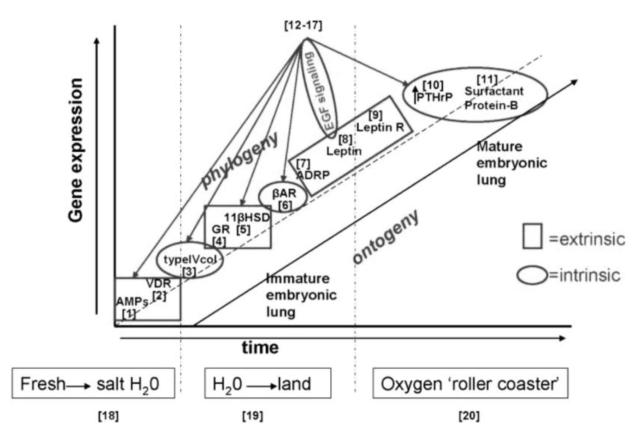
Perhaps development is more than just morphogenesis. We now recognize that the conceptus expresses epigenetic marks that heritably affect it phenotypically, indicating that the offspring are to some degree genetically autonomous, and that ontogeny and phylogeny may coordinately determine the fate of such marks. This scenario mechanistically links ecology, ontogeny and phylogeny together as an integrated mechanism for evolution for the first time. As a functional example, the Parathyroid Hormone-related Protein (PTHrP) signaling duplicated during the Phanerozoic water-land transition. The PTHrP signaling pathway was critical for the evolution of the skeleton, skin barrier, and lung function, based on experimental evidence, inferring that physiologic stress can profoundly affect adaptation through internal selection, giving seminal insights to how and why vertebrates were able to evolve from water to land. By viewing evolution from its inception in unicellular organisms, driven by competition between pro- and eukaryotes, the emergence of complex biologic traits from the unicellular cell membrane offers a novel way of thinking about the process of evolution from its beginnings, rather than from its consequences as is traditionally done. And by focusing on the epistatic balancing mechanisms for calcium and lipid homeostasis, the evolution of unicellular organisms, driven by competition between pro- and eukaryotes, gave rise to the emergence of complex biologic traits derived from the unicellular plasma lemma, offering a unique way of thinking about the process of evolution. By exploiting the cellular-molecular mechanisms of lung evolution as ontogeny and phylogeny, the sequence of events for the evolution of the skin, kidney and skeleton become more transparent. This novel approach to the evolution question offers equally novel insights to the primacy of the unicellular state, hologenomics and even bioethical decisions.
或许发育不仅仅是形态发生。我们现在认识到,胚胎表达的表观遗传标记会对其表型产生可遗传的影响,这表明后代在某种程度上具有基因自主性,并且个体发育和系统发育可能共同决定这些标记的命运。这种情况首次将生态、个体发育和系统发育作为一种综合的进化机制机械地联系在一起。作为一个功能示例,甲状旁腺激素相关蛋白(PTHrP)信号在显生宙水陆过渡期间发生了复制。基于实验证据,PTHrP信号通路对骨骼、皮肤屏障和肺功能的进化至关重要,这推断出生理应激可通过内部选择深刻影响适应性,为脊椎动物如何以及为何能够从水中进化到陆地提供了开创性的见解。从单细胞生物中进化的起始阶段来看进化,由原核生物和真核生物之间的竞争驱动,从单细胞细胞膜中出现复杂的生物学特征提供了一种从进化开始而非传统地从其结果来思考进化过程的新方式。并且通过关注钙和脂质稳态的上位平衡机制,由原核生物和真核生物之间的竞争驱动的单细胞生物进化导致了源自单细胞质膜的复杂生物学特征的出现,提供了一种思考进化过程的独特方式。通过将肺进化的细胞分子机制作为个体发育和系统发育来利用,皮肤、肾脏和骨骼进化的事件顺序变得更加清晰。这种解决进化问题的新方法为单细胞状态的首要地位、全息基因组学甚至生物伦理决策提供了同样新颖的见解。