Scheibe Madlen, Reichelt Julius, Bellmann Maike, Kirch Wilhelm
Technische Universität Dresden, Medizinische Fakultät Carl Gustav Carus, Research Association Public Health Saxony and Saxony-Anhalt, Dresden, Germany.
Med 2 0. 2015 Mar 2;4(1):e1. doi: 10.2196/med20.3912.
Mobile apps for people with diabetes offer great potential to support therapy management, increase therapy adherence, and reduce the probability of the occurrence of accompanying and secondary diseases. However, they are rarely used by elderly patients due to a lack of acceptance.
We investigated the question "Which factors influence the acceptance of diabetes apps among patients aged 50 or older?" Particular emphasis was placed on the current use of mobile devices/apps, acceptance-promoting/-inhibiting factors, features of a helpful diabetes app, and contact persons for technical questions. This qualitative study was the third of three substudies investigating factors influencing acceptance of diabetes apps among patients aged 50 or older.
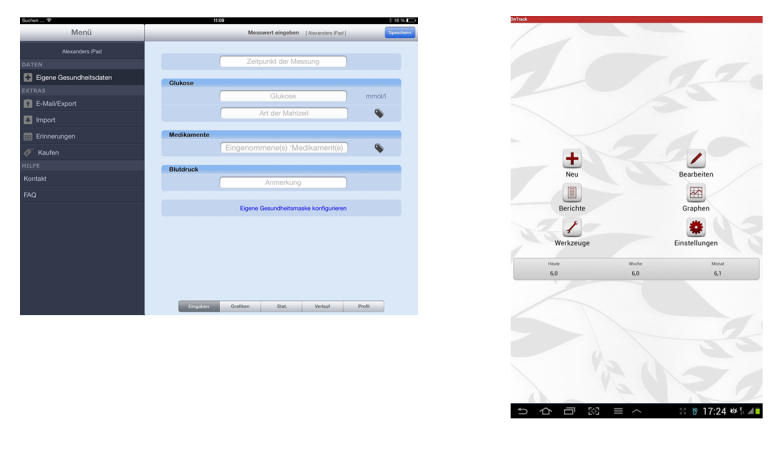
Guided interviews were chosen in order to get a comprehensive insight into the subjective perspective of elderly diabetes patients. At the end of each interview, the patients tested two existing diabetes apps to reveal obstacles in (first) use.
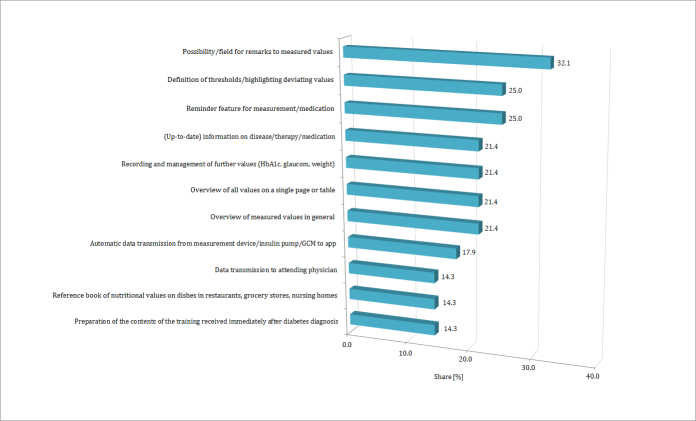
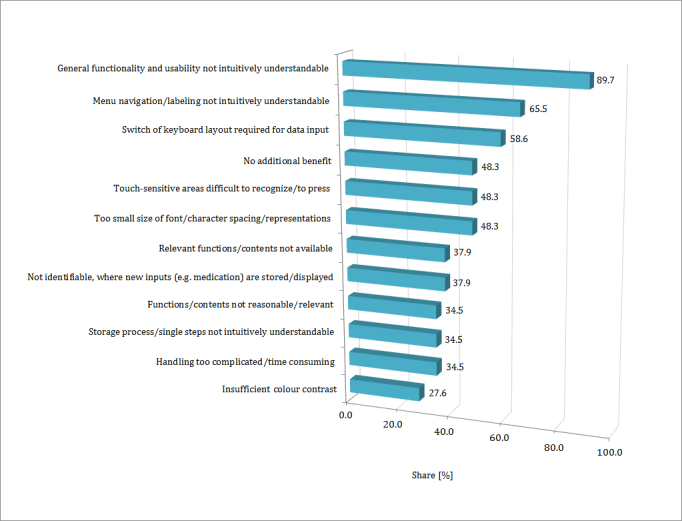
Altogether, 32 patients with diabetes were interviewed. The mean age was 68.8 years (SD 8.2). Of 32 participants, 15 (47%) knew apps, however only 2 (6%) had already used a diabetes app within their therapy. The reasons reported for being against the use of apps were a lack of additional benefits (4/8, 50%) compared to current therapy management, a lack of interoperability with other devices/apps (1/8, 12%), and no joy of use (1/8, 12%). The app test revealed the following main difficulties in use: nonintuitive understanding of the functionality of the apps (26/29, 90%), nonintuitive understanding of the menu navigation/labeling (19/29, 66%), font sizes and representations that were too small (14/29, 48%), and difficulties in recognizing and pressing touch-sensitive areas (14/29, 48%). Furthermore, the patients felt the apps lacked individually important functions (11/29, 38%), or felt the functions that were offered were unnecessary for their own therapy needs (10/29, 34%). The most important contents of a helpful diabetes app were reported as the ability to add remarks to measured values (9/28, 32%), the definition of thresholds for blood glucose values and highlighting deviating values (7/28, 25%), and a reminder feature for measurement/medication (7/28, 25%). The most important contact persons for technical questions were family members (19/31, 61%).
A lack of additional benefits and ease of use emerged as the key factors for the acceptance of diabetes apps among patients aged 50 or older. Furthermore, it has been shown that the needs of the investigated target group are highly heterogeneous due to varying previous knowledge, age, type of diabetes, and therapy. Therefore, a helpful diabetes app should be individually adaptable. Personal contact persons, especially during the initial phase of use, are of utmost importance to reduce the fear of data loss or erroneous data input, and to raise acceptance among this target group.
糖尿病患者使用的移动应用程序在支持治疗管理、提高治疗依从性以及降低伴发疾病和继发性疾病发生概率方面具有巨大潜力。然而,由于缺乏接受度,老年患者很少使用这类应用程序。
我们研究了“哪些因素影响50岁及以上患者对糖尿病应用程序的接受度?”这一问题。特别关注移动设备/应用程序的当前使用情况、促进/抑制接受度的因素、有用的糖尿病应用程序的功能以及技术问题的联系人。这项定性研究是三项子研究中的第三项,旨在调查影响50岁及以上患者对糖尿病应用程序接受度的因素。
选择进行引导式访谈,以便全面了解老年糖尿病患者的主观观点。在每次访谈结束时,患者测试两款现有的糖尿病应用程序,以揭示(首次)使用中的障碍。
总共采访了32名糖尿病患者。平均年龄为68.8岁(标准差8.2)。在32名参与者中,15人(47%)了解应用程序,但只有2人(6%)在治疗过程中使用过糖尿病应用程序。报告的反对使用应用程序的原因包括与当前治疗管理相比缺乏额外益处(4/8,50%)、与其他设备/应用程序缺乏互操作性(1/8,12%)以及使用起来不开心(1/8,12%)。应用程序测试揭示了以下主要使用困难:对应用程序功能的非直观理解(26/29,90%)、对菜单导航/标签的非直观理解(19/29,66%)、字体大小和显示过小(14/29,48%)以及识别和按压触摸敏感区域困难(14/29,48%)。此外,患者认为应用程序缺乏个人重要功能(11/29,38%),或者认为提供的功能对他们自己的治疗需求来说不必要(10/29,34%)。有用的糖尿病应用程序最重要的内容被报告为能够对测量值添加备注(9/28,32%)、定义血糖值阈值并突出显示偏差值(7/28,25%)以及测量/用药提醒功能(7/28,25%)。技术问题最重要的联系人是家庭成员(19/31,61%)。
缺乏额外益处和易用性是50岁及以上患者接受糖尿病应用程序的关键因素。此外,研究表明,由于先前知识、年龄、糖尿病类型和治疗方法的不同,所研究目标群体的需求高度异质。因此,有用的糖尿病应用程序应该能够个性化定制。个人联系人,尤其是在使用初期,对于减少对数据丢失或错误数据输入的恐惧以及提高该目标群体的接受度至关重要。