Sydney Health Literacy Lab, Sydney School of Public Health, Faculty of Medicine and Health, The University of Sydney, Sydney, Australia.
Ask, Share, Know: Rapid Evidence for General Practice Decisions Centre for Research Excellence, The University of Sydney, Sydney, Australia.
JMIR Mhealth Uhealth. 2019 Jan 16;7(1):e11885. doi: 10.2196/11885.
The health burden of type 2 diabetes can be mitigated by engaging patients in two key aspects of diabetes care: self-management and regular contact with health professionals. There is a clear benefit to integrating these aspects of care into a single clinical tool, and as mobile phone ownership increases, apps become a more feasible platform. However, the effectiveness of online health interventions is contingent on uptake by health care providers, which is typically low. There has been little research that focuses specifically on barriers and facilitators to health care provider uptake for interventions that link self-management apps to the user's primary care physician (PCP).
This study aimed to explore PCP perspectives on proposed features for a self-management app for patients with diabetes that would link to primary care services.
Researchers conducted 25 semistructured interviews. The interviewer discussed potential features that would link in with the patient's primary care services. Interviews were audio-recorded, transcribed, and coded. Framework analysis and the Consolidated Criteria for Reporting Qualitative Research checklist were employed to ensure rigor.
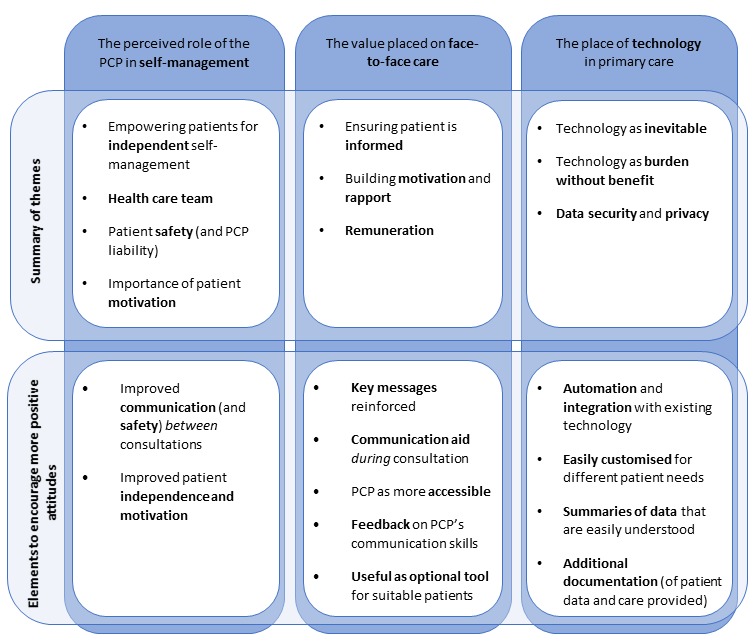
Our analysis indicated that PCP attitudes toward proposed features for an app were underpinned by perceived roles of (1) diabetes self-management, (2) face-to-face care, and (3) the anticipated burden of new technologies on their practice. Theme 1 explored PCP perceptions about how an app could foster patient independence for self-management behaviors but could also increase responsibility and liability for the PCP. Theme 2 identified beliefs underpinning a commonly expressed preference for face-to-face care. PCPs perceived information was more motivating, better understood, and presented with greater empathy when delivered face to face rather than online. Theme 3 described how most PCPs anticipated an initial increase in workload while they learned to use a new clinical tool. Some PCPs accepted this burden on the basis that the change was inevitable as health care became more integrated. Others reported potential benefits were outweighed by effort to implement an app. This study also identified how app features can be positively framed, highlighting potential benefits for PCPs to maximize PCP engagement, buy-in, and uptake. For example, PCPs were more positive when they perceived that an app could facilitate communication and motivation between consultations, focus on building capacity for patient independence, and reinforce rather than replace in-person care. They were also more positive about app features that were automated, integrated with existing software, flexible for different patients, and included secondary benefits such as improved documentation.
This study provided insight into PCP perspectives on a diabetes app integrated with primary care services. This was observed as more than a technological change; PCPs were concerned about changes in workload, their role in self-management, and the nature of consultations. Our research highlighted potential facilitators and barriers to engaging PCPs in the implementation process.
通过让患者参与糖尿病护理的两个关键方面——自我管理和定期与医疗保健专业人员接触,可以减轻 2 型糖尿病的健康负担。将这些护理方面整合到一个单一的临床工具中显然具有益处,并且随着手机拥有量的增加,应用程序成为更可行的平台。然而,在线健康干预措施的有效性取决于医疗保健提供者的参与度,而提供者的参与度通常较低。针对将自我管理应用程序与患者的初级保健医生 (PCP) 联系起来的干预措施,几乎没有专门研究医疗保健提供者参与的障碍和促进因素。
本研究旨在探讨 PCP 对拟议的糖尿病患者自我管理应用程序功能的看法,该应用程序将与初级保健服务联系起来。
研究人员进行了 25 次半结构化访谈。访谈者讨论了将与患者的初级保健服务联系起来的潜在功能。访谈进行了录音、转录和编码。采用框架分析和定性研究报告的综合标准清单,以确保严谨性。
我们的分析表明,PCP 对应用程序拟议功能的态度取决于(1)糖尿病自我管理、(2)面对面护理和(3)新技术对其实践预期负担的感知角色。主题 1 探讨了 PCP 对应用程序如何促进患者自我管理行为独立性的看法,但也增加了 PCP 的责任和责任。主题 2 确定了支持普遍偏好面对面护理的信念。PCP 认为,当面对面传递而不是在线传递时,信息更具激励性、更易理解且更具同理心。主题 3 描述了大多数 PCP 在学习使用新的临床工具时,如何预期工作量最初会增加。一些 PCP 接受了这种负担,因为随着医疗保健的整合,这种变化是不可避免的。其他人则报告说,潜在的好处被实施应用程序的努力所抵消。本研究还确定了如何以积极的方式构建应用程序功能,突出对 PCP 的潜在好处,以最大程度地提高 PCP 的参与度、接受度和采用率。例如,当 PCP 认为应用程序可以促进咨询之间的沟通和激励、专注于培养患者的独立性、并加强而不是取代面对面护理时,他们的看法更加积极。他们对自动化功能、与现有软件集成、灵活适用于不同患者以及包括改善文档记录等次要好处的应用程序功能也更加积极。
本研究深入了解了 PCP 对与初级保健服务集成的糖尿病应用程序的看法。这不仅仅是技术变革;PCP 还担心工作量、自我管理角色以及咨询性质的变化。我们的研究强调了在实施过程中吸引 PCP 的潜在促进因素和障碍。
