Jaeger Doris, Schoiswohl Gabriele, Hofer Peter, Schreiber Renate, Schweiger Martina, Eichmann Thomas O, Pollak Nina M, Poecher Nadja, Grabner Gernot F, Zierler Kathrin A, Eder Sandra, Kolb Dagmar, Radner Franz P W, Preiss-Landl Karina, Lass Achim, Zechner Rudolf, Kershaw Erin E, Haemmerle Guenter
Institute of Molecular Biosciences, University of Graz, Heinrichstrasse 31, A-8010 Graz, Austria.
Division of Endocrinology, Diabetes, and Metabolism, University of Pittsburgh, PA 15261, USA.
J Hepatol. 2015 Aug;63(2):437-45. doi: 10.1016/j.jhep.2015.02.035. Epub 2015 Feb 27.
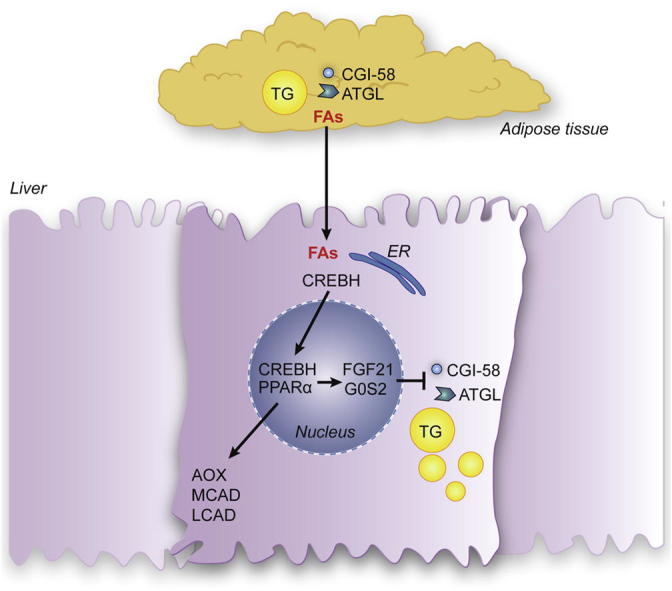
BACKGROUND & AIMS: Adipose tissue (AT)-derived fatty acids (FAs) are utilized for hepatic triacylglycerol (TG) generation upon fasting. However, their potential impact as signaling molecules is not established. Herein we examined the role of exogenous AT-derived FAs in the regulation of hepatic gene expression by investigating mice with a defect in AT-derived FA supply to the liver.
Plasma FA levels, tissue TG hydrolytic activities and lipid content were determined in mice lacking the lipase co-activator comparative gene identification-58 (CGI-58) selectively in AT (CGI-58-ATko) applying standard protocols. Hepatic expression of lipases, FA oxidative genes, transcription factors, ER stress markers, hormones and cytokines were determined by qRT-PCR, Western blotting and ELISA.
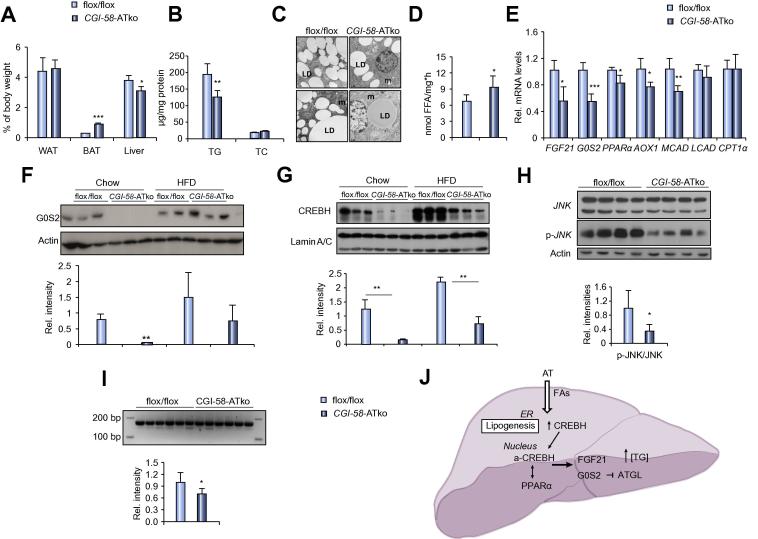
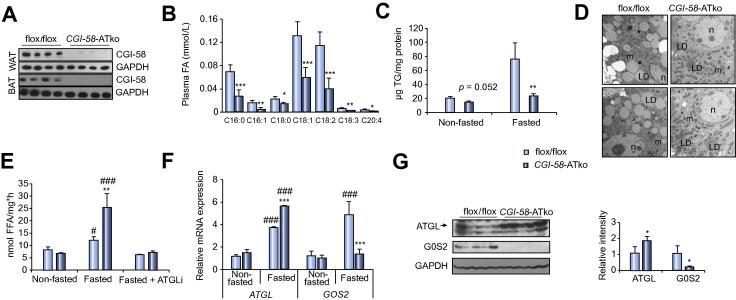
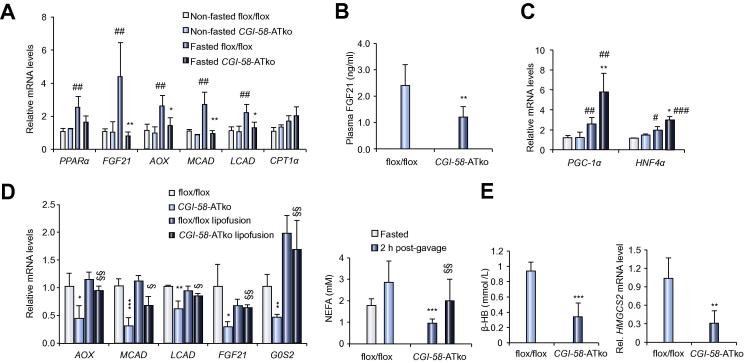
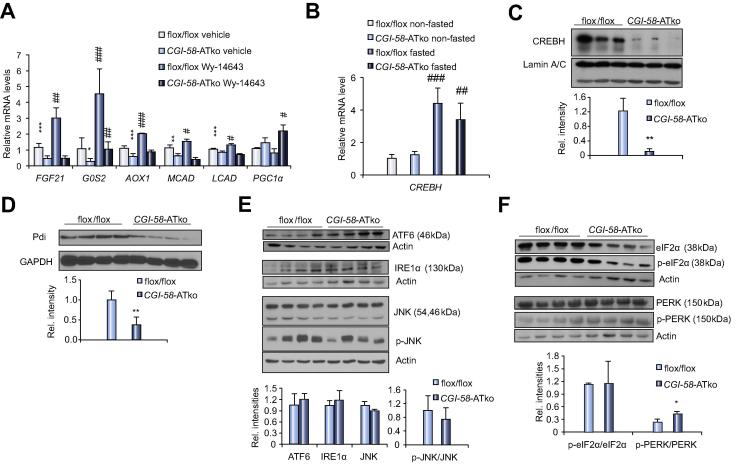
Impaired AT-derived FA supply upon fasting of CGI-58-ATko mice causes a marked defect in liver PPARα-signaling and nuclear CREBH translocation. This severely reduced the expression of respective target genes such as the ATGL inhibitor G0/G1 switch gene-2 (G0S2) and the endocrine metabolic regulator FGF21. These changes could be reversed by lipid administration and raising plasma FA levels. Impaired AT-lipolysis failed to induce hepatic G0S2 expression in fasted CGI-58-ATko mice leading to enhanced ATGL-mediated TG-breakdown strongly reducing hepatic TG deposition. On high fat diet, impaired AT-lipolysis counteracts hepatic TG accumulation and liver stress linked to improved systemic insulin sensitivity.
AT-derived FAs are a critical regulator of hepatic fasting gene expression required for the induction of G0S2-expression in the liver to control hepatic TG-breakdown. Interfering with AT-lipolysis or hepatic G0S2 expression represents an effective strategy for the treatment of hepatic steatosis.
禁食时,脂肪组织(AT)衍生的脂肪酸(FAs)被用于肝脏三酰甘油(TG)的生成。然而,它们作为信号分子的潜在影响尚未明确。在此,我们通过研究肝脏中AT衍生脂肪酸供应存在缺陷的小鼠,来探讨外源性AT衍生脂肪酸在肝脏基因表达调控中的作用。
采用标准方案,测定脂肪组织中选择性缺失脂肪酶共激活因子比较基因识别-58(CGI-58)的小鼠(CGI-58-ATko)的血浆脂肪酸水平、组织TG水解活性和脂质含量。通过qRT-PCR、蛋白质免疫印迹法和酶联免疫吸附测定法,测定肝脏中脂肪酶、脂肪酸氧化基因、转录因子、内质网应激标志物、激素和细胞因子的表达。
CGI-58-ATko小鼠禁食时,AT衍生脂肪酸供应受损,导致肝脏过氧化物酶体增殖物激活受体α(PPARα)信号传导和核类环腺苷酸反应元件结合蛋白H(CREBH)易位出现明显缺陷。这严重降低了相应靶基因的表达,如脂肪甘油三酯脂肪酶(ATGL)抑制剂G0/G1转换基因-2(G0S2)和内分泌代谢调节因子成纤维细胞生长因子21(FGF21)。脂质给药和提高血浆脂肪酸水平可逆转这些变化。禁食的CGI-58-ATko小鼠中,AT脂肪分解受损未能诱导肝脏G0S2表达,导致ATGL介导的TG分解增强,从而强烈减少肝脏TG沉积。在高脂饮食条件下,AT脂肪分解受损可抵消肝脏TG积累以及与全身胰岛素敏感性改善相关的肝脏应激。
AT衍生脂肪酸是肝脏禁食基因表达的关键调节因子,肝脏中G0S2表达的诱导需要它来控制肝脏TG分解。干扰AT脂肪分解或肝脏G0S2表达是治疗肝脂肪变性的有效策略。