Ilm Katharina, Kemmner Wolfgang, Osterland Marc, Burock Susen, Koch Gudrun, Herrmann Pia, Schlag Peter M, Stein Ulrike
Experimental and Clinical Research Center, Charité University Medicine Berlin and Max-Delbrück-Center for Molecular Medicine, Robert-Rössle-Str.10, 13125, Berlin, Germany.
Charité Comprehensive Cancer Center, Berlin, Germany.
Mol Cancer. 2015 Feb 14;14:38. doi: 10.1186/s12943-015-0316-2.
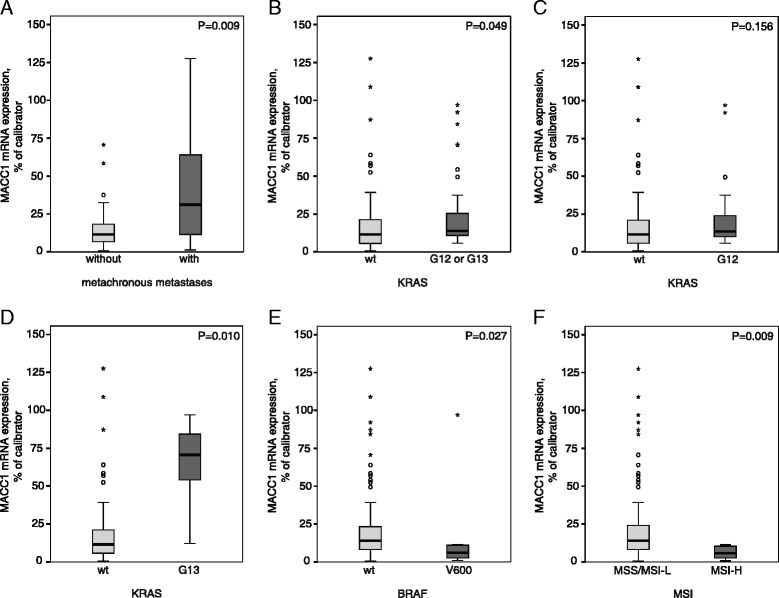
The metastasis-associated in colon cancer 1 (MACC1) gene has been identified as prognostic biomarker for colorectal cancer (CRC). Here, we aimed at the refinement of risk assessment by separate and combined survival analyses of MACC1 expression with any of the markers KRAS mutated in codon 12 (KRAS G12) or codon 13 (KRAS G13), BRAF V600 mutation and MSI status in a retrospective study of 99 CRC patients with tumors UICC staged I, II and III.
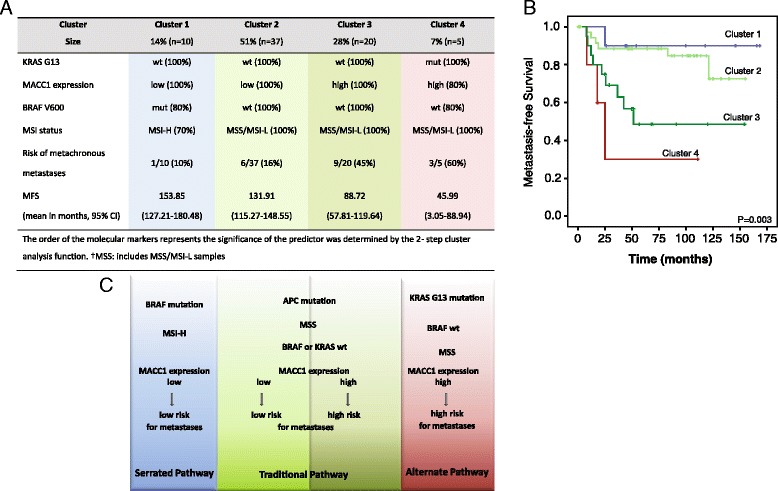
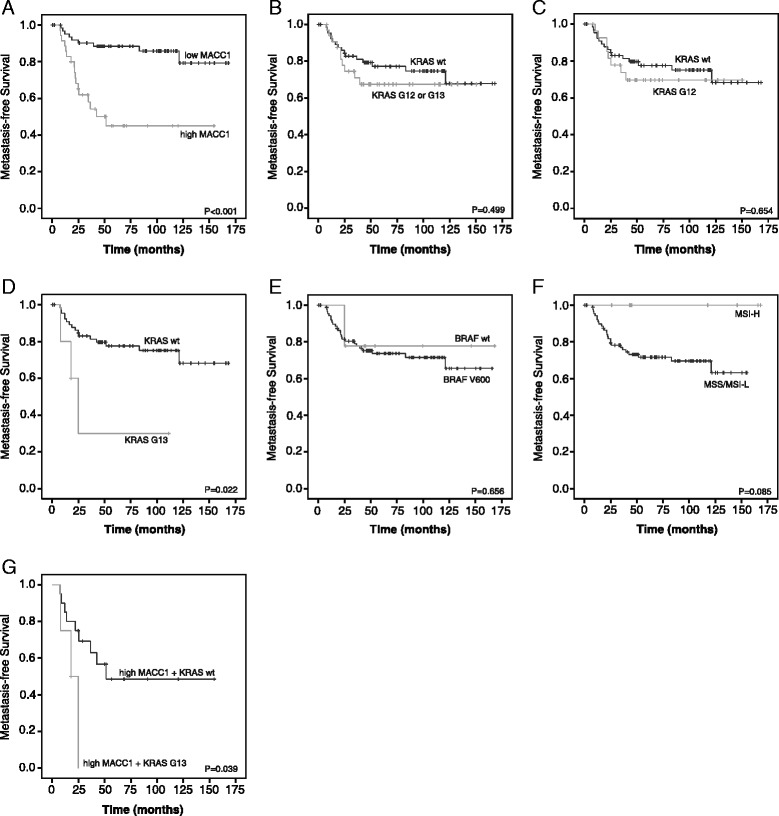
We showed that only high MACC1 expression (HR: 6.09, 95% CI: 2.50-14.85, P < 0.001) and KRAS G13 mutation (HR: 5.19, 95% CI: 1.06-25.45, P = 0.042) were independent prognostic markers for shorter metastasis-free survival (MFS). Accordingly, Cox regression analysis revealed that patients with high MACC1 expression and KRAS G13 mutation exhibited the worst prognosis (HR: 14.48, 95% CI: 3.37-62.18, P < 0.001). Patients were classified based on their molecular characteristics into four clusters with significant differences in MFS (P = 0.003) by using the SPSS 2-step cluster function and Kaplan-Meier survival analysis.
According to our results, patients with high MACC1 expression and mutated KRAS G13 exhibited the highest risk for metachronous metastases formation. Moreover, we demonstrated that the "Traditional pathway" with an intermediate risk for metastasis formation can be further subdivided by assessing MACC1 expression into a low and high risk group with regard to MFS prognosis. This is the first report showing that identification of CRC patients at high risk for metastasis is possible by assessing MACC1 expression in combination with KRAS G13 mutation.
结肠癌转移相关基因1(MACC1)已被确定为结直肠癌(CRC)的预后生物标志物。在此,我们旨在通过对99例国际抗癌联盟(UICC)分期为I、II和III期的CRC患者进行回顾性研究,对MACC1表达与密码子12(KRAS G12)或密码子13(KRAS G13)突变、BRAF V600突变及微卫星不稳定性(MSI)状态中的任何一种标志物进行单独和联合生存分析,以完善风险评估。
我们发现,只有MACC1高表达(风险比:6.09,95%置信区间:2.50 - 14.85,P < 0.001)和KRAS G13突变(风险比:5.19,95%置信区间:1.06 - 25.45,P = 0.042)是无转移生存期(MFS)较短的独立预后标志物。相应地,Cox回归分析显示,MACC1高表达且KRAS G13突变的患者预后最差(风险比:14.48,95%置信区间:3.37 - 62.18,P < 0.001)。通过使用SPSS两步聚类功能和Kaplan - Meier生存分析,根据患者的分子特征将其分为四个簇,MFS存在显著差异(P = 0.003)。
根据我们的结果,MACC1高表达且KRAS G13突变的患者发生异时性转移的风险最高。此外,我们证明,对于转移形成风险中等的“传统途径”,通过评估MACC1表达可进一步细分为MFS预后的低风险和高风险组。这是第一份表明通过联合评估MACC1表达和KRAS G13突变来识别CRC转移高风险患者是可行的报告。