Experimental and Clinical Research Center, Charité-Universitätsmedizin Berlin and Max-Delbrück-Center for Molecular Medicine in the Helmholtz Association, Berlin, Germany.
German Cancer Consortium (DKTK), Heidelberg, Germany.
Oncogene. 2022 Sep;41(39):4446-4458. doi: 10.1038/s41388-022-02407-6. Epub 2022 Aug 25.
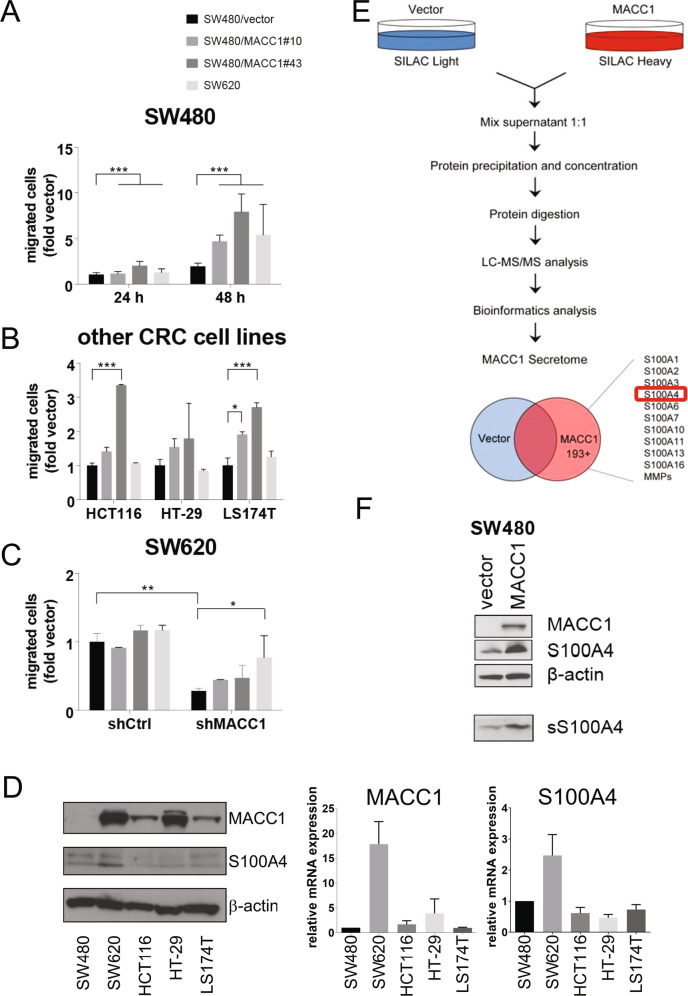
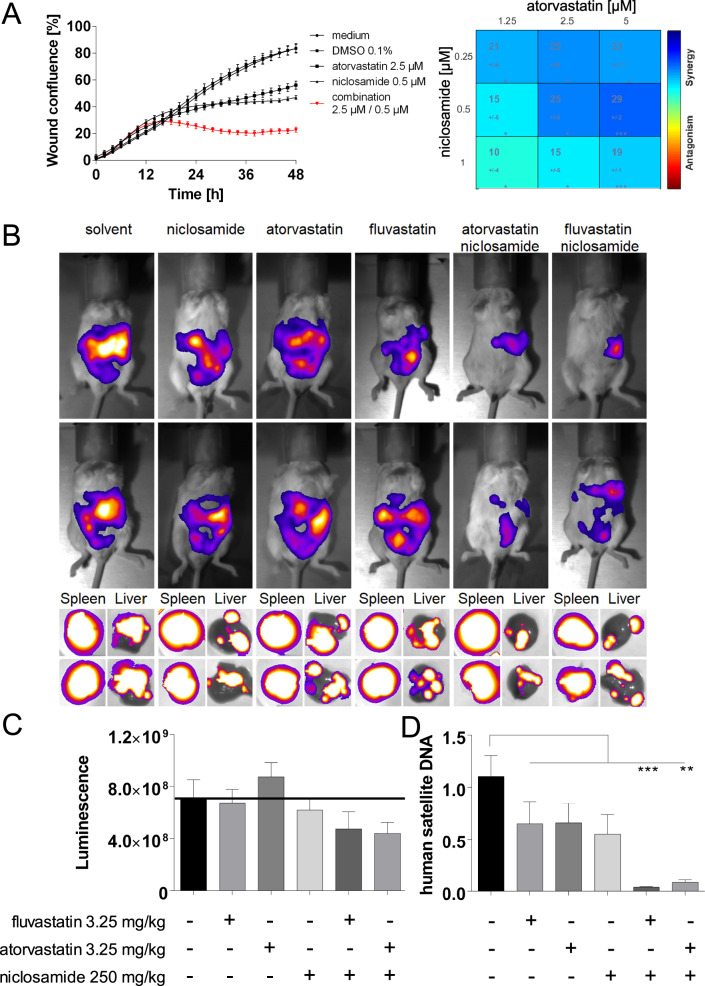
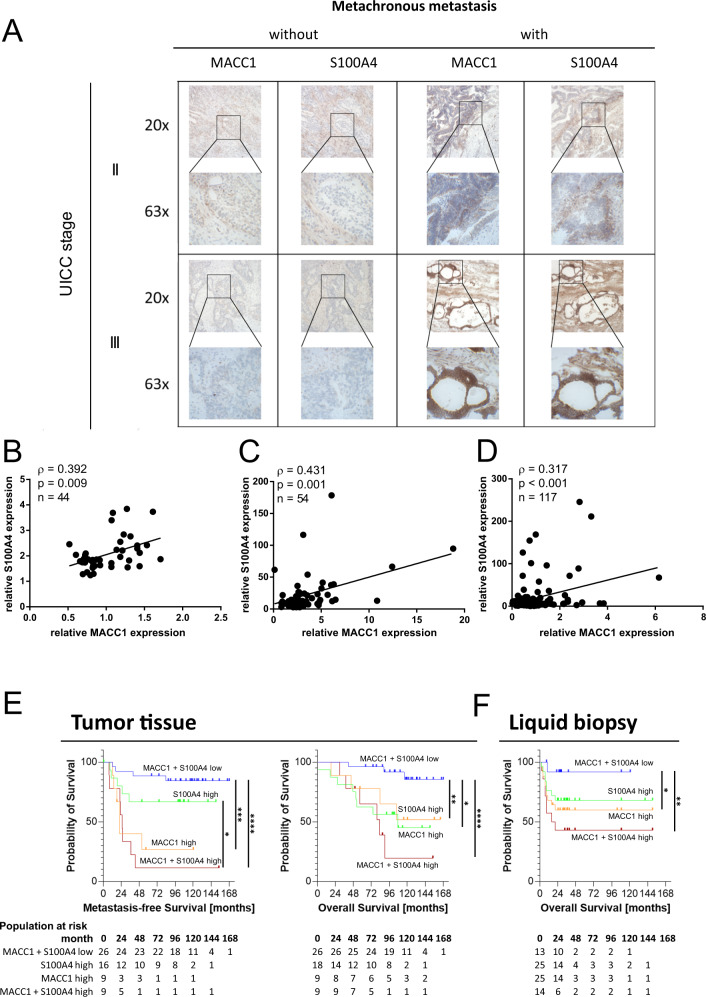
Colorectal cancer (CRC) is the second-most common malignant disease worldwide, and metastasis is the main culprit of CRC-related death. Metachronous metastases remain to be an unpredictable, unpreventable, and fatal complication, and tracing the molecular chain of events that lead to metastasis would provide mechanistically linked biomarkers for the maintenance of remission in CRC patients after curative treatment. We hypothesized, that Metastasis-associated in colorectal cancer-1 (MACC1) induces a secretory phenotype to enforce metastasis in a paracrine manner, and found, that the cell-free culture medium of MACC1-expressing CRC cells induces migration. Stable isotope labeling by amino acids in cell culture mass spectrometry (SILAC-MS) of the medium revealed, that S100A4 is significantly enriched in the MACC1-specific secretome. Remarkably, both biomarkers correlate in expression data of independent cohorts as well as within CRC tumor sections. Furthermore, combined elevated transcript levels of the metastasis genes MACC1 and S100A4 in primary tumors and in blood plasma robustly identifies CRC patients at high risk for poor metastasis-free (MFS) and overall survival (OS). Mechanistically, MACC1 strengthens the interaction of β-catenin with TCF4, thus inducing S100A4 synthesis transcriptionally, resulting in elevated secretion to enforce cell motility and metastasis. In cell motility assays, S100A4 was indispensable for MACC1-induced migration, as shown via knock-out and pharmacological inhibition of S100A4. The direct transcriptional and functional relationship of MACC1 and S100A4 was probed by combined targeting with repositioned drugs. In fact, the MACC1-β-catenin-S100A4 axis by statins (MACC1) and niclosamide (S100A4) synergized in inhibiting cancer cell motility in vitro and metastasis in vivo. The MACC1-β-catenin-S100A4 signaling axis is causal for CRC metastasis. Selectively repositioned drugs synergize in restricting MACC1/S100A4-driven metastasis with cross-entity potential.
结直肠癌(CRC)是全球第二大常见恶性疾病,转移是 CRC 相关死亡的主要罪魁祸首。异时转移仍然是一种不可预测、不可预防和致命的并发症,追踪导致转移的分子链事件将为 CRC 患者在治愈性治疗后维持缓解提供机制上相关的生物标志物。我们假设,结直肠癌转移相关基因-1(MACC1)通过旁分泌方式诱导分泌表型以促进转移,并发现,表达 MACC1 的 CRC 细胞的无细胞培养物培养基诱导迁移。培养基中通过氨基酸稳定同位素标记的细胞培养质谱(SILAC-MS)表明,S100A4 在 MACC1 特异性分泌组中明显富集。值得注意的是,这两个生物标志物在独立队列的表达数据中以及在 CRC 肿瘤切片中均相关。此外,在原发肿瘤和血浆中,转移基因 MACC1 和 S100A4 的转录水平升高均能可靠地识别出 CRC 患者具有较高的无转移生存(MFS)和总体生存(OS)风险。从机制上讲,MACC1 增强了β-catenin 与 TCF4 的相互作用,从而转录诱导 S100A4 合成,导致分泌增加以增强细胞迁移和转移。在细胞迁移实验中,通过敲除和 S100A4 的药理学抑制证明 S100A4 对于 MACC1 诱导的迁移是不可或缺的。通过重新定位药物联合靶向,研究了 MACC1 和 S100A4 的直接转录和功能关系。实际上,他汀类药物(MACC1)和硝唑酰胺(S100A4)通过抑制 MACC1-β-catenin-S100A4 轴协同抑制体内外癌细胞迁移和转移。MACC1-β-catenin-S100A4 信号轴是 CRC 转移的原因。选择性重新定位的药物协同作用,限制了由 MACC1/S100A4 驱动的转移,具有跨实体潜力。