Benetti Federico, Legname Giuseppe
a Laboratory of Prion Biology, Department of Neuroscience; Scuola Internazionale Superiore di Studi Avanzati (SISSA) , Trieste , Italy.
Prion. 2015;9(2):119-24. doi: 10.1080/19336896.2015.1022023.
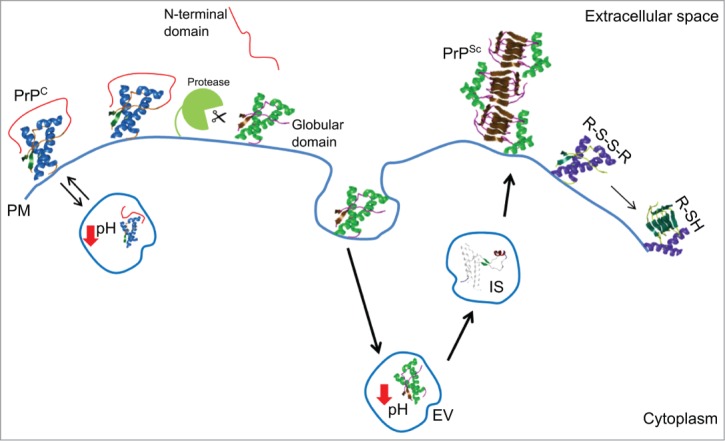
Prions are the etiological agent of fatal neurodegenerative diseases called prion diseases or transmissible spongiform encephalopathies. These maladies can be sporadic, genetic or infectious disorders. Prions are due to post-translational modifications of the cellular prion protein leading to the formation of a β-sheet enriched conformer with altered biochemical properties. The molecular events causing prion formation in sporadic prion diseases are still elusive. Recently, we published a research elucidating the contribution of major structural determinants and environmental factors in prion protein folding and stability. Our study highlighted the crucial role of octarepeats in stabilizing prion protein; the presence of a highly enthalpically stable intermediate state in prion-susceptible species; and the role of disulfide bridge in preserving native fold thus avoiding the misfolding to a β-sheet enriched isoform. Taking advantage from these findings, in this work we present new insights into structural determinants of prion protein folding and stability.
朊病毒是一类致命神经退行性疾病的病原体,这类疾病被称为朊病毒病或传染性海绵状脑病。这些疾病可以是散发性、遗传性或传染性疾病。朊病毒是细胞朊蛋白翻译后修饰的结果,导致形成富含β-折叠的构象异构体,其生化特性发生改变。散发性朊病毒病中导致朊病毒形成的分子事件仍然不清楚。最近,我们发表了一项研究,阐明了主要结构决定因素和环境因素在朊蛋白折叠和稳定性中的作用。我们的研究强调了八肽重复序列在稳定朊蛋白中的关键作用;朊病毒易感物种中存在高度焓稳定的中间状态;以及二硫键在维持天然折叠从而避免错误折叠为富含β-折叠的异构体中的作用。利用这些发现,在这项工作中,我们对朊蛋白折叠和稳定性的结构决定因素提出了新的见解。