Mahmoudvand Hossein, Ezzatkhah Fatemeh, Sharififar Fariba, Sharifi Iraj, Dezaki Ebrahim Saedi
Herbal and Traditional Medicines Research Center, Kerman University of Medical Sciences, Kerman, Iran.
Leishmaniasis Research Center, Kerman University of Medical Sciences, Kerman, Iran.
Korean J Parasitol. 2015 Feb;53(1):21-7. doi: 10.3347/kjp.2015.53.1.21. Epub 2015 Feb 27.
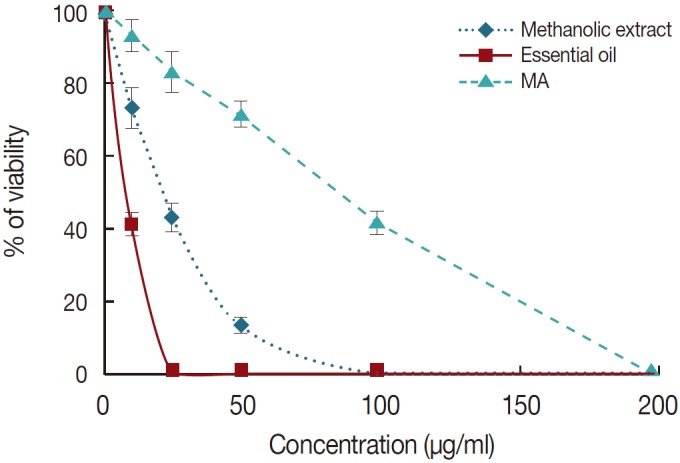
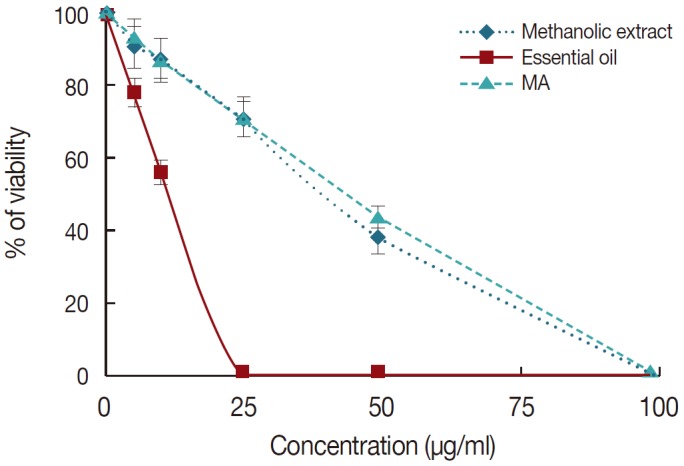
Plants used for traditional medicine contain a wide range of substances that can be used to treat various diseases such as infectious diseases. The present study was designed to evaluate the antileishmanial effects of the essential oil and methanolic extract of Myrtus communis against Leishmania tropica on an in vitro model. Antileishmanial effects of essential oil and methanolic extract of M. communis on promastigote forms and their cytotoxic activities against J774 cells were evaluated using MTT assay for 72 hr. In addition, their leishmanicidal activity against amastigote forms was determined in a macrophage model, for 72 hr. Findings showed that the main components of essential oil were α-pinene (24.7%), 1,8-cineole (19.6%), and linalool (12.6%). Findings demonstrated that M. communis, particularly its essential oil, significantly (P<0.05) inhibited the growth rate of promastigote and amastigote forms of L. tropica based on a dose-dependent response. The IC50 values for essential oil and methanolic extract was 8.4 and 28.9 μg/ml against promastigotes, respectively. These values were 11.6 and 40.8 μg/ml against amastigote forms, respectively. Glucantime as control drug also revealed IC50 values of 88.3 and 44.6 μg/ml for promastigotes and amastigotes of L. tropica, respectively. The in vitro assay demonstrated no significant cytotoxicity in J774 cells. However, essential oil indicated a more cytotoxic effect as compared with the methanolic extract of M. communis. The findings of the present study demonstrated that M. communis might be a natural source for production of a new leishmanicidal agent.
用于传统医学的植物含有多种可用于治疗各种疾病(如传染病)的物质。本研究旨在评估香桃木精油和甲醇提取物对热带利什曼原虫在体外模型中的抗利什曼原虫作用。使用MTT法评估香桃木精油和甲醇提取物对前鞭毛体形式的抗利什曼原虫作用及其对J774细胞的细胞毒性活性,持续72小时。此外,在巨噬细胞模型中测定它们对无鞭毛体形式的杀利什曼原虫活性,持续72小时。研究结果表明,精油的主要成分是α-蒎烯(24.7%)、1,8-桉叶素(19.6%)和芳樟醇(12.6%)。研究结果表明,香桃木,尤其是其精油,基于剂量依赖性反应,显著(P<0.05)抑制热带利什曼原虫前鞭毛体和无鞭毛体形式的生长速率。精油和甲醇提取物对前鞭毛体的IC50值分别为8.4和28.9μg/ml。这些值对无鞭毛体形式分别为11.6和40.8μg/ml。作为对照药物的葡糖胺对热带利什曼原虫前鞭毛体和无鞭毛体的IC50值分别为88.3和44.6μg/ml。体外试验表明J774细胞中无显著细胞毒性。然而,与香桃木甲醇提取物相比,精油显示出更强的细胞毒性作用。本研究结果表明,香桃木可能是生产新型杀利什曼原虫剂的天然来源。