Li Sheyu, Li Qianrui, Li Yun, Li Ling, Tian Haoming, Sun Xin
Department of Endocrinology and Metabolism, West China Hospital, Sichuan University, Chengdu, 610041, China.
Chinese Evidence-Based Medicine Center, West China Hospital, Sichuan University, Chengdu, 610041, China.
PLoS One. 2015 Mar 9;10(3):e0119479. doi: 10.1371/journal.pone.0119479. eCollection 2015.
Acetyl-L-carnitine (ALC), a constructive molecule in fatty acid metabolism, is an agent potentially effective for treating peripheral neuropathic pain (PNP). Its effect, however, remains uncertain. We aimed to access the efficacy and safety of ALC for the treatment of patients with PNP.
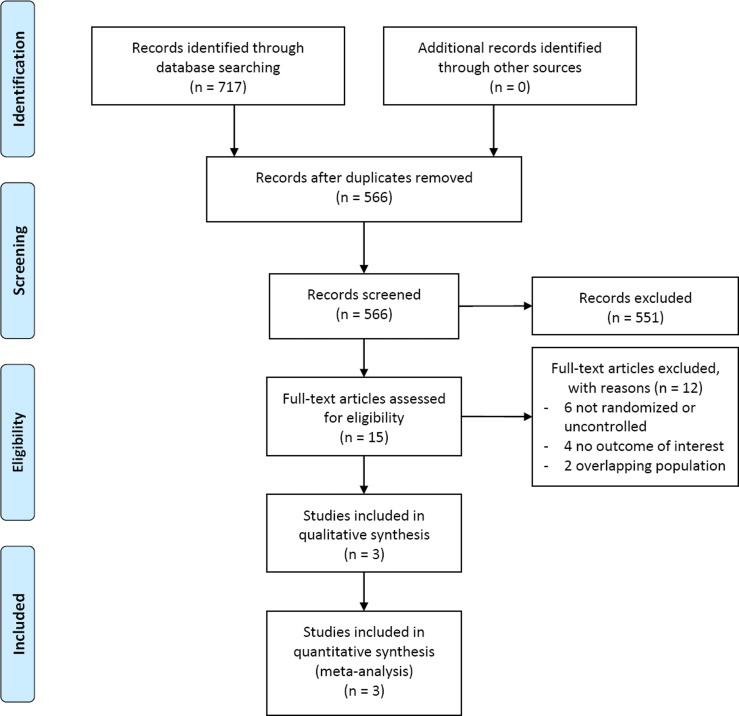
We searched MEDLINE (1996-2014), EMBase (1974-2014), and CENTRAL (May 2014) up to June 27, 2014 for randomized controlled trials (RCTs) comparing ALC with placebo or other active medications in diabetic and non-diabetic PNP patients that reported the change of pain using visual analogue scale (VAS). Mean difference (MD) and 95% confidence interval (CI) were used for pooling continuous data.
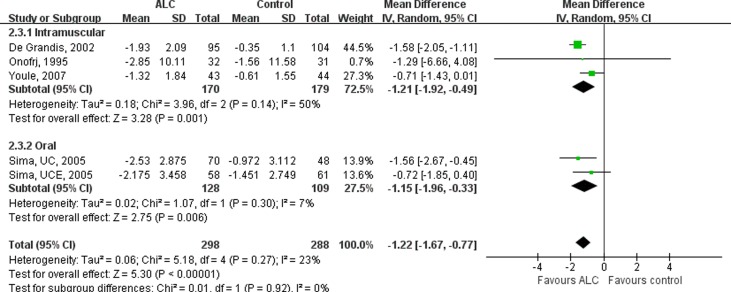
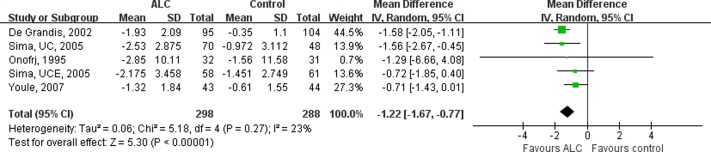
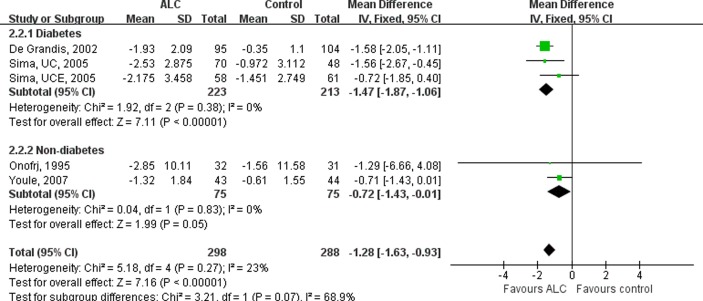
Four RCTs comparing ALC with placebo and reporting in three articles (n = 523) were included. Compared with placebo, ALC significantly reduced VAS scores of PNP patients (MD of VAS, 1.20; 95% CI, 0.68-1.72, P <0.00001). In the subgroup analysis, the effect of ALC on VAS was similar in different administration routes (intramuscular-oral sequential subgroup: MD, 1.19; 95% CI, 0.34-2.04, P = 0.006; oral only subgroup: pooled MD, 1.15; 95%CI, 0.33-1.96, P = 0.006), and ALC appeared more effective in diabetic PNP patients than non-diabetic PNP patients (diabetic subgroup: MD, 1.47; 95%CI, 1.06-1.87, P <0.00001; non-diabetic subgroup: MD, 0.71; 95% CI, -0.01-1.43, P = 0.05). No severe adverse events were reported related to ALC. The common adverse events were pain, headache, paraesthesia, hyperesthesia, retching, biliary colic, and gastrointestinal disorders. The rates of total adverse events were similar in ALC and control group.
The current evidence suggests that ALC has a moderate effect in reducing pain measured on VAS in PNP patients with acceptable safety. Larger trials with longer follow-up, however, are warranted to establish the effects.
乙酰左旋肉碱(ALC)是脂肪酸代谢中的一种建设性分子,是一种可能有效治疗周围神经性疼痛(PNP)的药物。然而,其效果仍不确定。我们旨在评估ALC治疗PNP患者的疗效和安全性。
我们检索了截至2014年6月27日的MEDLINE(1996 - 2014年)、EMBase(1974 - 2014年)和CENTRAL(2014年5月),以查找比较ALC与安慰剂或其他活性药物在糖尿病和非糖尿病PNP患者中使用视觉模拟量表(VAS)报告疼痛变化的随机对照试验(RCT)。采用平均差(MD)和95%置信区间(CI)汇总连续数据。
纳入了4项比较ALC与安慰剂并在3篇文章中报告的RCT(n = 523)。与安慰剂相比,ALC显著降低了PNP患者的VAS评分(VAS的MD为1.20;95%CI为0.68 - 1.72,P <0.00001)。在亚组分析中,ALC对VAS的影响在不同给药途径中相似(肌肉注射 - 口服序贯亚组:MD为1.19;95%CI为0.34 - 2.04,P = 0.006;仅口服亚组:汇总MD为1.15;95%CI为0.33 - 1.96,P = 0.006),并且ALC在糖尿病PNP患者中似乎比非糖尿病PNP患者更有效(糖尿病亚组:MD为1.47;95%CI为1.06 - 1.87,P <0.00001;非糖尿病亚组:MD为0.71;95%CI为 - 0.01 - 1.43,P = 0.05)。未报告与ALC相关的严重不良事件。常见的不良事件有疼痛、头痛、感觉异常、感觉过敏、干呕、胆绞痛和胃肠道紊乱。ALC组和对照组的总不良事件发生率相似。
目前的证据表明,ALC在降低PNP患者VAS测量的疼痛方面有中等效果,安全性可接受。然而,需要进行更大规模、随访时间更长的试验来确定其效果。