Zimmermann E, Ängquist L H, Mirza S S, Zhao J H, Chasman D I, Fischer K, Qi Q, Smith A V, Thinggaard M, Jarczok M N, Nalls M A, Trompet S, Timpson N J, Schmidt B, Jackson A U, Lyytikäinen L P, Verweij N, Mueller-Nurasyid M, Vikström M, Marques-Vidal P, Wong A, Meidtner K, Middelberg R P, Strawbridge R J, Christiansen L, Kyvik K O, Hamsten A, Jääskeläinen T, Tjønneland A, Eriksson J G, Whitfield J B, Boeing H, Hardy R, Vollenweider P, Leander K, Peters A, van der Harst P, Kumari M, Lehtimäki T, Meirhaeghe A, Tuomilehto J, Jöckel K-H, Ben-Shlomo Y, Sattar N, Baumeister S E, Smith G Davey, Casas J P, Houston D K, März W, Christensen K, Gudnason V, Hu F B, Metspalu A, Ridker P M, Wareham N J, Loos R J F, Tiemeier H, Sonestedt E, Sørensen T I A
Institute of Preventive Medicine, Bispebjerg and Frederiksberg Hospitals, The Capital Region, Copenhagen, Denmark.
Department of Epidemiology, Erasmus Medical Centre, Rotterdam, The Netherlands.
Obes Rev. 2015 Apr;16(4):327-340. doi: 10.1111/obr.12263. Epub 2015 Mar 5.
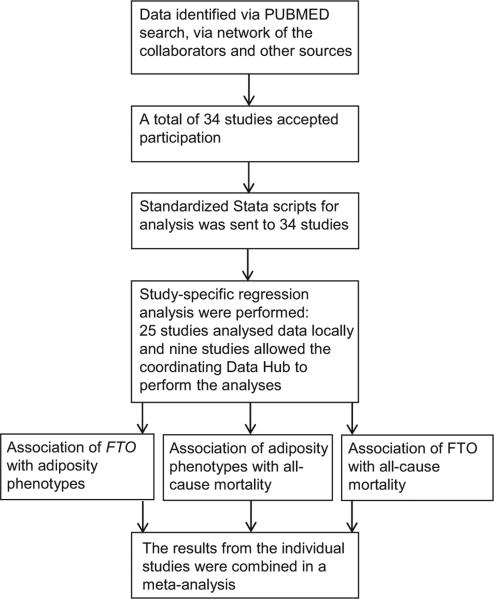
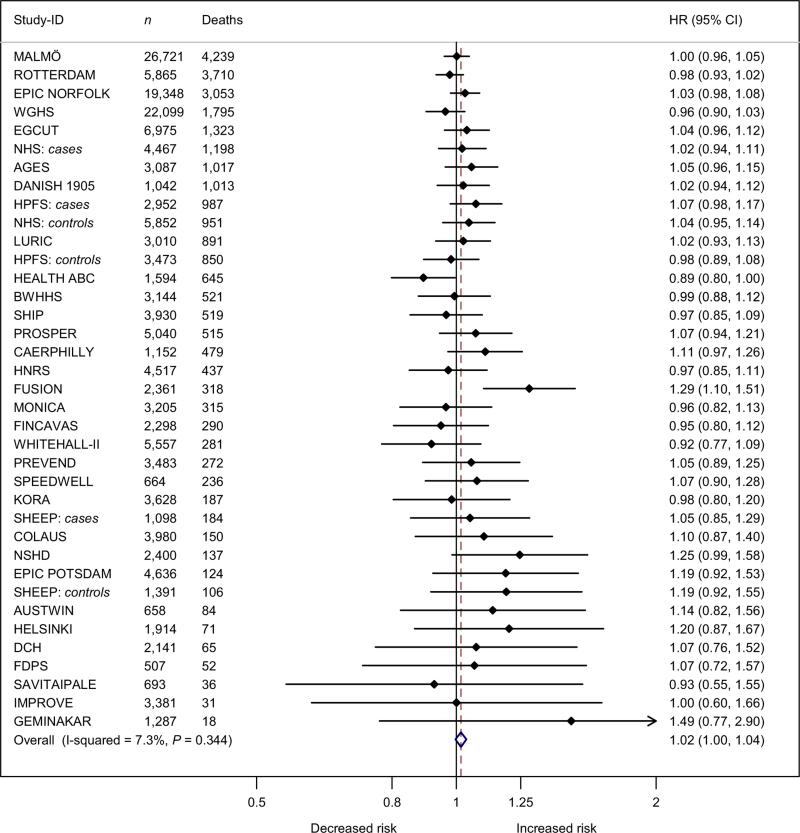
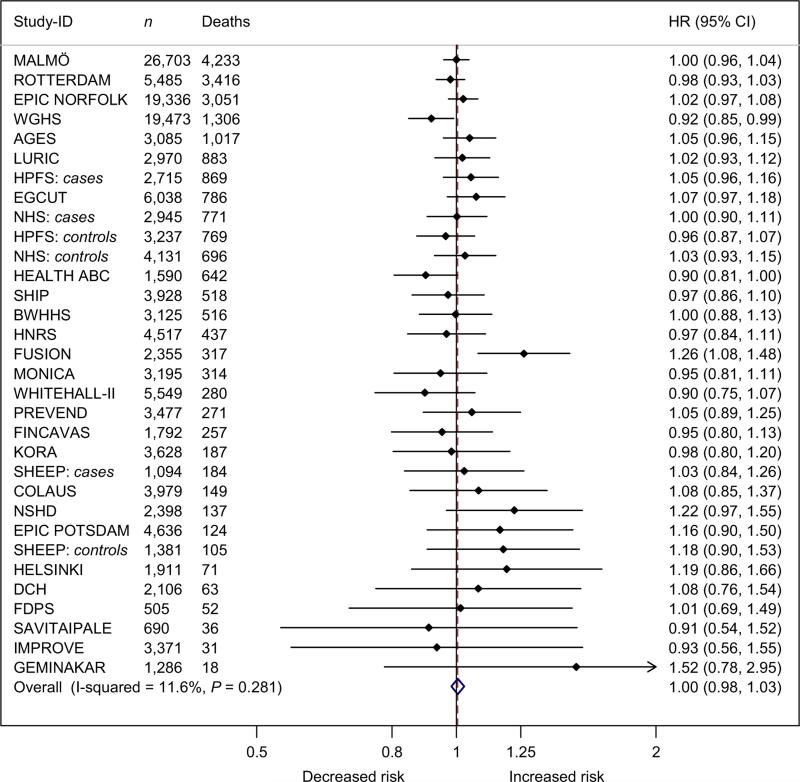
Previously, a single nucleotide polymorphism (SNP), rs9939609, in the FTO gene showed a much stronger association with all-cause mortality than expected from its association with body mass index (BMI), body fat mass index (FMI) and waist circumference (WC). This finding implies that the SNP has strong pleiotropic effects on adiposity and adiposity-independent pathological pathways that leads to increased mortality. To investigate this further, we conducted a meta-analysis of similar data from 34 longitudinal studies including 169,551 adult Caucasians among whom 27,100 died during follow-up. Linear regression showed that the minor allele of the FTO SNP was associated with greater BMI (n = 169,551; 0.32 kg m(-2) ; 95% CI 0.28-0.32, P < 1 × 10(-32) ), WC (n = 152,631; 0.76 cm; 0.68-0.84, P < 1 × 10(-32) ) and FMI (n = 48,192; 0.17 kg m(-2) ; 0.13-0.22, P = 1.0 × 10(-13) ). Cox proportional hazard regression analyses for mortality showed that the hazards ratio (HR) for the minor allele of the FTO SNPs was 1.02 (1.00-1.04, P = 0.097), but the apparent excess risk was eliminated after adjustment for BMI and WC (HR: 1.00; 0.98-1.03, P = 0.662) and for FMI (HR: 1.00; 0.96-1.04, P = 0.932). In conclusion, this study does not support that the FTO SNP is associated with all-cause mortality independently of the adiposity phenotypes.
此前,FTO基因中的单核苷酸多态性(SNP)rs9939609与全因死亡率的关联比其与体重指数(BMI)、体脂质量指数(FMI)和腰围(WC)的关联更强。这一发现表明,该SNP对肥胖及导致死亡率增加的肥胖非依赖性病理途径具有强大的多效性作用。为进一步研究这一问题,我们对34项纵向研究的类似数据进行了荟萃分析,这些研究共纳入169,551名成年白种人,其中27,100人在随访期间死亡。线性回归分析显示,FTO SNP的次要等位基因与更高的BMI(n = 169,551;0.32 kg m-2;95% CI 0.28 - 0.32,P < 1×10-32)、WC(n = 152,631;0.76 cm;0.68 - 0.84,P < 1×10-32)和FMI(n = 48,192;0.17 kg m-2;0.13 - 0.22,P = 1.0×10⁻¹³)相关。对死亡率进行的Cox比例风险回归分析显示,FTO SNPs次要等位基因的风险比(HR)为1.02(1.00 - 1.04,P = 0.097),但在调整BMI和WC后(HR:1.00;0.98 - 1.03,P = 0.662)以及调整FMI后(HR:1.00;0.96 - 1.04,P = 0.932),明显的额外风险被消除。总之,本研究不支持FTO SNP独立于肥胖表型与全因死亡率相关。