Grosso Giuseppe, Stepaniak Urszula, Micek Agnieszka, Topor-Mądry Roman, Stefler Denes, Szafraniec Krystyna, Bobak Martin, Pająk Andrzej
Department of Clinical and Molecular Biomedicine, Section of Pharmacology and Biochemistry, University of Catania, Catania, Italy; Department of Epidemiology and Population Studies, Jagiellonian University Medical College, Krakow, Poland.
Department of Epidemiology and Population Studies, Jagiellonian University Medical College, Krakow, Poland.
Metabolism. 2015 Jun;64(6):738-46. doi: 10.1016/j.metabol.2015.02.007. Epub 2015 Feb 25.
The aim of this study was to evaluate the relationship between adherence to a Mediterranean-type diet and metabolic syndrome (MetS) in the Polish arm of the Health, Alcohol and Psychosocial factors In Eastern Europe (HAPIEE) cohort study.
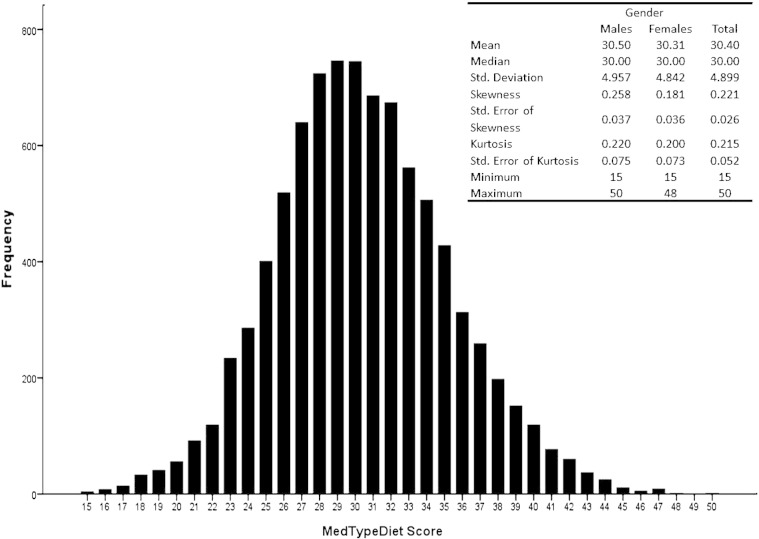
MATERIALS/METHODS: A cross-sectional survey including 8821 adults was conducted in Krakow, Poland. Food intake was evaluated through a validated food frequency questionnaire and adherence to the dietary pattern was assessed using a score specifically developed for non-Mediterranean countries (MedTypeDiet score). Linear and logistic regression models were performed to estimate beta and odds ratios (ORs) and 95% confidence intervals (CIs), respectively.
Significant associations between the MedTypeDiet score and waist circumference (β=-0.307±0.239cm), systolic blood pressure (β=-0.440±0.428mmHg), and triglycerides (β=-0.021±0.016mmol/L) were observed. After multivariable adjustment, individuals in the highest quartile of the score were less likely to have MetS, central obesity, high triglycerides, and hypertension. Increase of one standard deviation of the score was associated with 7% less odds of having MetS (OR 0.93, 95% CI: 0.88, 0.97). When analyzing the relation of single components of the MedTypeDiet score, wine, dairy products, and the total unsaturated:saturated fatty acids ratio were associated with MetS.
Adherence to a Mediterranean-like diet may decrease the risk of MetS also among non-Mediterranean populations.
本研究旨在评估在东欧健康、酒精与社会心理因素(HAPIEE)队列研究的波兰分支中,坚持地中海式饮食与代谢综合征(MetS)之间的关系。
材料/方法:在波兰克拉科夫对8821名成年人进行了一项横断面调查。通过一份经过验证的食物频率问卷评估食物摄入量,并使用专门为非地中海国家开发的评分(MedTypeDiet评分)来评估对饮食模式的依从性。分别进行线性和逻辑回归模型以估计β系数和比值比(OR)以及95%置信区间(CI)。
观察到MedTypeDiet评分与腰围(β=-0.307±0.239cm)、收缩压(β=-0.440±0.428mmHg)和甘油三酯(β=-0.021±0.016mmol/L)之间存在显著关联。经过多变量调整后,评分处于最高四分位数的个体患MetS、中心性肥胖、高甘油三酯和高血压的可能性较小。评分增加一个标准差与患MetS的几率降低7%相关(OR 0.93,95% CI:0.88,0.97)。在分析MedTypeDiet评分的单个成分之间的关系时,葡萄酒、乳制品以及总不饱和脂肪酸与饱和脂肪酸的比例与MetS相关。
坚持类似地中海式饮食也可能降低非地中海人群患MetS的风险。