Mayne S L, Auchincloss A H, Michael Y L
Department of Epidemiology and Biostatistics, School of Public Health, Drexel University, Philadelphia, PA, USA.
Obes Rev. 2015 May;16(5):362-75. doi: 10.1111/obr.12269. Epub 2015 Mar 5.
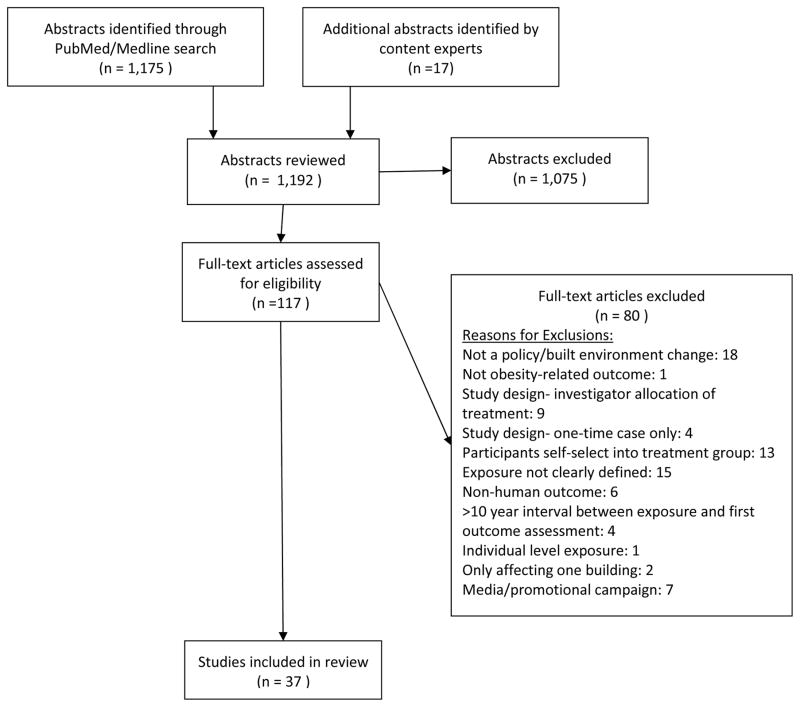
Policies and changes to the built environment are promising targets for obesity prevention efforts and can be evaluated as 'natural'- or 'quasi'-experiments. This systematic review examined the use of natural- or quasi-experiments to evaluate the efficacy of policy and built environment changes on obesity-related outcomes (body mass index, diet or physical activity). PubMed (Medline) was searched for studies published 2005-2013; 1,175 abstracts and 115 papers were reviewed. Of the 37 studies included, 18 studies evaluated impacts on nutrition/diet, 17 on physical activity and 3 on body mass index. Nutrition-related studies found greater effects because of bans/restrictions on unhealthy foods, mandates offering healthier foods, and altering purchase/payment rules on foods purchased using low-income food vouchers compared with other interventions (menu labelling, new supermarkets). Physical activity-related studies generally found stronger impacts when the intervention involved improvements to active transportation infrastructure, longer follow-up time or measured process outcomes (e.g., cycling rather than total physical activity), compared with other studies. Only three studies directly assessed body mass index or weight, and only one (installing light-rail system) observed a significant effect. Studies varied widely in the strength of their design and studies with weaker designs were more likely to report associations in the positive direction.
政策及建筑环境的改变有望成为预防肥胖的目标,并且可以作为“自然”或“准”实验进行评估。本系统评价考察了运用自然或准实验来评估政策及建筑环境改变对肥胖相关结局(体重指数、饮食或身体活动)的效果。检索了PubMed(Medline)中2005年至2013年发表的研究;共审查了1175篇摘要和115篇论文。纳入的37项研究中,18项研究评估了对营养/饮食的影响,17项评估了对身体活动的影响,3项评估了对体重指数的影响。与其他干预措施(菜单标签、新建超市)相比,与营养相关的研究发现,对不健康食品的禁令/限制、提供更健康食品的强制规定以及改变使用低收入食品券购买食品的购买/支付规则,产生的效果更大。与其他研究相比,与身体活动相关的研究通常发现,当干预措施涉及改善主动运输基础设施、更长的随访时间或测量过程结局(如骑自行车而非总体身体活动)时,影响更强。只有三项研究直接评估了体重指数或体重,只有一项研究(安装轻轨系统)观察到显著效果。各项研究的设计强度差异很大,设计较弱的研究更有可能报告正向关联。