Hoffman-Luca C Gianna, Ziazadeh Daniel, McEachern Donna, Zhao Yujun, Sun Wei, Debussche Laurent, Wang Shaomeng
University of Michigan Comprehensive Cancer Center, Ann Arbor, Michigan. Department of Pharmacology, University of Michigan, Ann Arbor, Michigan.
University of Michigan Comprehensive Cancer Center, Ann Arbor, Michigan. Department of Internal Medicine, University of Michigan, Ann Arbor, Michigan.
Clin Cancer Res. 2015 Jun 1;21(11):2558-68. doi: 10.1158/1078-0432.CCR-14-2506. Epub 2015 Mar 9.
Two clinical-stage anticancer drugs, the Bcl-2 inhibitor ABT-263, and the MDM2 inhibitor SAR405838 achieve complete tumor regression in animal models of leukemia but also induce acquired resistance. Elucidation of acquired resistance mechanisms and development of strategies to overcome the resistance are critical for their successful clinical development.
We employed RS4;11 and MV4;11 cell lines, two acute leukemia models, to investigate acquired resistance mechanisms for both drugs in vitro and in vivo and evaluated several treatment regimens in xenograft mouse models to improve long-term, complete tumor regression.
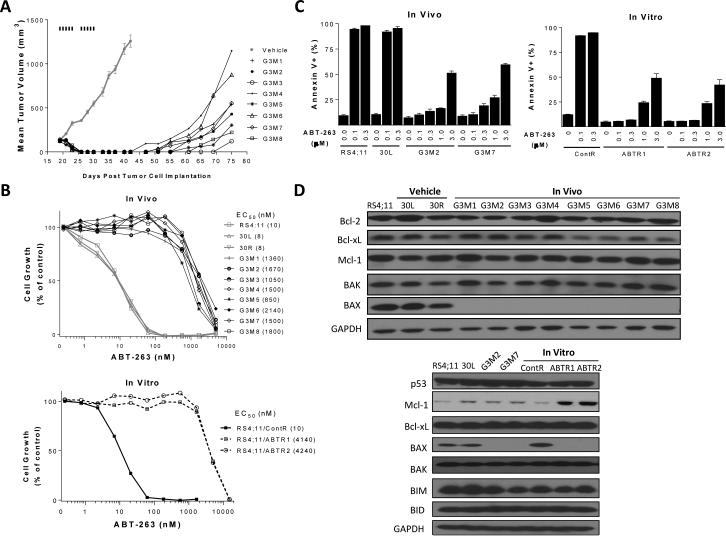
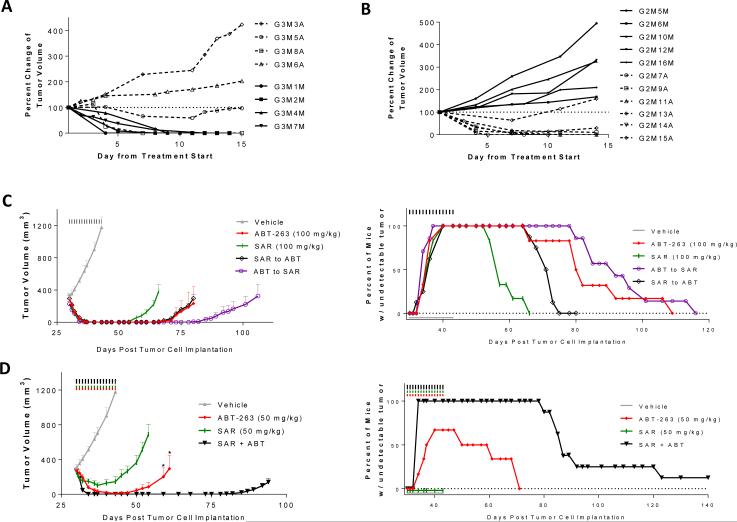
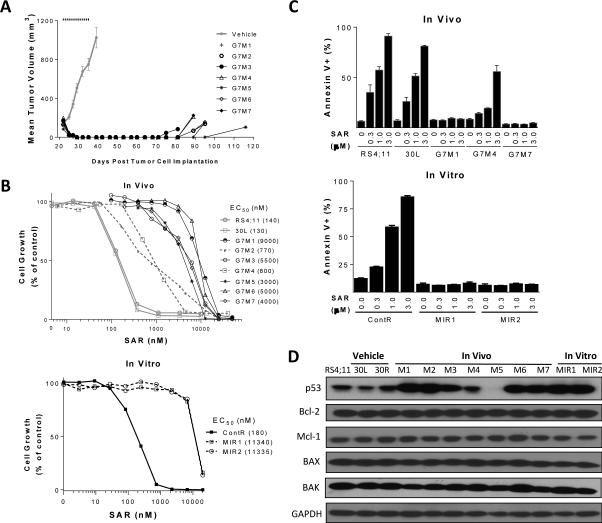
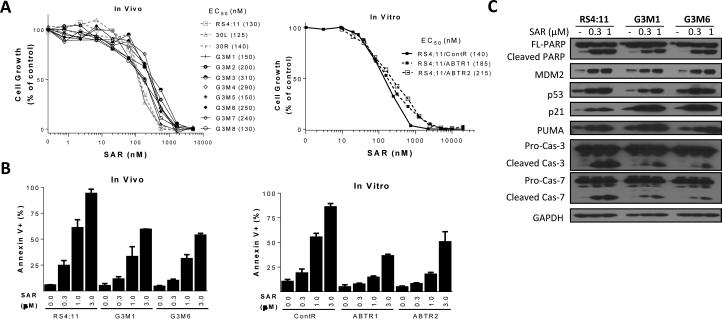
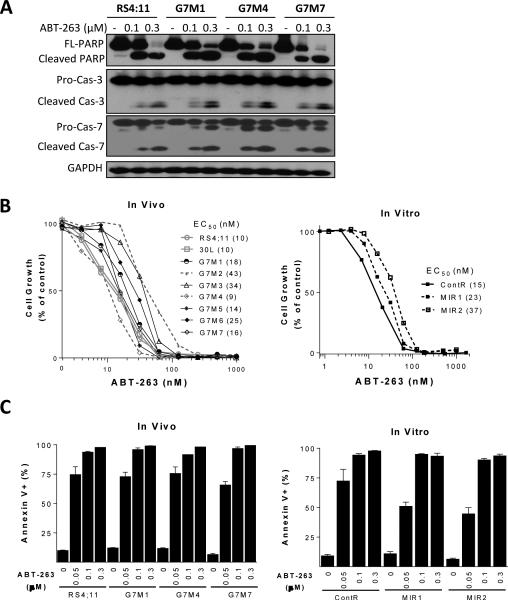
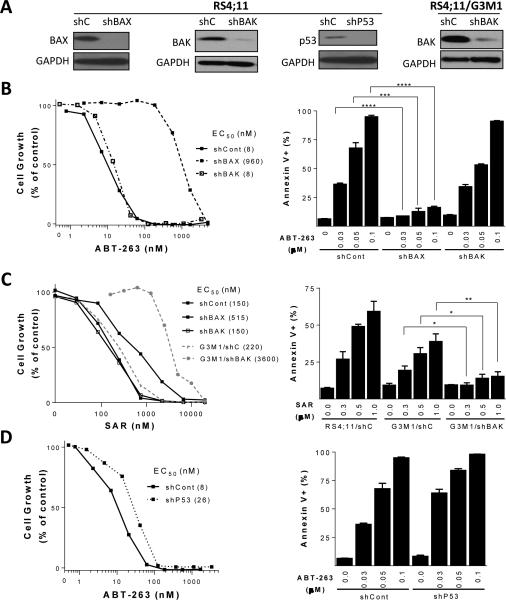
Resistance to either SAR405838 or ABT-263 (or its analogue ABT-737) develops in acute leukemia models in vitro and in vivo. RS4;11 and MV4;11 tumors treated with SAR405838 acquire resistance to the drug by mutation of the TP53 gene or compromise of p53 protein function. RS4;11 tumors treated with either ABT-263 or ABT-737 acquire resistance primarily through downregulation of BAX but not BAK. When acute leukemia cells become highly resistant to the MDM2 inhibitor, they retain their sensitivity to the Bcl-2 inhibitors, or vice versa. Certain sequential or combination treatment of SAR405838 and ABT-263 can achieve longer-term tumor regression than treatment with either agent alone.
Our study provides new insights into the mechanisms of acquired resistance of Bcl-2 and MDM2 inhibitors in acute leukemia models and suggests that certain sequential or combination treatment of these two distinct classes of apoptosis-inducing agents should be tested as new treatment strategies for acute leukemia in the clinic.
两种临床阶段的抗癌药物,Bcl-2抑制剂ABT-263和MDM2抑制剂SAR405838在白血病动物模型中可实现肿瘤完全消退,但也会诱导获得性耐药。阐明获得性耐药机制并开发克服耐药性的策略对其成功的临床开发至关重要。
我们采用RS4;11和MV4;11细胞系这两种急性白血病模型,在体外和体内研究这两种药物的获得性耐药机制,并在异种移植小鼠模型中评估几种治疗方案,以改善长期的肿瘤完全消退情况。
在急性白血病模型的体外和体内实验中,均出现了对SAR405838或ABT-263(或其类似物ABT-737)的耐药。用SAR405838治疗的RS4;11和MV4;11肿瘤通过TP53基因突变或p53蛋白功能受损而获得对该药物的耐药性。用ABT-263或ABT-737治疗的RS4;11肿瘤主要通过下调BAX而非BAK获得耐药性。当急性白血病细胞对MDM2抑制剂产生高度耐药时,它们对Bcl-2抑制剂仍保持敏感,反之亦然。与单独使用任何一种药物相比,SAR405838和ABT-263的某些序贯或联合治疗可实现更长时间的肿瘤消退。
我们的研究为急性白血病模型中Bcl-2和MDM2抑制剂获得性耐药机制提供了新见解,并表明这两类不同的凋亡诱导剂的某些序贯或联合治疗应作为急性白血病临床新治疗策略进行测试。