Biomedical Engineering Faculty, Technion-Israel Institute of Technology Haifa, Israel.
Laboratory of Cardiovascular Science, Biomedical Research Center, Intramural Research Program, National Institute on Aging, National Institutes of Health Baltimore, MD, USA.
Front Physiol. 2015 Feb 23;6:47. doi: 10.3389/fphys.2015.00047. eCollection 2015.
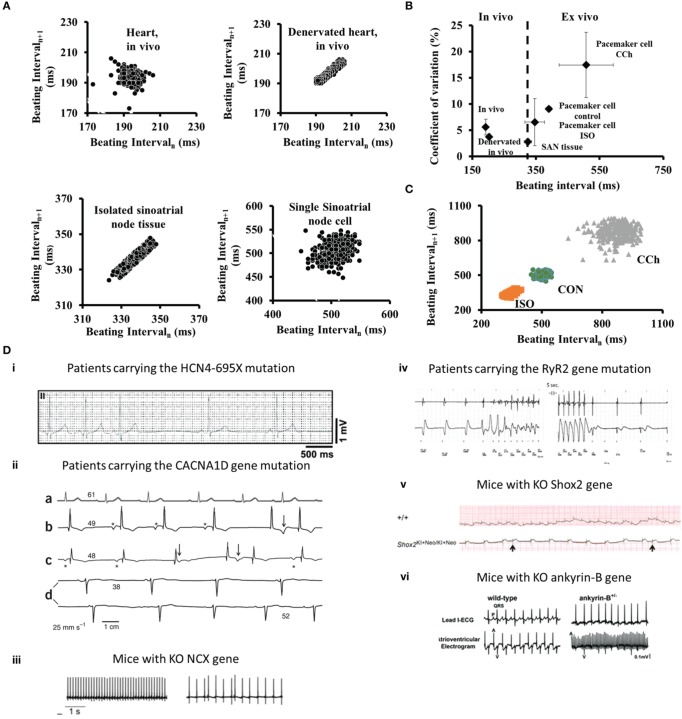
The heart's regular electrical activity is initiated by specialized cardiac pacemaker cells residing in the sinoatrial node. The rate and rhythm of spontaneous action potential firing of sinoatrial node cells are regulated by stochastic mechanisms that determine the level of coupling of chemical to electrical clocks within cardiac pacemaker cells. This coupled-clock system is modulated by autonomic signaling from the brain via neurotransmitter release from the vagus and sympathetic nerves. Abnormalities in brain-heart clock connections or in any molecular clock activity within pacemaker cells lead to abnormalities in the beating rate and rhythm of the pacemaker tissue that initiates the cardiac impulse. Dysfunction of pacemaker tissue can lead to tachy-brady heart rate alternation or exit block that leads to long atrial pauses and increases susceptibility to other cardiac arrhythmia. Here we review evidence for the idea that disturbances in the intrinsic components of pacemaker cells may be implemented in arrhythmia induction in the heart.
心脏的规则电活动是由位于窦房结中的专门的心脏起搏器细胞发起的。窦房结细胞的自发性动作电位发射的速率和节律受到随机机制的调节,该机制决定了心脏起搏器细胞内化学时钟与电时钟的耦合水平。这种耦合时钟系统受到来自大脑的自主信号的调制,通过迷走神经和交感神经从神经递质释放。大脑 - 心脏时钟连接的异常或起搏器细胞内任何分子时钟活动的异常都会导致启动心脏冲动的起搏器组织的跳动频率和节律异常。起搏器组织的功能障碍可导致心动过速 - 心动过缓心率交替或出口阻滞,导致心房长间歇,并增加对其他心律失常的易感性。在这里,我们回顾了这样一种观点的证据,即起搏器细胞的内在成分的干扰可能在心脏的心律失常诱导中实现。