CONICET-Instituto de Investigación en Paleobiología y Geología, Universidad Nacional de Río Negro , Roca, Río Negro , Argentina ; Área de Paleontología, Facultad de Ciencias, Universidad de Zaragoza , C/Pedro Cerbuna, Zaragoza , Spain.
Institut Català de Paleontologia Miquel Crusafont, C/Escola Industrial , Sabadell , Spain ; Departament de Resistència de Materials i Estructures a l'Enginyeria, Universitat Politècnica de Catalunya , Terrassa , Spain.
PeerJ. 2015 Feb 24;3:e802. doi: 10.7717/peerj.802. eCollection 2015.
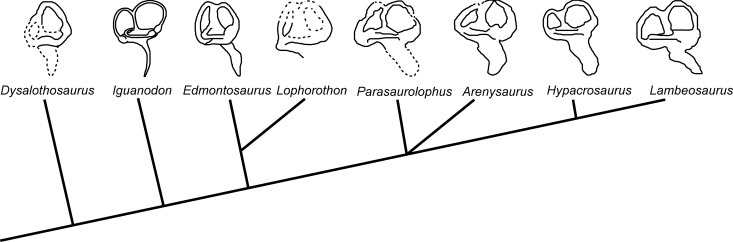
The neuroanatomy of hadrosaurid dinosaurs is well known from North America and Asia. In Europe only a few cranial remains have been recovered that include the braincase. Arenysaurus is the first European endocast for which the paleoneuroanatomy has been studied. The resulting data have enabled us to draw ontogenetic, phylogenetic and functional inferences. Arenysaurus preserves the endocast and the inner ear. This cranial material was CT scanned, and a 3D-model was generated. The endocast morphology supports a general pattern for hadrosaurids with some characters that distinguish it to a subfamily level, such as a brain cavity that is anteroposteriorly shorter or the angle of the major axis of the cerebral hemisphere to the horizontal in lambeosaurines. Both these characters are present in the endocast of Arenysaurus. Osteological features indicate an adult ontogenetic stage, while some paleoneuroanatomical features are indicative of a subadult ontogenetic stage. It is hypothesized that the presence of puzzling mixture of characters that suggest different ontogenetic stages for this specimen may reflect some degree of dwarfism in Arenysaurus. Regarding the inner ear, its structure shows differences from the ornithopod clade with respect to the height of the semicircular canals. These differences could lead to a decrease in the compensatory movements of eyes and head, with important implications for the paleobiology and behavior of hadrosaurid taxa such as Edmontosaurus, Parasaurolophus and Arenysaurus. The endocranial morphology of European hadrosaurids sheds new light on the evolution of this group and may reflect the conditions in the archipelago where these animals lived during the Late Cretaceous.
鸭嘴龙类恐龙的神经解剖结构在北美学界和亚洲学界广为人知。在欧洲,仅有少量颅后骨骼被发现,其中包括脑颅。阿雷尼厄斯龙是第一个对其脑颅进行古神经解剖学研究的欧洲标本。所得数据使我们能够进行种系发生、系统发育和功能推断。阿雷尼厄斯龙保存了脑腔和内耳。该颅骨标本经过 CT 扫描并生成了 3D 模型。脑腔形态支持鸭嘴龙类的一般模式,具有一些将其区分到亚科水平的特征,例如,脑腔前后较短或大脑半球的主轴与水平方向的夹角在 lambeosaurines 中。这些特征在阿雷尼厄斯龙的脑腔中都存在。骨骼特征表明其为成年个体,而一些古神经解剖特征则指示亚成年个体。推测该标本存在令人困惑的特征组合,提示其具有不同的个体发育阶段,可能反映了阿雷尼厄斯龙存在某种程度的侏儒症。关于内耳,其结构与禽龙类在半规管高度上存在差异。这些差异可能导致眼睛和头部的代偿运动减少,对埃德蒙顿龙、副栉龙和阿雷尼厄斯龙等鸭嘴龙类的古生物学和行为具有重要意义。欧洲鸭嘴龙类的脑腔形态为该类群的演化提供了新的视角,可能反映了这些动物在晚白垩世生活的群岛环境条件。