Nguyen Jennifer L, Link Mark S, Luttmann-Gibson Heike, Laden Francine, Schwartz Joel, Wessler Benjamin S, Mittleman Murray A, Gold Diane R, Dockery Douglas W
From the aDepartment of Environmental Health Sciences, Mailman School of Public Health, Columbia University, New York, NY; bCardiac Arrhythmia Service, Division of Cardiology, Tufts Medical Center, Tufts University School of Medicine, Boston, MA; cDepartment of Environmental Health, dDepartment of Epidemiology, Harvard School of Public Health, Boston, MA; eChanning Division of Network Medicine, Department of Medicine, Brigham and Women's Hospital and Harvard Medical School, Boston, MA; and fCardiovascular Epidemiology Research Unit, Beth Israel Deaconess Medical Center, Boston, MA.
Epidemiology. 2015 May;26(3):374-80. doi: 10.1097/EDE.0000000000000284.
The few previous studies on the onset of paroxysmal atrial fibrillation and meteorologic conditions have focused on outdoor temperature and hospital admissions, but hospital admissions are a crude indicator of atrial fibrillation incidence, and studies have found other weather measures in addition to temperature to be associated with cardiovascular outcomes.
Two hundred patients with dual chamber implantable cardioverter-defibrillators were enrolled and followed prospectively from 2006 to 2010 for new onset episodes of atrial fibrillation. The date and time of arrhythmia episodes documented by the implanted cardioverter-defibrillators were linked to meteorologic data and examined using a case-crossover analysis. We evaluated associations with outdoor temperature, apparent temperature, air pressure, and three measures of humidity (relative humidity, dew point, and absolute humidity).
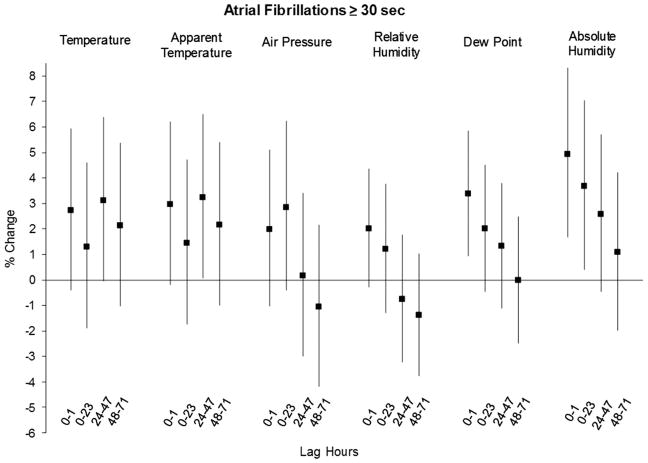
Of the 200 enrolled patients, 49 patients experienced 328 atrial fibrillation episodes lasting ≥30 seconds. Lower temperatures in the prior 48 hours were positively associated with atrial fibrillation. Lower absolute humidity (ie, drier air) had the strongest and most consistent association: each 0.5 g/m decrease in the prior 24 hours increased the odds of atrial fibrillation by 4% (95% confidence interval [CI]: 0%, 7%) and by 5% (95% CI: 2%, 8%) for exposure in the prior 2 hours. Results were similar for dew point but slightly weaker.
Recent exposure to drier air and lower temperatures were associated with the onset of atrial fibrillation among patients with known cardiac disease, supporting the hypothesis that meteorologic conditions trigger acute cardiovascular episodes.
先前关于阵发性心房颤动发作与气象条件的少数研究主要集中在室外温度和住院情况,但住院情况是心房颤动发病率的粗略指标,并且研究发现除温度外的其他气象指标也与心血管结局相关。
纳入200例植入双腔植入式心脏复律除颤器的患者,于2006年至2010年对其进行前瞻性随访,观察新发心房颤动发作情况。将植入式心脏复律除颤器记录的心律失常发作日期和时间与气象数据相关联,并采用病例交叉分析进行研究。我们评估了与室外温度、体感温度、气压以及三种湿度指标(相对湿度、露点和绝对湿度)之间的关联。
在纳入的200例患者中,49例患者经历了328次持续时间≥30秒的心房颤动发作。前48小时温度较低与心房颤动呈正相关。较低的绝对湿度(即空气更干燥)具有最强且最一致的关联:前24小时每降低0.5 g/m³,心房颤动发生几率增加4%(95%置信区间[CI]:0%,7%),前2小时暴露于此湿度条件下发生几率增加5%(95%CI:2%,8%)。露点的结果相似,但关联稍弱。
近期暴露于更干燥的空气和更低的温度与已知心脏病患者的心房颤动发作相关,支持气象条件触发急性心血管事件的假说。