Chen Qun, Xu Haishan, Xu Aijun, Ross Thomas, Bowler Elizabeth, Hu Ying, Lesnefsky Edward J
Department of Medicine, Pauley Heart Center, Division of Cardiology, Virginia Commonwealth University, Richmond, Virginia, United States of America.
Department of Medicine, Pauley Heart Center, Division of Cardiology, Virginia Commonwealth University, Richmond, Virginia, United States of America; Department of Anesthesiology, Tongji Hospital, Huazhong University of Science and Technology, Wuhan, China.
PLoS One. 2015 Mar 10;10(3):e0118834. doi: 10.1371/journal.pone.0118834. eCollection 2015.
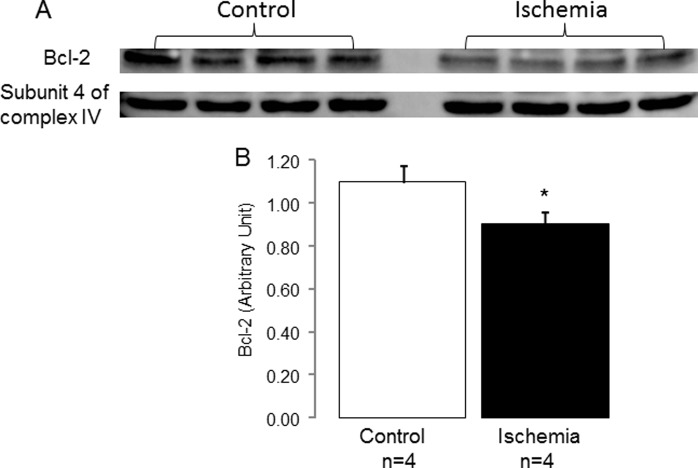
Mitochondria are critical to cardiac injury during reperfusion as a result of damage sustained during ischemia, including the loss of bcl-2. We asked if bcl-2 depletion not only leads to selective permeation of the outer mitochondrial membrane (MOMP) favoring cytochrome c release and programmed cell death, but also favors opening of the mitochondrial permeability transition pore (MPTP). An increase in MPTP susceptibility would support a role for bcl-2 depletion mediated cell death in the calcium overload setting of early reperfusion via MPTP as well as later in reperfusion via MOMP as myocardial calcium content normalizes.
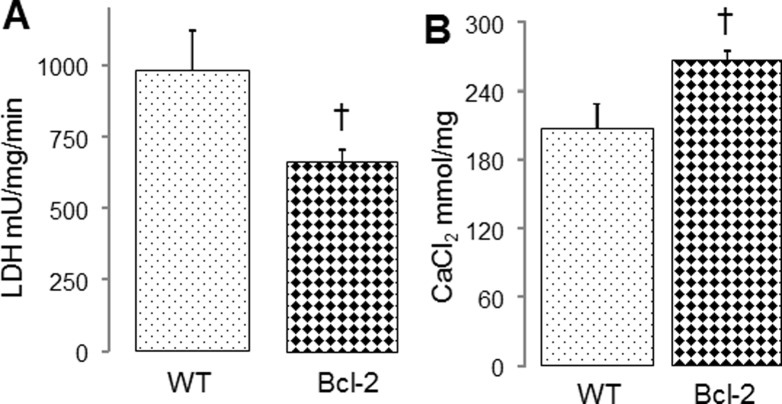
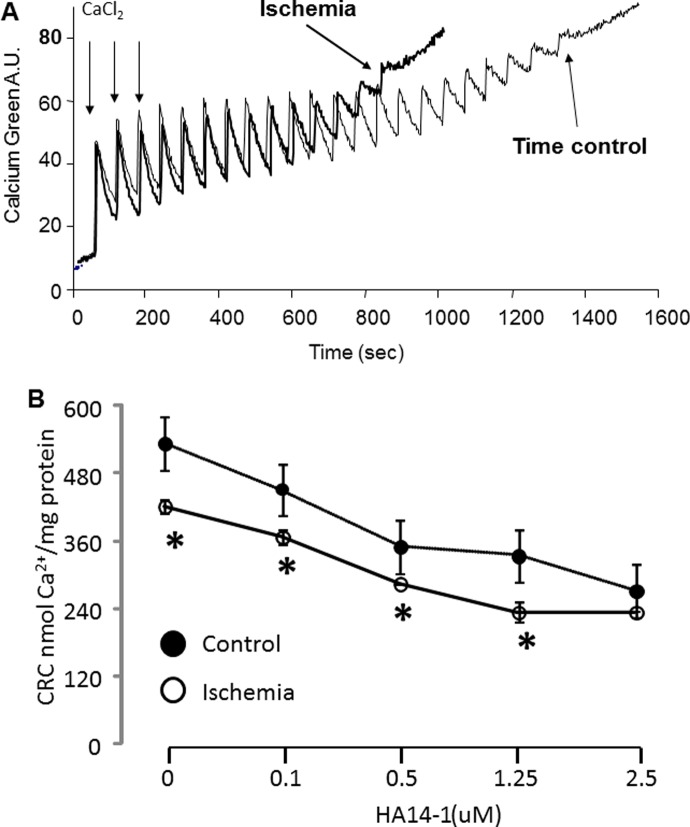
Calcium retention capacity (CRC) was used to reflect the sensitivity of the MPTP opening in isolated cardiac mitochondria. To study the relationship between bcl-2 inhibition and MPTP opening, mitochondria were incubated with a bcl-2 inhibitor (HA14-1) and CRC measured. The contribution of preserved bcl-2 content to MPTP opening following ischemia-reperfusion was explored using transgenic bcl-2 overexpressed mice.
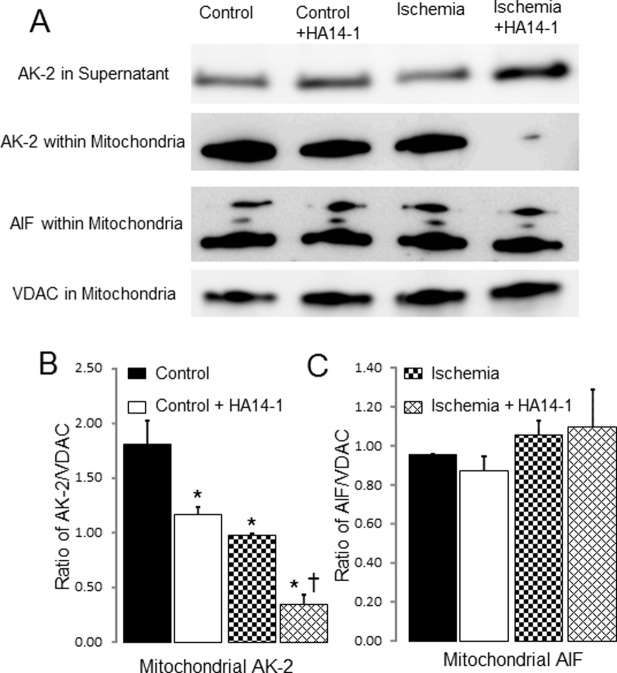
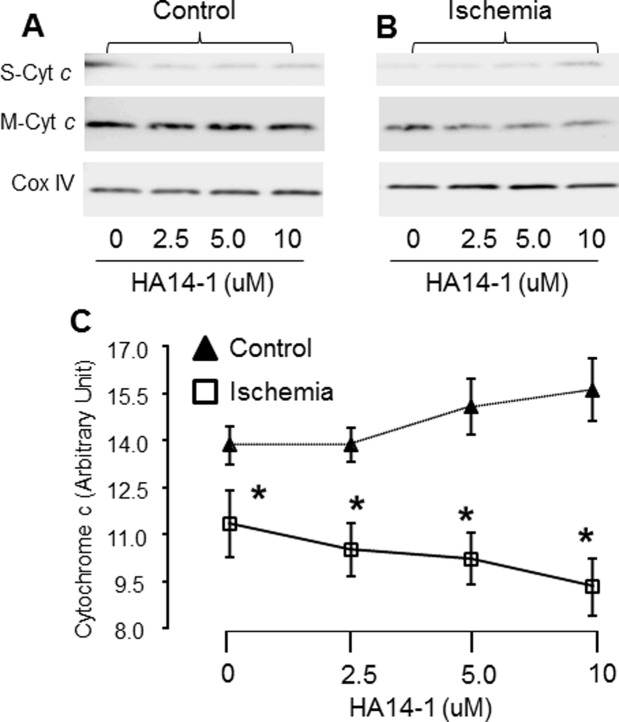
CRC was decreased in mitochondria following reperfusion compared to ischemia alone, indicating that reperfusion further sensitizes to MPTP opening. Incubation of ischemia-damaged mitochondria with increasing HA14-1concentrations increased calcium-stimulated MPTP opening, supporting that functional inhibition of bcl-2 during simulated reperfusion favors MPTP opening. Moreover, HA14-1 sensitivity was increased by ischemia compared to non-ischemic controls. Overexpression of bcl-2 attenuated MPTP opening in following ischemia-reperfusion. HA14-1 inhibition also increased the permeability of the outer membrane in the absence of exogenous calcium, indicating that bcl-2 inhibition favors MOMP when calcium is low.
The depletion and functional inhibition of bcl-2 contributes to cardiac injury by increasing susceptibility to MPTP opening in high calcium environments and MOMP in the absence of calcium overload. Thus, ischemia-damaged mitochondria with decreased bcl-2 content are susceptible to MPTP opening in early reperfusion and MOMP later in reperfusion when cytosolic calcium has normalized.
线粒体对于再灌注期间的心脏损伤至关重要,这是由于缺血期间遭受的损伤,包括bcl-2的丧失。我们询问bcl-2的缺失是否不仅导致线粒体外膜(MOMP)的选择性通透,有利于细胞色素c的释放和程序性细胞死亡,而且还有利于线粒体通透性转换孔(MPTP)的开放。MPTP敏感性的增加将支持bcl-2缺失介导的细胞死亡在早期再灌注的钙超载环境中通过MPTP以及在再灌注后期通过MOMP发挥作用,此时心肌钙含量恢复正常。
钙保留能力(CRC)用于反映分离的心脏线粒体中MPTP开放的敏感性。为了研究bcl-2抑制与MPTP开放之间的关系,将线粒体与bcl-2抑制剂(HA14-1)一起孵育并测量CRC。使用转基因bcl-2过表达小鼠探讨了缺血再灌注后保留的bcl-2含量对MPTP开放的贡献。
与单独缺血相比,再灌注后线粒体中的CRC降低,表明再灌注进一步使MPTP开放敏感。用增加的HA14-1浓度孵育缺血损伤的线粒体增加了钙刺激的MPTP开放,支持在模拟再灌注期间bcl-2的功能抑制有利于MPTP开放。此外,与非缺血对照相比缺血增加了HA14-1敏感性。bcl-2的过表达减弱了缺血再灌注后的MPTP开放。HA14-1抑制在没有外源钙的情况下也增加了外膜的通透性,表明当钙含量低时bcl-2抑制有利于MOMP。
bcl-2的缺失和功能抑制通过增加在高钙环境中对MPTP开放的敏感性以及在没有钙超载的情况下对MOMP的敏感性而导致心脏损伤。因此,bcl-2含量降低的缺血损伤线粒体在早期再灌注时易发生MPTP开放,而在再灌注后期当胞质钙恢复正常时易发生MOMP。