Jacobson Joseph L, Muckle Gina, Ayotte Pierre, Dewailly Éric, Jacobson Sandra W
Department of Psychiatry and Behavioral Neurosciences, Wayne State University School of Medicine, Detroit, Michigan, USA.
Environ Health Perspect. 2015 Aug;123(8):827-33. doi: 10.1289/ehp.1408554. Epub 2015 Mar 10.
Although prenatal methylmercury exposure has been linked to poorer intellectual function in several studies, data from two major prospective, longitudinal studies yielded contradictory results. Associations with cognitive deficits were reported in a Faroe Islands cohort, but few were found in a study in the Seychelles Islands. It has been suggested that co-exposure to another contaminant, polychlorinated biphenyls (PCBs), may be responsible for the positive findings in the former study and that co-exposure to nutrients in methylmercury-contaminated fish may have obscured and/or protected against adverse effects in the latter.
We aimed to determine the degree to which co-exposure to PCBs may account for the adverse effects of methylmercury and the degree to which co-exposure to docosahexaenoic acid (DHA) may obscure these effects in a sample of Inuit children in Arctic Québec.
IQ was estimated in 282 school-age children from whom umbilical cord blood samples had been obtained and analyzed for mercury and other environmental exposures.
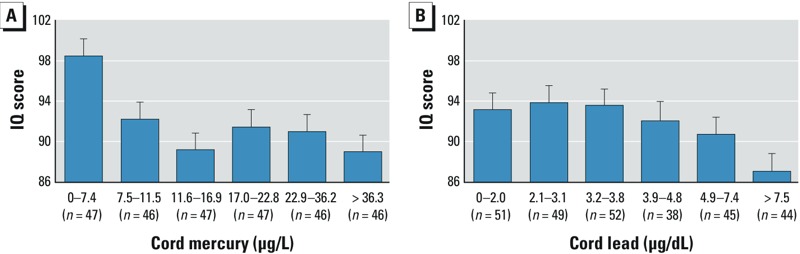
Prenatal mercury exposure was related to poorer estimated IQ after adjustment for potential confounding variables. The entry of DHA into the model significantly strengthened the association with mercury, supporting the hypothesis that beneficial effects from DHA intake can obscure adverse effects of mercury exposure. Children with cord mercury ≥ 7.5 μg/L were four times as likely to have an IQ score < 80, the clinical cut-off for borderline intellectual disability. Co-exposure to PCBs did not alter the association of mercury with IQ.
To our knowledge, this is the first study to document an association of prenatal mercury exposure with poorer performance on a school-age assessment of IQ, a measure whose relevance for occupational success in adulthood is well established. This association was seen at levels in the range within which many U.S. children of Asian-American background are exposed.
尽管在多项研究中,产前甲基汞暴露与智力功能较差有关,但两项主要的前瞻性纵向研究得出了相互矛盾的数据。法罗群岛队列研究报告了与认知缺陷的关联,但在塞舌尔群岛的一项研究中却很少发现这种关联。有人提出,同时接触另一种污染物多氯联苯(PCBs)可能是前一项研究中出现阳性结果的原因,而在甲基汞污染的鱼类中同时接触营养物质可能掩盖和/或预防了后一项研究中的不良影响。
我们旨在确定在魁北克北极地区的因纽特儿童样本中,同时接触多氯联苯对甲基汞不良影响的影响程度,以及同时接触二十二碳六烯酸(DHA)对这些影响的掩盖程度。
对282名学龄儿童进行智商评估,这些儿童的脐带血样本已采集并分析了汞及其他环境暴露因素。
在对潜在混杂变量进行调整后,产前汞暴露与较低的估计智商相关。DHA纳入模型后显著增强了与汞的关联,支持了DHA摄入的有益作用可掩盖汞暴露不良影响的假设。脐带血汞含量≥7.5μg/L的儿童智商得分<80(边缘智力障碍的临床临界值)的可能性是其他儿童的四倍。同时接触多氯联苯并未改变汞与智商的关联。
据我们所知,这是第一项记录产前汞暴露与学龄期智商评估表现较差之间关联的研究,智商评估对成年职业成功的相关性已得到充分证实。这种关联在许多亚裔美国背景的美国儿童所接触的汞含量范围内即可观察到。