Weiss Andrea, Bonvin Débora, Berndsen Robert H, Scherrer Edoardo, Wong Tse J, Dyson Paul J, Griffioen Arjan W, Nowak-Sliwinska Patrycja
1] Institute of Chemical Sciences and Engineering, Swiss Federal Institute of Technology (EPFL), Lausanne, Switzerland [2] Angiogenesis Laboratory, Department of Medical Oncology, VU University Medical Center Amsterdam, The Netherlands.
Institute of Chemical Sciences and Engineering, Swiss Federal Institute of Technology (EPFL), Lausanne, Switzerland.
Sci Rep. 2015 Mar 11;5:8990. doi: 10.1038/srep08990.
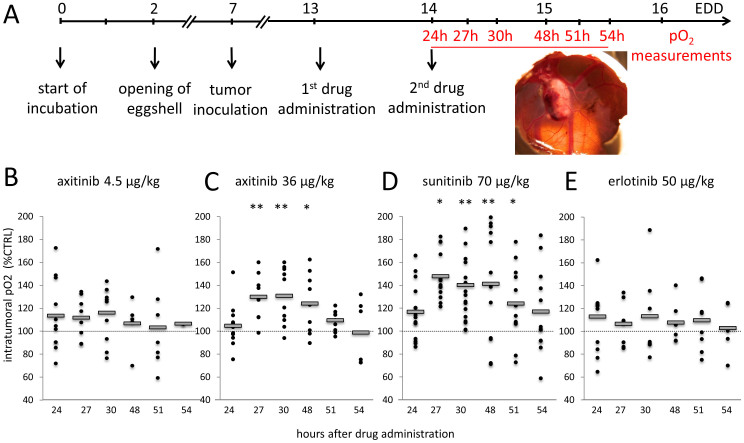
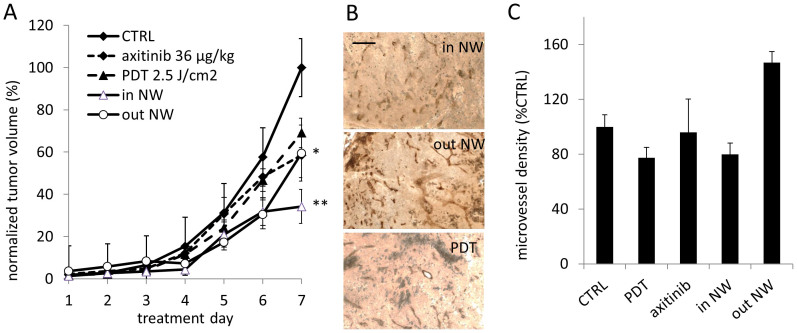
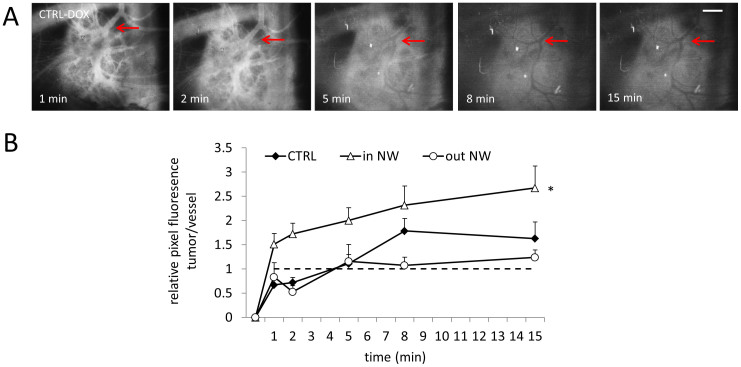
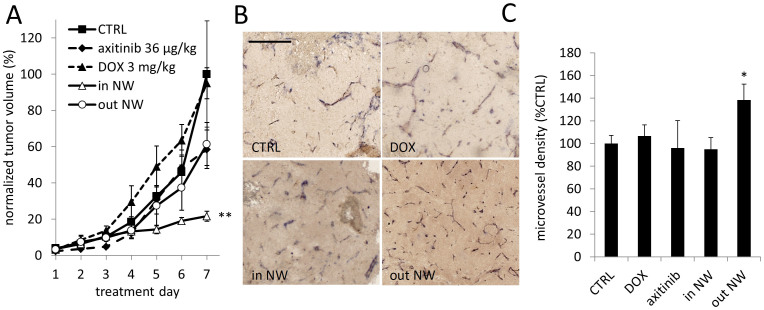
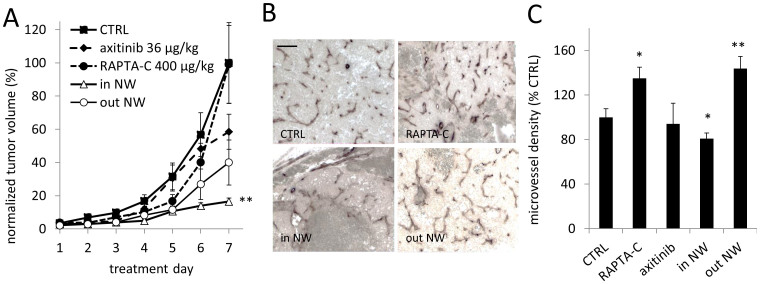
Tumor vasculature is known to be poorly organized leading to increased leakage of molecules to the extravascular space. This process can potentially increase interstitial fluid pressure impairing intra-tumoral blood flow and oxygen supply, and can affect drug uptake. Anti-angiogenic therapies are believed to reduce vascular permeability, potentially reducing interstitial fluid pressure and improving the extravasation of small molecule-based chemotherapeutics. Here we show that pretreatment of human ovarian carcinoma tumors with sub-optimal doses of the VEGFR targeting tyrosine kinase inhibitor axitinib, but not the EGFR targeting kinase inhibitor erlotinib, induces a transient period of increased tumor oxygenation. Doxorubicin administered within this window was found to enter the extravascular tumor space more rapidly compared to doxorubicin when applied alone or outside this time window. Treatment with the chemotherapeutics, doxorubicin and RAPTA-C, as well as applying photodynamic therapy during this period of elevated oxygenation led to enhanced tumor growth inhibition. Improvement of therapy was not observed when applied outside the window of increased oxygenation. Taken together, these findings further confirm the hypothesis of angiostasis-induced vascular normalization and also help to understand the interactions between anti-angiogenesis and other anti-cancer strategies.
已知肿瘤血管系统组织不良,导致分子向血管外间隙的渗漏增加。这一过程可能会增加间质液压力,损害肿瘤内的血流和氧气供应,并可能影响药物摄取。抗血管生成疗法被认为可以降低血管通透性,潜在地降低间质液压力,并改善基于小分子的化疗药物的外渗。在此,我们表明,用次优剂量的靶向VEGFR的酪氨酸激酶抑制剂阿昔替尼(而非靶向EGFR的激酶抑制剂厄洛替尼)预处理人卵巢癌肿瘤,会诱导肿瘤氧合增加的短暂时期。发现在此窗口期内给予的多柔比星与单独应用或在此时间窗口之外应用时相比,进入血管外肿瘤间隙的速度更快。在此氧合升高期间用化疗药物多柔比星和RAPTA-C进行治疗,以及应用光动力疗法,均导致增强的肿瘤生长抑制。在氧合增加窗口之外应用时未观察到治疗改善。综上所述,这些发现进一步证实了血管生成抑制诱导血管正常化的假说,也有助于理解抗血管生成与其他抗癌策略之间的相互作用。