Kleibeuker Esther A, Ten Hooven Matthijs A, Castricum Kitty C, Honeywell Richard, Griffioen Arjan W, Verheul Henk M, Slotman Ben J, Thijssen Victor L
Department of Radiation Oncology, VU University Medical Center, Amsterdam, The Netherlands.
Department of Medical Oncology, VU University Medical Center, Amsterdam, The Netherlands.
Cancer Med. 2015 Jul;4(7):1003-15. doi: 10.1002/cam4.441. Epub 2015 Mar 31.
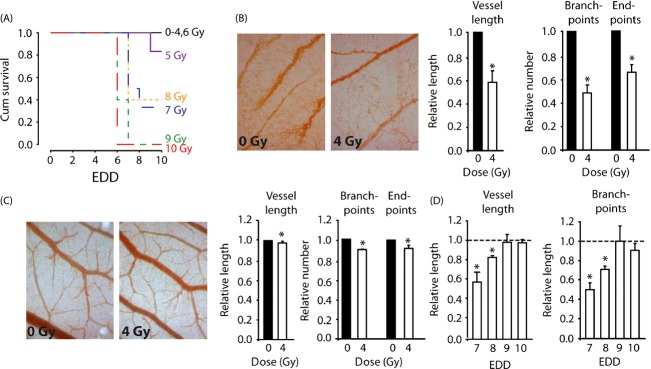
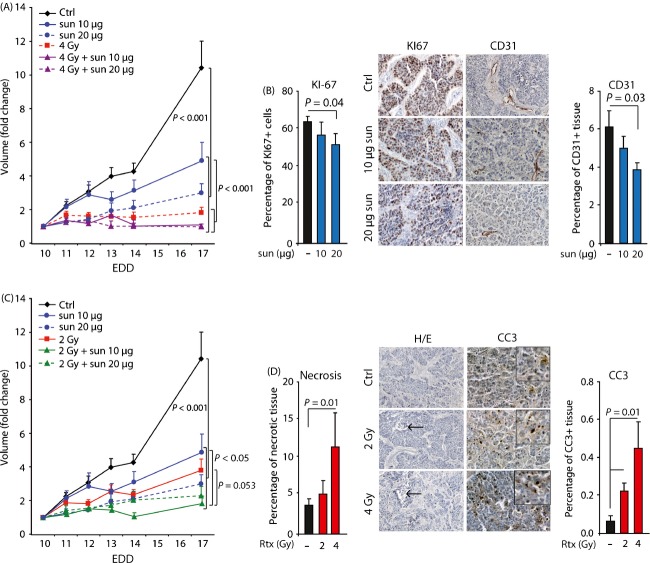
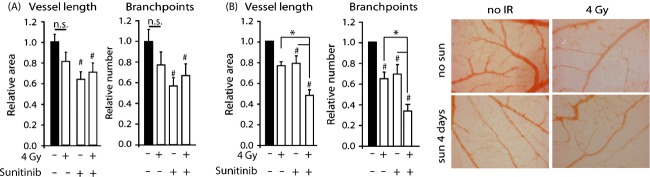
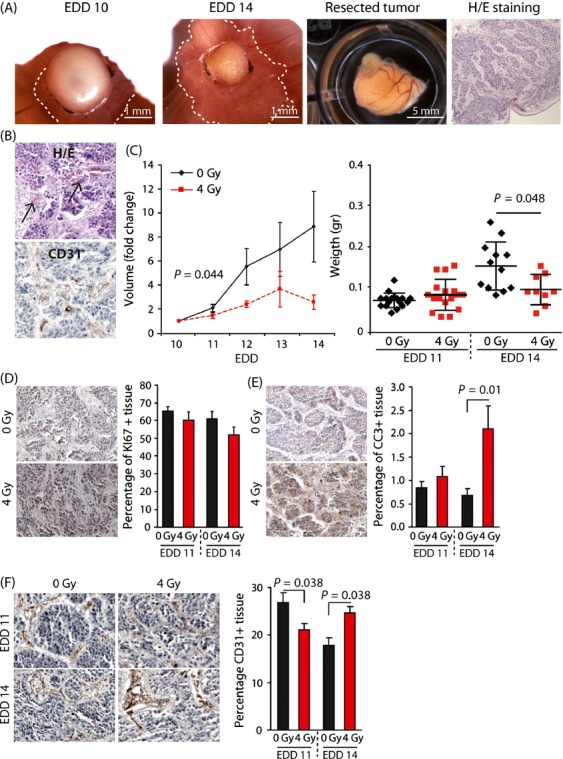
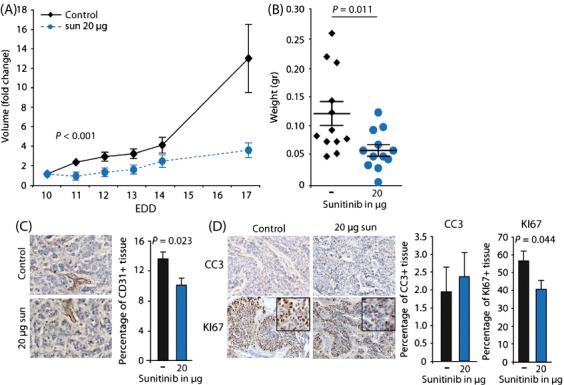
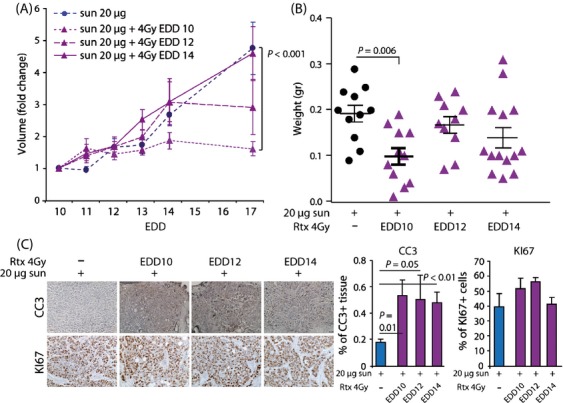
The combination of radiotherapy with sunitinib is clinically hampered by rare but severe side effects and varying results with respect to clinical benefit. We studied different scheduling regimes and dose reduction in sunitinib and radiotherapy in preclinical tumor models to improve potential outcome of this combination treatment strategy. The chicken chorioallantoic membrane (CAM) was used as an angiogenesis in vivo model and as a xenograft model with human tumor cells (HT29 colorectal adenocarcinoma, OE19 esophageal adenocarcinoma). Treatment consisted of ionizing radiation (IR) and sunitinib as single therapy or in combination, using different dose-scheduling regimes. Sunitinib potentiated the inhibitory effect of IR (4 Gy) on angiogenesis. In addition, IR (4 Gy) and sunitinib (4 days of 32.5 mg/kg per day) inhibited tumor growth. Ionizing radiation induced tumor cell apoptosis and reduced proliferation, whereas sunitinib decreased tumor angiogenesis and reduced tumor cell proliferation. When IR was applied before sunitinib, this almost completely inhibited tumor growth, whereas concurrent IR was less effective and IR after sunitinib had no additional effect on tumor growth. Moreover, optimal scheduling allowed a 50% dose reduction in sunitinib while maintaining comparable antitumor effects. This study shows that the therapeutic efficacy of combination therapy improves when proper dose-scheduling is applied. More importantly, optimal treatment regimes permit dose reductions in the angiogenesis inhibitor, which will likely reduce the side effects of combination therapy in the clinical setting. Our study provides important leads to optimize combination treatment in the clinical setting.
放疗与舒尼替尼联合使用在临床上受到罕见但严重的副作用以及临床获益结果各异的阻碍。我们在临床前肿瘤模型中研究了舒尼替尼与放疗的不同给药方案和剂量降低情况,以改善这种联合治疗策略的潜在疗效。鸡胚绒毛尿囊膜(CAM)被用作体内血管生成模型以及人肿瘤细胞(HT29结肠腺癌、OE19食管腺癌)的异种移植模型。治疗包括电离辐射(IR)和舒尼替尼单一疗法或联合疗法,采用不同的剂量给药方案。舒尼替尼增强了IR(4 Gy)对血管生成的抑制作用。此外,IR(4 Gy)和舒尼替尼(每天32.5 mg/kg,共4天)抑制了肿瘤生长。电离辐射诱导肿瘤细胞凋亡并减少增殖,而舒尼替尼减少肿瘤血管生成并降低肿瘤细胞增殖。当在舒尼替尼之前应用IR时,几乎完全抑制了肿瘤生长,而同时应用IR效果较差,在舒尼替尼之后应用IR对肿瘤生长没有额外影响。此外,最佳给药方案允许舒尼替尼剂量降低50%,同时保持相当的抗肿瘤效果。这项研究表明,当应用适当的剂量给药方案时,联合治疗的疗效会提高。更重要的是,最佳治疗方案允许降低血管生成抑制剂的剂量,这可能会减少临床环境中联合治疗的副作用。我们的研究为优化临床环境中的联合治疗提供了重要线索。