Tchetina Elena V, Maslova Karina A, Krylov Mikhail Y, Myakotkin Valery A
Genetics Department, Nasonova Research Institute of Rheumatology, Moscow 115522, Russia ; Clinical Immunology Department, Nasonova Research Institute of Rheumatology, Kashirskoye Shosse 34A, Moscow 115522, Russia.
Genetics Department, Nasonova Research Institute of Rheumatology, Moscow 115522, Russia ; Janssen Pharmaceutical Companies of Johnson and Johnson, Toronto, ON, Canada N1K 1A5.
J Osteoporos. 2015;2015:802694. doi: 10.1155/2015/802694. Epub 2015 Feb 10.
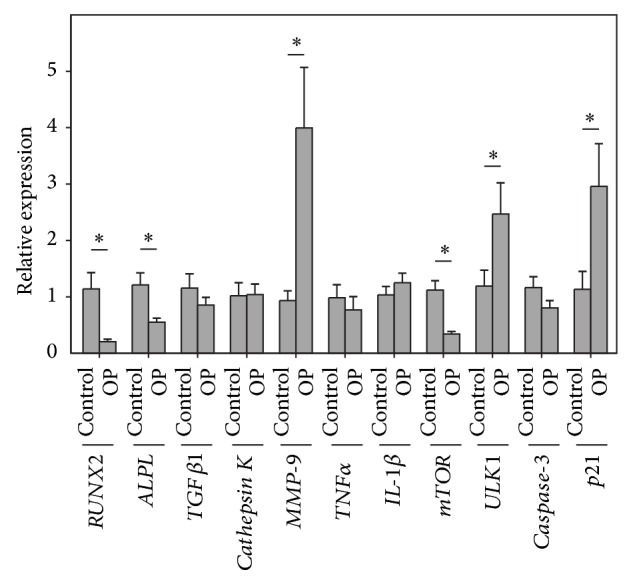
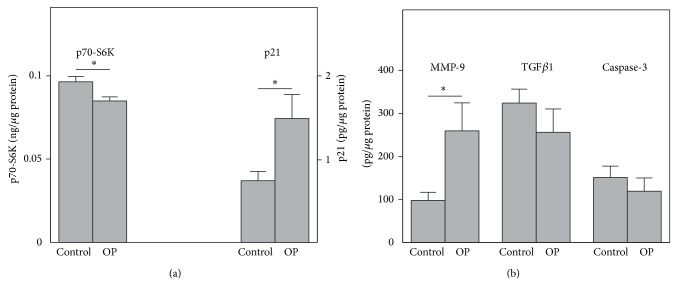
We aimed to identify bone related markers in the peripheral blood of osteoporotic (OP) patients that pointed toward molecular mechanisms underlying late postmenopausal bone loss. Whole blood from 22 late postmenopausal OP patients and 26 healthy subjects was examined. Bone mineral density (BMD) was measured by DXA. Protein levels of p70-S6K, p21, MMP-9, TGFβ1, and caspase-3 were quantified by ELISA. Gene expression was measured using real-time RT-PCR. OP registered by low BMD indices in late postmenopausal patients was associated with a significant upregulation of autophagy protein ULK1, cyclin-dependent kinase inhibitor p21, and metalloproteinase MMP-9 gene expression in the blood compared to the healthy controls and in a significant downregulation of mTOR (mammalian target of rapamycin), RUNX2, and ALPL gene expression, while expression of cathepsin K, caspase-3, transforming growth factor (TGF) β1, interleukin- (IL-) 1β, and tumor necrosis factor α (TNFα) was not significantly affected. We also observed a positive correlation between TGFβ1 and RUNX2 expression and BMD at femoral sites in these patients. Therefore, bone loss in late postmenopausal OP patients is associated with a significant upregulation of survival-related genes (ULK1 and p21) and MMP-9, as well as the downregulation of mTOR and osteoblast differentiation-related genes (RUNX2 and ALPL) in the peripheral blood compared to the healthy controls.
我们旨在识别骨质疏松症(OP)患者外周血中与骨骼相关的标志物,这些标志物指向绝经后晚期骨质流失的潜在分子机制。对22例绝经后晚期OP患者和26名健康受试者的全血进行了检测。采用双能X线吸收法(DXA)测量骨密度(BMD)。通过酶联免疫吸附测定(ELISA)定量检测p70-S6K、p21、基质金属蛋白酶-9(MMP-9)、转化生长因子β1(TGFβ1)和半胱天冬酶-3的蛋白水平。使用实时逆转录聚合酶链反应(RT-PCR)测量基因表达。与健康对照相比,绝经后晚期患者低骨密度指数所记录的OP与血液中自噬蛋白ULK1、细胞周期蛋白依赖性激酶抑制剂p21和金属蛋白酶MMP-9基因表达的显著上调以及雷帕霉素靶蛋白(mTOR)、 runt相关转录因子2(RUNX2)和成骨细胞碱性磷酸酶(ALPL)基因表达的显著下调相关,而组织蛋白酶K、半胱天冬酶-3、转化生长因子(TGF)β1、白细胞介素-(IL-)1β和肿瘤坏死因子α(TNFα)的表达未受到显著影响。我们还观察到这些患者中TGFβ1和RUNX2表达与股骨部位骨密度之间呈正相关。因此,与健康对照相比,绝经后晚期OP患者的骨质流失与外周血中生存相关基因(ULK1和p21)和MMP-9的显著上调以及mTOR和成骨细胞分化相关基因(RUNX2和ALPL)的下调有关。