Bell Erica Hlavin, Kirste Simon, Fleming Jessica L, Stegmaier Petra, Drendel Vanessa, Mo Xiaokui, Ling Stella, Fabian Denise, Manring Isabel, Jilg Cordula A, Schultze-Seemann Wolfgang, McNulty Maureen, Zynger Debra L, Martin Douglas, White Julia, Werner Martin, Grosu Anca L, Chakravarti Arnab
Department of Radiation Oncology, Arthur G. James Hospital/ Ohio State Comprehensive Cancer Center, Columbus, Ohio, United States of America.
Department of Radiation Oncology, Arthur G. James Hospital/ Ohio State Comprehensive Cancer Center, Columbus, Ohio, United States of America; Department of Radiation Oncology, University Medical Center Freiburg, Freiburg, Germany.
PLoS One. 2015 Mar 11;10(3):e0118745. doi: 10.1371/journal.pone.0118745. eCollection 2015.
To develop a microRNA (miRNA)-based predictive model for prostate cancer patients of 1) time to biochemical recurrence after radical prostatectomy and 2) biochemical recurrence after salvage radiation therapy following documented biochemical disease progression post-radical prostatectomy.
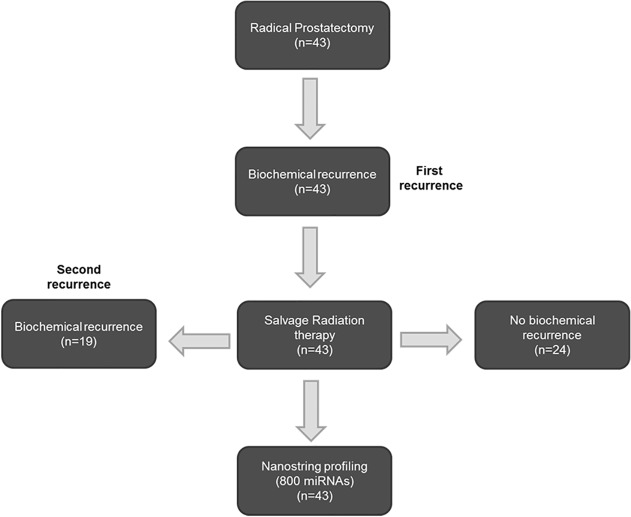
Forty three patients who had undergone salvage radiation therapy following biochemical failure after radical prostatectomy with greater than 4 years of follow-up data were identified. Formalin-fixed, paraffin-embedded tissue blocks were collected for all patients and total RNA was isolated from 1mm cores enriched for tumor (>70%). Eight hundred miRNAs were analyzed simultaneously using the nCounter human miRNA v2 assay (NanoString Technologies; Seattle, WA). Univariate and multivariate Cox proportion hazards regression models as well as receiver operating characteristics were used to identify statistically significant miRNAs that were predictive of biochemical recurrence.
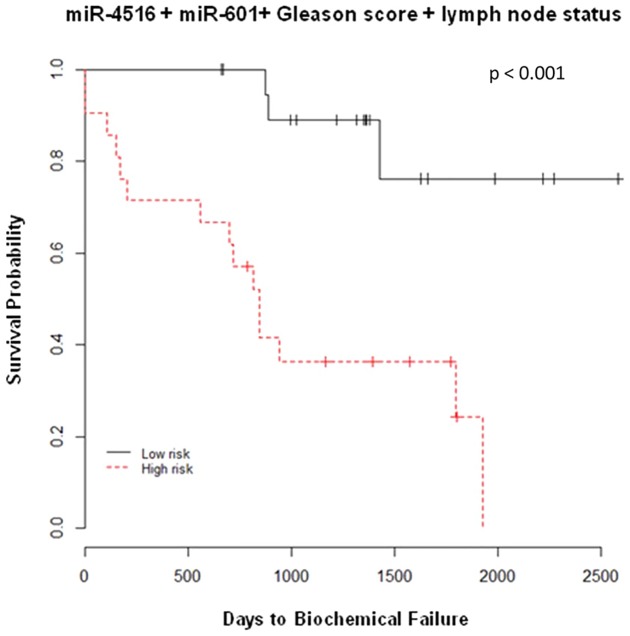
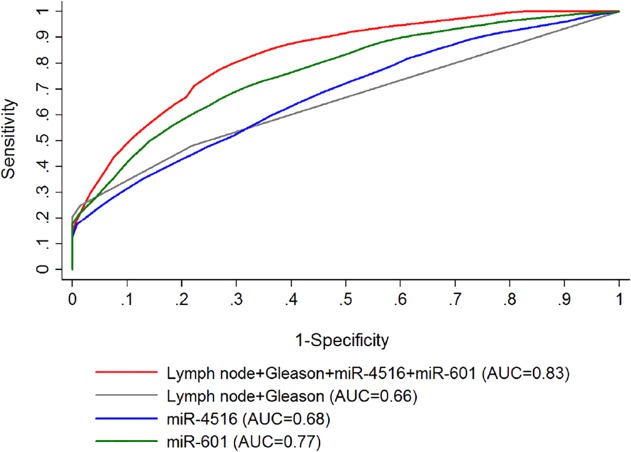
Eighty eight miRNAs were identified to be significantly (p<0.05) associated with biochemical failure post-prostatectomy by multivariate analysis and clustered into two groups that correlated with early (≤ 36 months) versus late recurrence (>36 months). Nine miRNAs were identified to be significantly (p<0.05) associated by multivariate analysis with biochemical failure after salvage radiation therapy. A new predictive model for biochemical recurrence after salvage radiation therapy was developed; this model consisted of miR-4516 and miR-601 together with, Gleason score, and lymph node status. The area under the ROC curve (AUC) was improved to 0.83 compared to that of 0.66 for Gleason score and lymph node status alone.
miRNA signatures can distinguish patients who fail soon after radical prostatectomy versus late failures, giving insight into which patients may need adjuvant therapy. Notably, two novel miRNAs (miR-4516 and miR-601) were identified that significantly improve prediction of biochemical failure post-salvage radiation therapy compared to clinico-histopathological factors, supporting the use of miRNAs within clinically used predictive models. Both findings warrant further validation studies.
为前列腺癌患者建立基于微小RNA(miRNA)的预测模型,用于预测1)根治性前列腺切除术后生化复发时间,以及2)根治性前列腺切除术后出现生化疾病进展后挽救性放疗后的生化复发情况。
确定43例根治性前列腺切除术后生化失败后接受挽救性放疗且有超过4年随访数据的患者。收集所有患者的福尔马林固定、石蜡包埋组织块,从富含肿瘤(>70%)的1mm组织芯中分离总RNA。使用nCounter人类miRNA v2分析(NanoString Technologies;华盛顿州西雅图)同时分析800种miRNA。采用单变量和多变量Cox比例风险回归模型以及受试者工作特征曲线来识别可预测生化复发的具有统计学意义的miRNA。
通过多变量分析确定88种miRNA与前列腺切除术后生化失败显著相关(p<0.05),并聚为两组,分别与早期(≤36个月)和晚期复发(>36个月)相关。通过多变量分析确定9种miRNA与挽救性放疗后的生化失败显著相关(p<0.05)。建立了一种新的挽救性放疗后生化复发预测模型;该模型由miR-4516和miR-601以及Gleason评分和淋巴结状态组成。与单独的Gleason评分和淋巴结状态相比,ROC曲线下面积(AUC)提高到了0.83,而单独的Gleason评分和淋巴结状态的AUC为0.66。
miRNA特征可区分根治性前列腺切除术后很快出现失败的患者与晚期失败的患者,有助于了解哪些患者可能需要辅助治疗。值得注意的是,与临床组织病理学因素相比,已确定两种新型miRNA(miR-4516和miR-601)可显著改善挽救性放疗后生化失败的预测,支持在临床使用的预测模型中使用miRNA。这两项发现均需要进一步的验证研究。