Instituto de Biomedicina de Sevilla (IBiS), Hospital Universitario Virgen del Rocío/CSIC/Universidad de Sevilla Seville, Spain.
Instituto de Biomedicina de Sevilla (IBiS), Hospital Universitario Virgen del Rocío/CSIC/Universidad de Sevilla Seville, Spain ; Departamento de Fisiología Médica y Biofísica, Facultad de Medicina, Universidad de Sevilla Seville, Spain ; Centro de Investigación Biomédica en Red sobre Enfermedades Neurodegenerativas (CIBERNED) Madrid, Spain.
Front Neuroanat. 2015 Feb 13;9:10. doi: 10.3389/fnana.2015.00010. eCollection 2015.
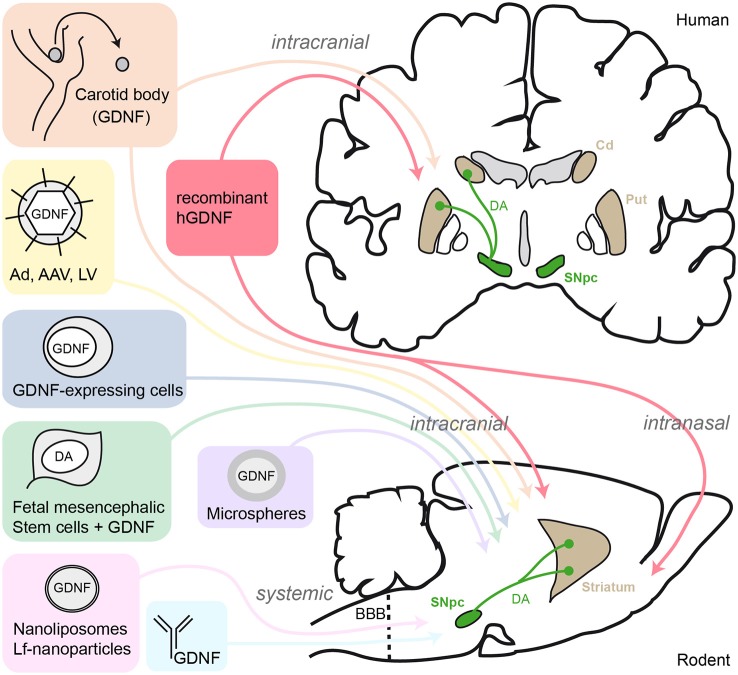
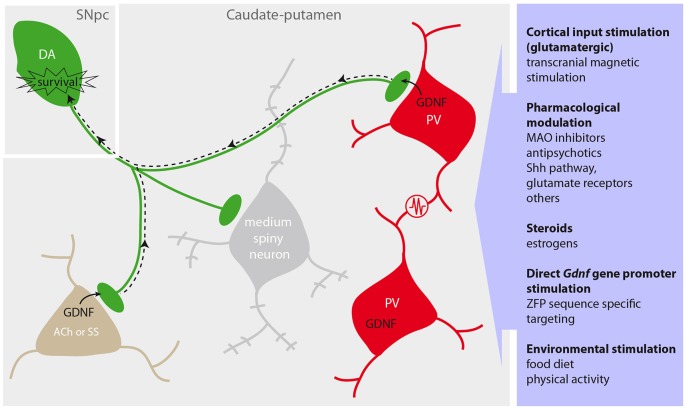
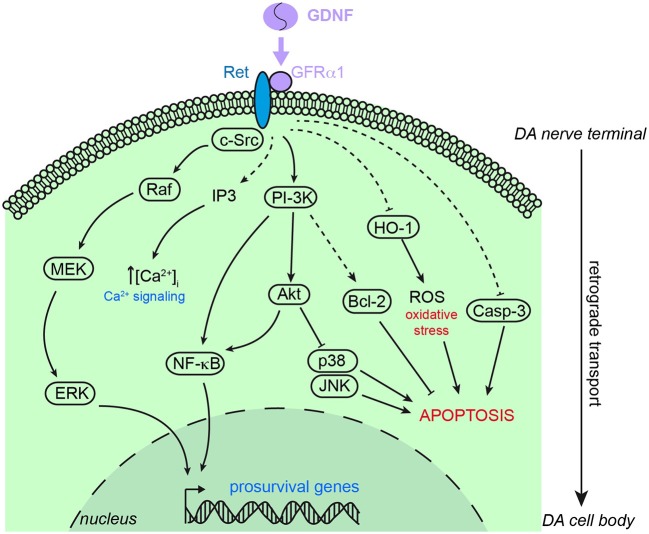
The glial cell line-derived neurotrophic factor (GDNF) is a well-established trophic agent for dopaminergic (DA) neurons in vitro and in vivo. GDNF is necessary for maintenance of neuronal morphological and neurochemical phenotype and protects DA neurons from toxic damage. Numerous studies on animal models of Parkinson's disease (PD) have reported beneficial effects of GDNF on nigrostriatal DA neuron survival. However, translation of these observations to the clinical setting has been hampered so far by side effects associated with the chronic continuous intra-striatal infusion of recombinant GDNF. In addition, double blind and placebo-controlled clinical trials have not reported any clinically relevant effect of GDNF on PD patients. In the past few years, experiments with conditional Gdnf knockout mice have suggested that GDNF is necessary for maintenance of DA neurons in adulthood. In parallel, new methodologies for exogenous GDNF delivery have been developed. Recently, it has been shown that a small population of scattered, electrically interconnected, parvalbumin positive (PV+) GABAergic interneurons is responsible for most of the GDNF produced in the rodent striatum. In addition, cholinergic striatal interneurons appear to be also involved in the modulation of striatal GDNF. In this review, we summarize current knowledge on brain GDNF delivery, homeostasis, and its effects on nigrostriatal DA neurons. Special attention is paid to the therapeutic potential of endogenous GDNF stimulation in PD.
胶质细胞源性神经营养因子(GDNF)是一种成熟的体外和体内多巴胺能(DA)神经元营养因子。GDNF 对于维持神经元的形态和神经化学表型以及保护 DA 神经元免受毒性损伤是必需的。大量关于帕金森病(PD)动物模型的研究报告了 GDNF 对黑质纹状体 DA 神经元存活的有益作用。然而,到目前为止,这些观察结果在向临床环境的转化中受到了与重组 GDNF 慢性连续纹状体内输注相关的副作用的阻碍。此外,双盲和安慰剂对照的临床试验也没有报告 GDNF 对 PD 患者有任何临床相关的影响。在过去的几年中,条件性 Gdnf 敲除小鼠的实验表明,GDNF 对于成年 DA 神经元的维持是必需的。与此同时,新的外源性 GDNF 传递方法也得到了发展。最近,已经表明,一小部分分散的、电相互连接的、钙结合蛋白 Parvalbumin 阳性(PV+)GABA 能中间神经元负责产生大多数在啮齿动物纹状体中的 GDNF。此外,纹状体胆碱能中间神经元似乎也参与了纹状体内 GDNF 的调节。在这篇综述中,我们总结了目前关于大脑 GDNF 传递、内稳态及其对黑质纹状体 DA 神经元的影响的知识。特别关注内源性 GDNF 刺激在 PD 中的治疗潜力。