Department of Psychological Sciences, Purdue University West Lafayette, IN, USA.
Department of Educational Psychology and Psychology, University of Illinois at Urbana-Champaign Champaign, IL, USA.
Front Psychol. 2015 Feb 25;6:189. doi: 10.3389/fpsyg.2015.00189. eCollection 2015.
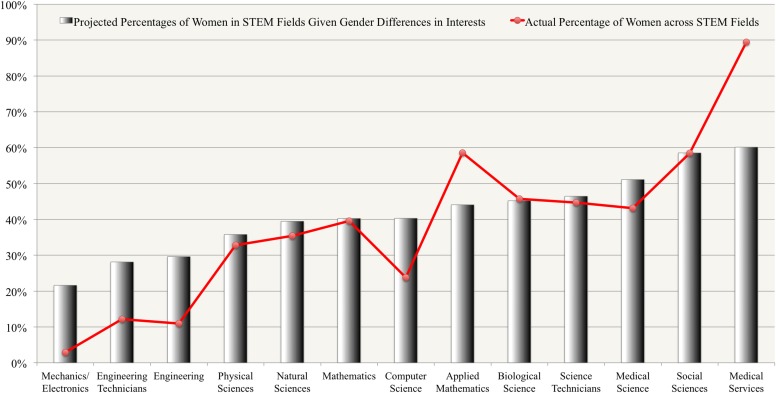
The degree of women's underrepresentation varies by STEM fields. Women are now overrepresented in social sciences, yet only constitute a fraction of the engineering workforce. In the current study, we investigated the gender differences in interests as an explanation for the differential distribution of women across sub-disciplines of STEM as well as the overall underrepresentation of women in STEM fields. Specifically, we meta-analytically reviewed norm data on basic interests from 52 samples in 33 interest inventories published between 1964 and 2007, with a total of 209,810 male and 223,268 female respondents. We found gender differences in interests to vary largely by STEM field, with the largest gender differences in interests favoring men observed in engineering disciplines (d = 0.83-1.21), and in contrast, gender differences in interests favoring women in social sciences and medical services (d = -0.33 and -0.40, respectively). Importantly, the gender composition (percentages of women) in STEM fields reflects these gender differences in interests. The patterns of gender differences in interests and the actual gender composition in STEM fields were explained by the people-orientation and things-orientation of work environments, and were not associated with the level of quantitative ability required. These findings suggest potential interventions targeting interests in STEM education to facilitate individuals' ability and career development and strategies to reform work environments to better attract and retain women in STEM occupations.
女性在 STEM 领域的代表性不足程度因学科而异。女性在社会科学领域的代表性过高,但在工程劳动力中只占一小部分。在本研究中,我们调查了兴趣方面的性别差异,以解释女性在 STEM 各子学科中的分布差异以及女性在 STEM 领域总体代表性不足的原因。具体来说,我们对 1964 年至 2007 年间发表的 33 个兴趣量表中的 52 个样本的基本兴趣规范数据进行了元分析,共有 209810 名男性和 223268 名女性受访者。我们发现,兴趣方面的性别差异在很大程度上因 STEM 领域而异,在工程学科中观察到的性别差异最大(d = 0.83-1.21),相比之下,在社会科学和医疗服务领域,兴趣方面有利于女性的性别差异(d = -0.33 和 -0.40)。重要的是,STEM 领域的性别构成(女性百分比)反映了这些兴趣方面的性别差异。兴趣方面的性别差异模式和 STEM 领域的实际性别构成由工作环境的人际导向和物的导向解释,与所需的定量能力水平无关。这些发现表明,在 STEM 教育中针对兴趣的潜在干预措施可以促进个人的能力和职业发展,以及改革工作环境的策略,可以吸引和留住更多女性从事 STEM 职业。