Laboratory of Food Microbiology and Leuven Food Science and Nutrition Research Centre, Department of Microbial and Molecular Systems, Faculty of Bioscience Engineering, KU Leuven Leuven, Belgium.
Laboratory of Food Microbiology and Leuven Food Science and Nutrition Research Centre, Department of Microbial and Molecular Systems, Faculty of Bioscience Engineering, KU Leuven Leuven, Belgium ; Division of Mechatronics, Biostatistics and Sensors, Department of Biosystems, Faculty of Bioscience Engineering, KU Leuven Leuven, Belgium.
Front Microbiol. 2015 Feb 25;6:150. doi: 10.3389/fmicb.2015.00150. eCollection 2015.
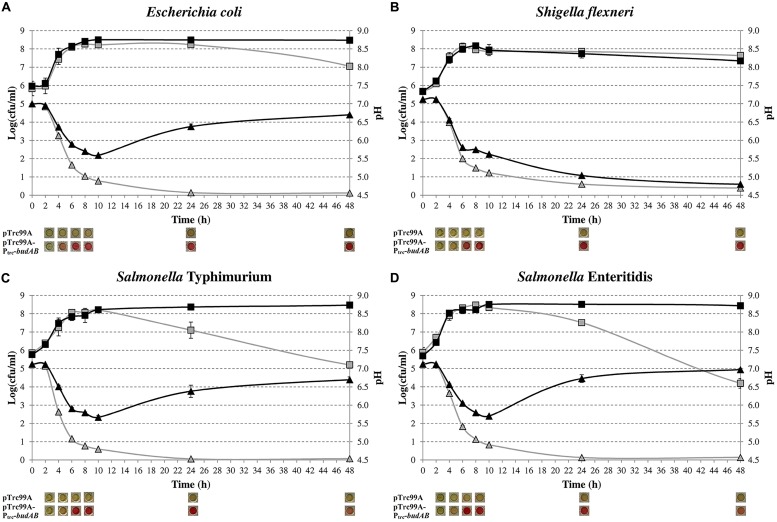
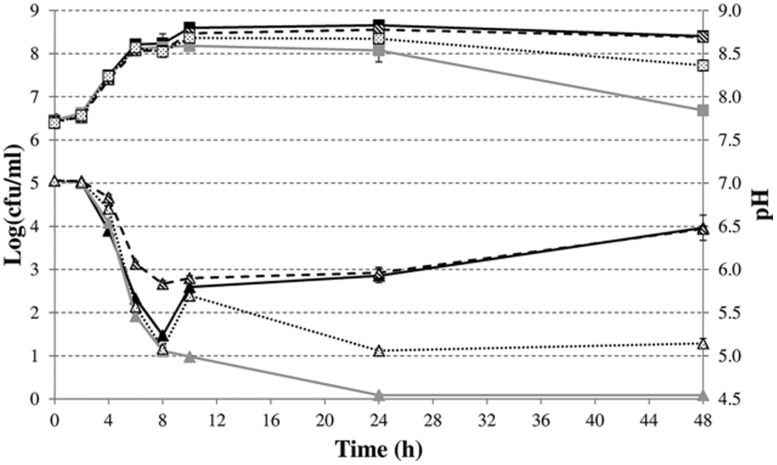
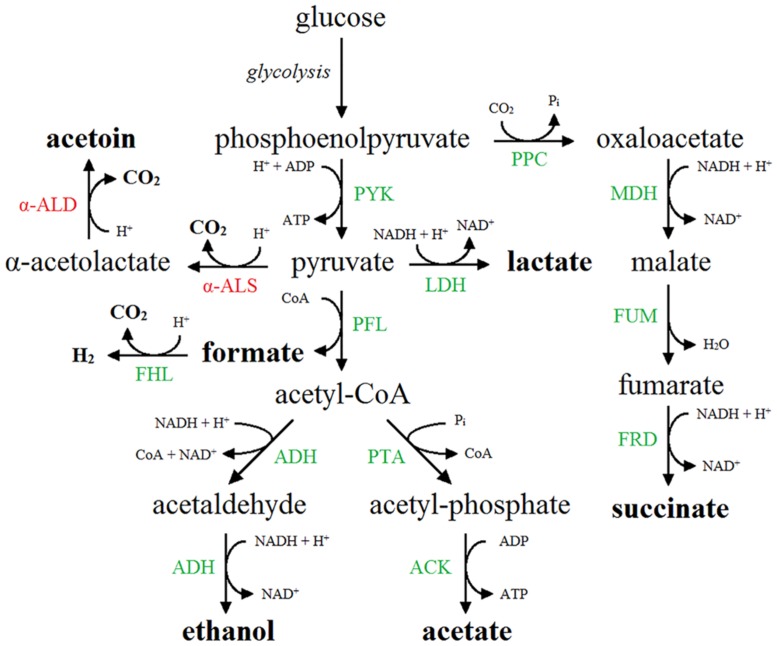
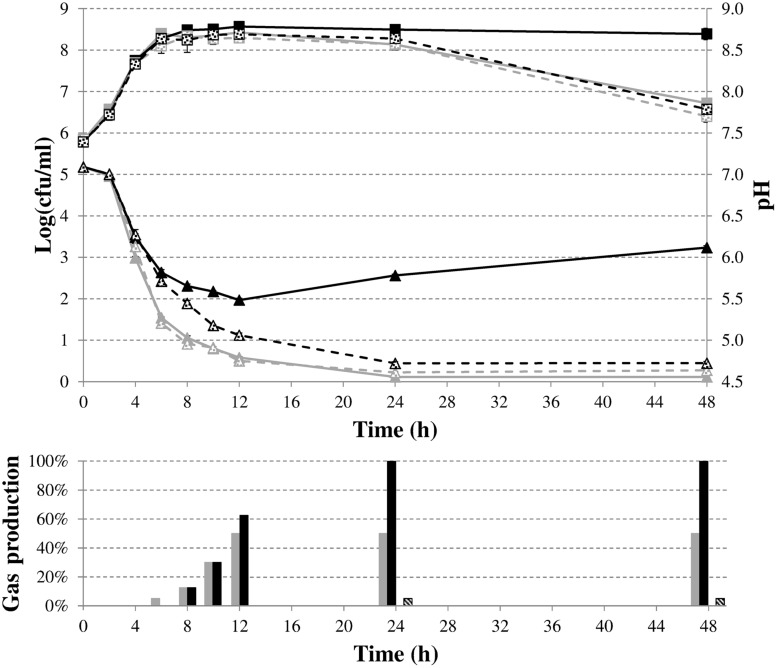
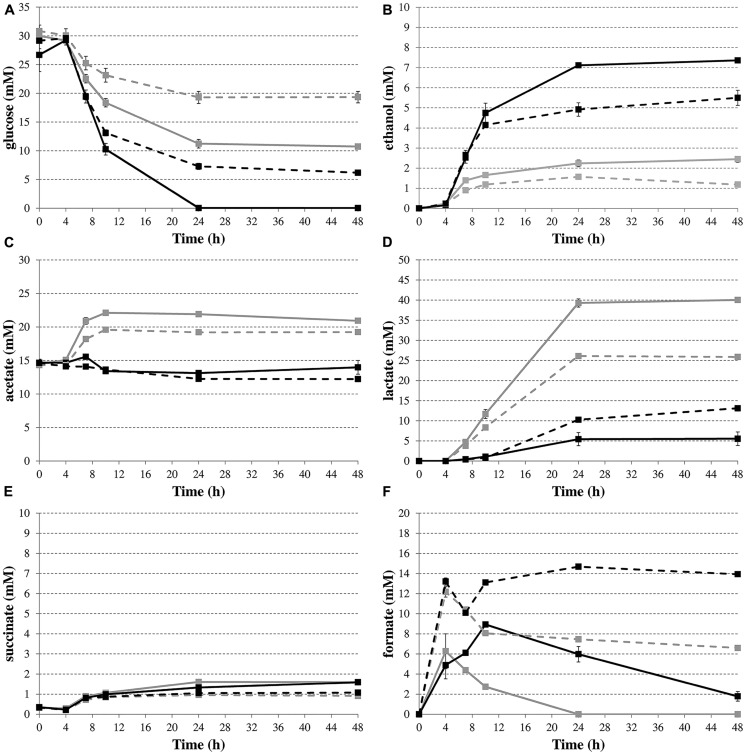
Two fermentation types exist in the Enterobacteriaceae family. Mixed-acid fermenters produce substantial amounts of lactate, formate, acetate, and succinate, resulting in lethal medium acidification. On the other hand, 2,3-butanediol fermenters switch to the production of the neutral compounds acetoin and 2,3-butanediol and even deacidify the environment after an initial acidification phase, thereby avoiding cell death. We equipped three mixed-acid fermenters (Salmonella Typhimurium, S. Enteritidis and Shigella flexneri) with the acetoin pathway from Serratia plymuthica to investigate the mechanisms of deacidification. Acetoin production caused attenuated acidification during exponential growth in all three bacteria, but stationary-phase deacidification was only observed in Escherichia coli and Salmonella, suggesting that it was not due to the consumption of protons accompanying acetoin production. To identify the mechanism, 34 transposon mutants of acetoin-producing E. coli that no longer deacidified the culture medium were isolated. The mutations mapped to 16 genes, all involved in formate metabolism. Formate is an end product of mixed-acid fermentation that can be converted to H2 and CO2 by the formate hydrogen lyase (FHL) complex, a reaction that consumes protons and thus can explain medium deacidification. When hycE, encoding the large subunit of hydrogenase 3 that is part of the FHL complex, was deleted in acetoin-producing E. coli, deacidification capacity was lost. Metabolite analysis in E. coli showed that introduction of the acetoin pathway reduced lactate and acetate production, but increased glucose consumption and formate and ethanol production. Analysis of a hycE mutant in S. plymuthica confirmed that medium deacidification in this organism is also mediated by FHL. These findings improve our understanding of the physiology and function of fermentation pathways in Enterobacteriaceae.
肠杆菌科中存在两种发酵类型。混合酸发酵菌会大量产生乳酸、甲酸盐、乙酸盐和琥珀酸盐,导致培养基严重酸化。另一方面,2,3-丁二醇发酵菌在初始酸化阶段后切换为产生中性化合物乙酰基和 2,3-丁二醇,并使环境脱酸,从而避免细胞死亡。我们为三种混合酸发酵菌(鼠伤寒沙门氏菌、肠炎沙门氏菌和福氏志贺菌)配备了来自粘质沙雷氏菌的乙酰基途径,以研究脱酸机制。在所有三种细菌的指数生长期,乙酰基的产生导致酸化减弱,但只有大肠杆菌和沙门氏菌进入静止期后才会脱酸,这表明这不是由于伴随乙酰基产生而消耗质子所致。为了确定机制,我们分离了不再使培养基脱酸的产乙酰基大肠杆菌的 34 个转座子突变体。突变体定位于 16 个基因,这些基因均参与甲酸盐代谢。甲酸盐是混合酸发酵的终产物,可通过甲酸氢裂解酶(FHL)复合物转化为 H2 和 CO2,该反应消耗质子,因此可以解释培养基的脱酸。当产乙酰基大肠杆菌中编码 FHL 复合物的大亚基氢酶 3 的 hycE 基因缺失时,脱酸能力丧失。大肠杆菌中的代谢物分析表明,乙酰基途径的引入减少了乳酸盐和乙酸盐的产生,但增加了葡萄糖的消耗以及甲酸盐和乙醇的产生。在粘质沙雷氏菌中的 hycE 突变体分析证实,该生物体中的培养基脱酸也是由 FHL 介导的。这些发现提高了我们对肠杆菌科发酵途径的生理学和功能的理解。