New Zealand Institute for Advanced Study, Massey University, Auckland, New Zealand; Department of Environmental Microbiology, Eawag, Dübendorf, Switzerland; Department of Environmental Systems Science, ETH Zürich, Zürich, Switzerland.
New Zealand Institute for Advanced Study, Massey University, Auckland, New Zealand; Santa Fe Institute, Santa Fe, New Mexico, United States of America.
PLoS Biol. 2015 Mar 12;13(3):e1002109. doi: 10.1371/journal.pbio.1002109. eCollection 2015 Mar.
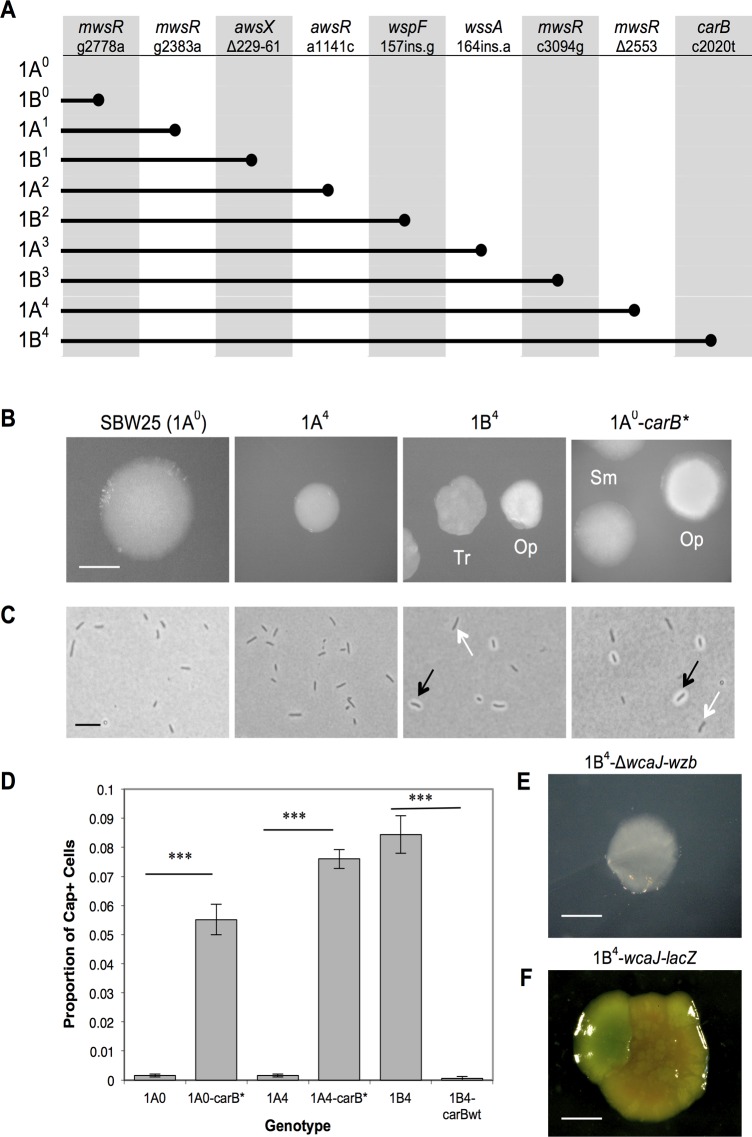
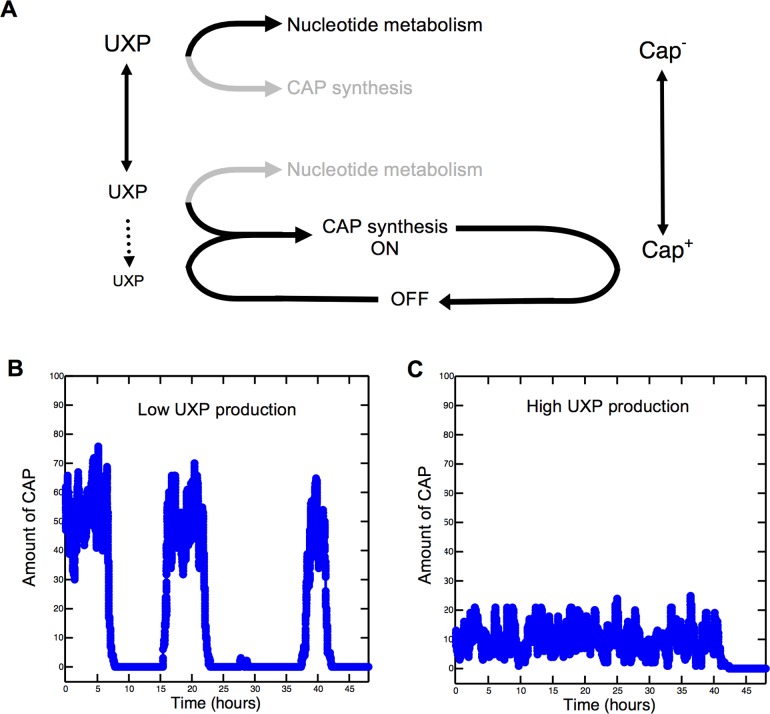
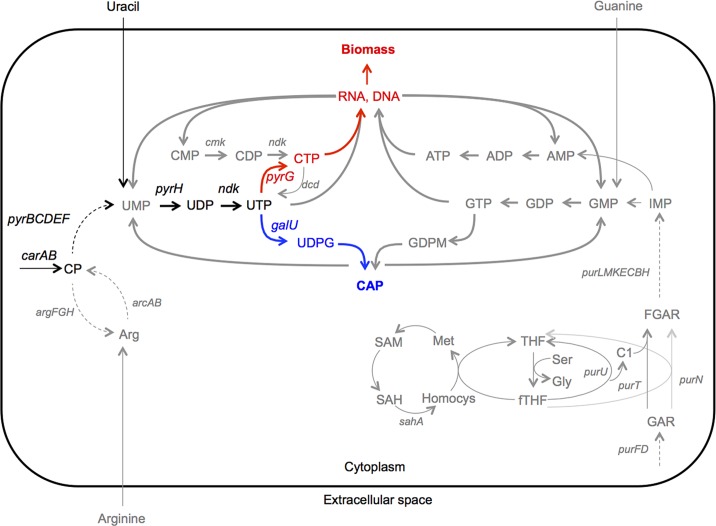
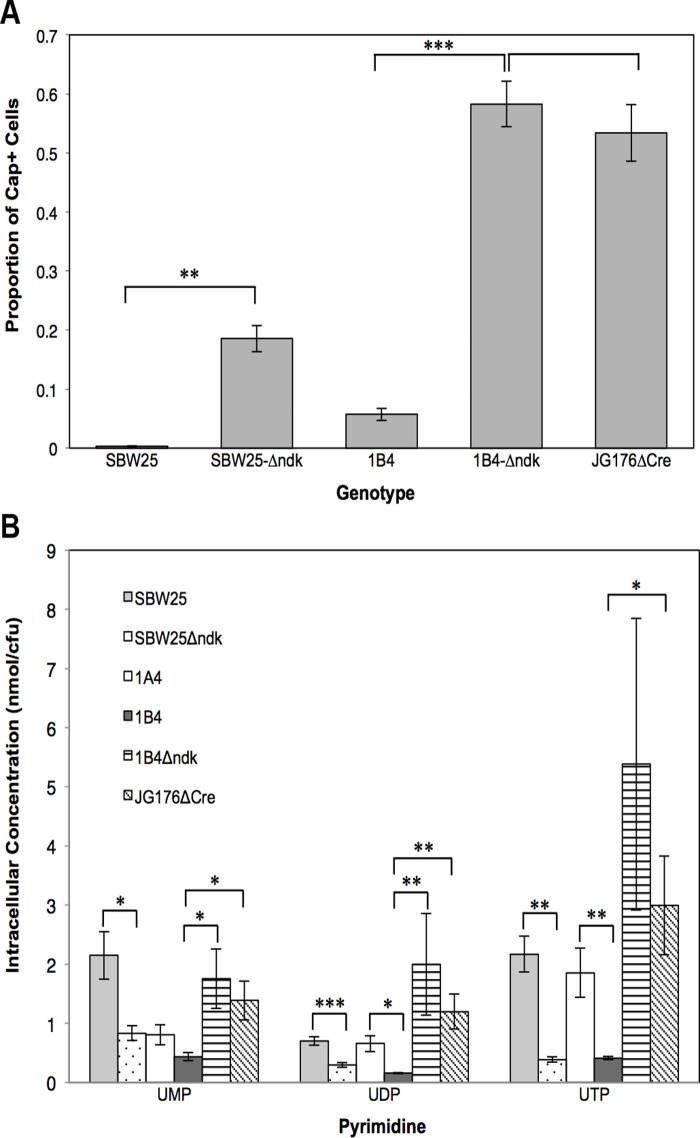
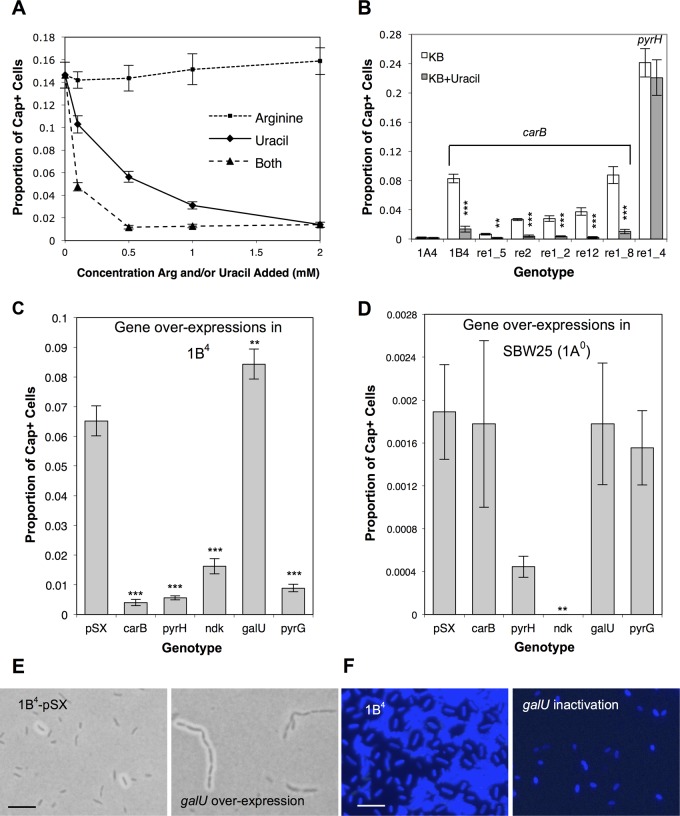
Phenotype switching is commonly observed in nature. This prevalence has allowed the elucidation of a number of underlying molecular mechanisms. However, little is known about how phenotypic switches arise and function in their early evolutionary stages. The first opportunity to provide empirical insight was delivered by an experiment in which populations of the bacterium Pseudomonas fluorescens SBW25 evolved, de novo, the ability to switch between two colony phenotypes. Here we unravel the molecular mechanism behind colony switching, revealing how a single nucleotide change in a gene enmeshed in central metabolism (carB) generates such a striking phenotype. We show that colony switching is underpinned by ON/OFF expression of capsules consisting of a colanic acid-like polymer. We use molecular genetics, biochemical analyses, and experimental evolution to establish that capsule switching results from perturbation of the pyrimidine biosynthetic pathway. Of central importance is a bifurcation point at which uracil triphosphate is partitioned towards either nucleotide metabolism or polymer production. This bifurcation marks a cell-fate decision point whereby cells with relatively high pyrimidine levels favour nucleotide metabolism (capsule OFF), while cells with lower pyrimidine levels divert resources towards polymer biosynthesis (capsule ON). This decision point is present and functional in the wild-type strain. Finally, we present a simple mathematical model demonstrating that the molecular components of the decision point are capable of producing switching. Despite its simple mutational cause, the connection between genotype and phenotype is complex and multidimensional, offering a rare glimpse of how noise in regulatory networks can provide opportunity for evolution.
表型转换在自然界中很常见。这种普遍性使得许多潜在的分子机制得以阐明。然而,对于表型转换在其早期进化阶段是如何产生和发挥作用的,人们知之甚少。第一个提供经验性见解的机会是通过一项实验提供的,在该实验中,荧光假单胞菌 SBW25 的种群新获得了在两种菌落表型之间切换的能力。在这里,我们揭示了菌落切换背后的分子机制,揭示了一个基因(carB)中单个核苷酸的变化如何产生如此显著的表型,该基因参与中心代谢。我们表明,菌落切换是由包含类似于菌胶的聚合物的胶囊的 ON/OFF 表达所支撑的。我们使用分子遗传学、生化分析和实验进化来建立,胶囊切换是由于嘧啶生物合成途径的干扰而产生的。至关重要的是一个分叉点,在该分叉点处尿嘧啶三磷酸被分配到核苷酸代谢或聚合物生产中。这个分叉标志着一个细胞命运决策点,其中嘧啶水平相对较高的细胞有利于核苷酸代谢(胶囊关闭),而嘧啶水平较低的细胞则将资源转移到聚合物生物合成(胶囊打开)。这个决策点在野生型菌株中存在且功能正常。最后,我们提出了一个简单的数学模型,表明决策点的分子成分能够产生切换。尽管其突变原因简单,但基因型和表型之间的联系是复杂和多维的,这为我们提供了一个难得的机会,可以了解调控网络中的噪声如何为进化提供机会。