Lai Keng Po, Li Jing-Woei, Wang Simon Yuan, Chiu Jill Man-Ying, Tse Anna, Lau Karen, Lok Si, Au Doris Wai-Ting, Tse William Ka-Fai, Wong Chris Kong-Chu, Chan Ting-Fung, Kong Richard Yuen-Chong, Wu Rudolf Shiu-Sun
School of Biological Sciences, Kadoorie Biological Sciences Building, The University of Hong Kong, Pokfulam Road, Hong Kong, SAR, China.
The State Key Laboratory in Marine Pollution, Hong Kong, China.
BMC Genomics. 2015 Feb 27;16(1):135. doi: 10.1186/s12864-015-1325-7.
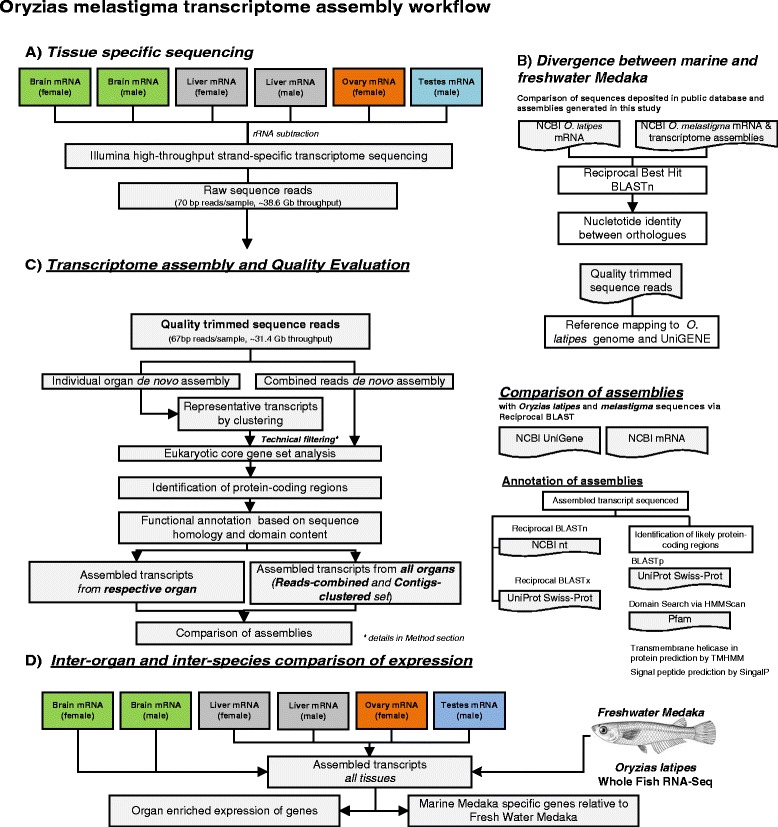
The marine medaka Oryzias melastigma has been demonstrated as a novel model for marine ecotoxicological studies. However, the lack of genome and transcriptome reference has largely restricted the use of O. melastigma in the assessment of in vivo molecular responses to environmental stresses and the analysis of biological toxicity in the marine environment. Although O. melastigma is believed to be phylogenetically closely related to Oryzias latipes, the divergence between these two species is still largely unknown. Using Illumina high-throughput RNA sequencing followed by de novo assembly and comprehensive gene annotation, we provided transcriptomic resources for the brain, liver, ovary and testis of O. melastigma. We also investigated the possible extent of divergence between O. melastigma and O. latipes at the transcriptome level.
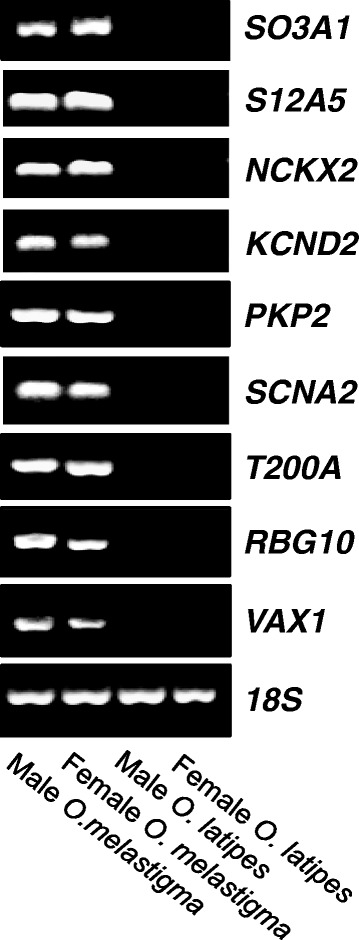
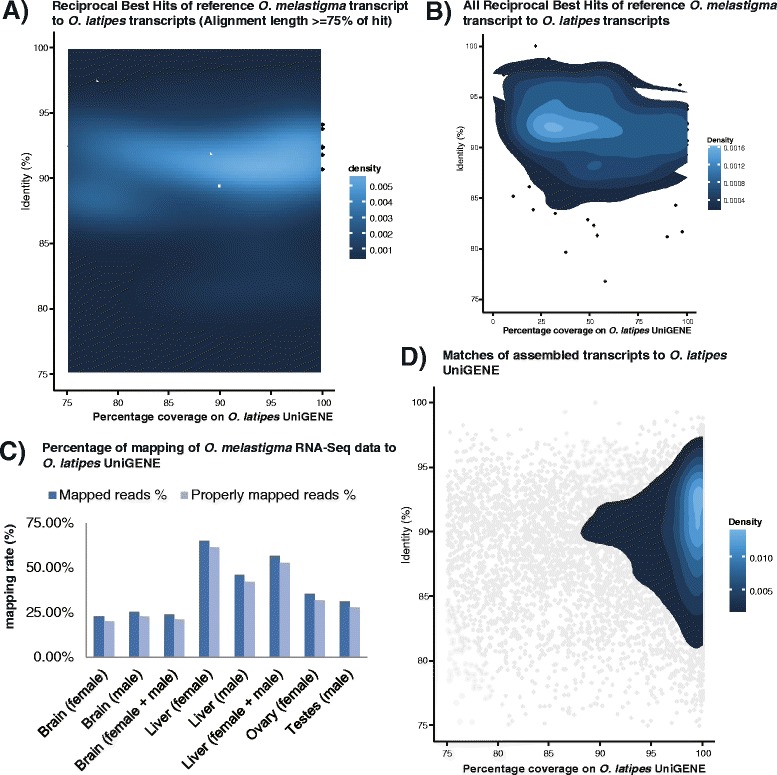
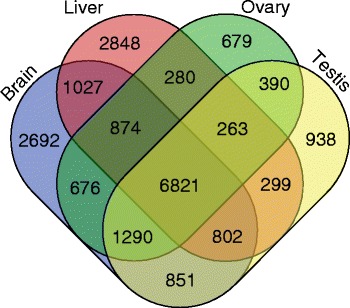
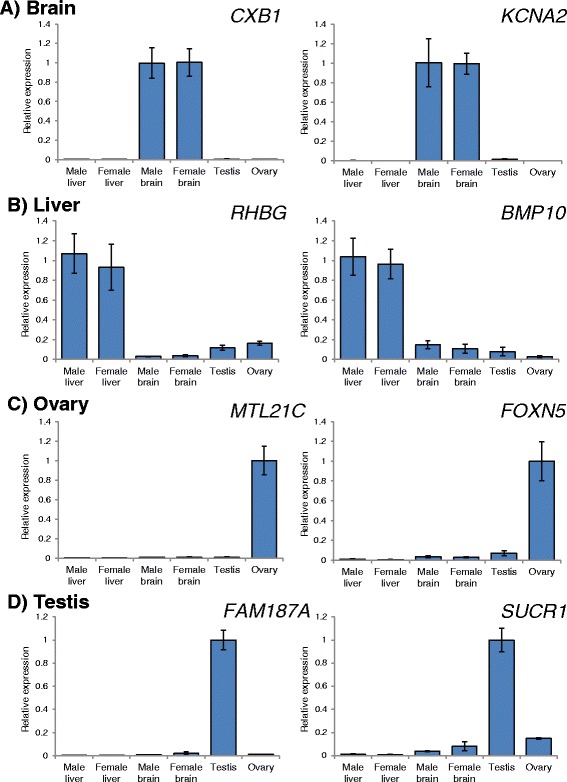
More than 14,000 transcripts across brain, liver, ovary and testis in marine medaka were annotated, of which 5880 transcripts were orthologous between O. melastigma and O. latipes. Tissue-enriched genes were identified in O. melastigma, and Gene Ontology analysis demonstrated the functional specificity of the annotated genes in respective tissue. Lastly, the identification of marine medaka-enriched transcripts suggested the necessity of generating transcriptome dataset of O. melastigma.
Orthologous transcripts between O. melastigma and O. latipes, tissue-enriched genes and O. melastigma-enriched transcripts were identified. Genome-wide expression studies of marine medaka require an assembled transcriptome, and this sequencing effort has generated a valuable resource of coding DNA for a non-model species. This transcriptome resource will aid future studies assessing in vivo molecular responses to environmental stresses and those analyzing biological toxicity in the marine environment.
海洋青鳉(Oryzias melastigma)已被证明是海洋生态毒理学研究的一种新型模式生物。然而,缺乏基因组和转录组参考极大地限制了海洋青鳉在评估体内对环境胁迫的分子反应以及分析海洋环境中生物毒性方面的应用。尽管人们认为海洋青鳉在系统发育上与青鳉(Oryzias latipes)密切相关,但这两个物种之间的差异仍 largely 未知。通过使用 Illumina 高通量 RNA 测序,随后进行从头组装和全面的基因注释,我们为海洋青鳉的脑、肝、卵巢和睾丸提供了转录组资源。我们还在转录组水平上研究了海洋青鳉和青鳉之间可能的差异程度。
在海洋青鳉的脑、肝、卵巢和睾丸中注释了超过 14000 个转录本,其中 5880 个转录本在海洋青鳉和青鳉之间是直系同源的。在海洋青鳉中鉴定出了组织富集基因,基因本体分析证明了注释基因在各自组织中的功能特异性。最后,海洋青鳉富集转录本的鉴定表明生成海洋青鳉转录组数据集的必要性。
鉴定出了海洋青鳉和青鳉之间的直系同源转录本、组织富集基因和海洋青鳉富集转录本。海洋青鳉的全基因组表达研究需要一个组装好的转录组,并且这项测序工作为一个非模式物种生成了有价值的编码 DNA 资源。这个转录组资源将有助于未来评估体内对环境胁迫的分子反应以及分析海洋环境中生物毒性的研究。