Department of Neurology, Changhai Hospital, Second Military Medical University of Chinese PLA, Shanghai 200433, China.
Department of Biochemistry & Genetics, the National Education Base for Basic Medical Sciences, Institute of Cell Biology, Zhejiang University School of Medicine, Hangzhou 310058, Zhejiang Province, China.
Neural Regen Res. 2012 Jan 15;7(2):96-100. doi: 10.3969/j.issn.1673-5374.2012.02.003.
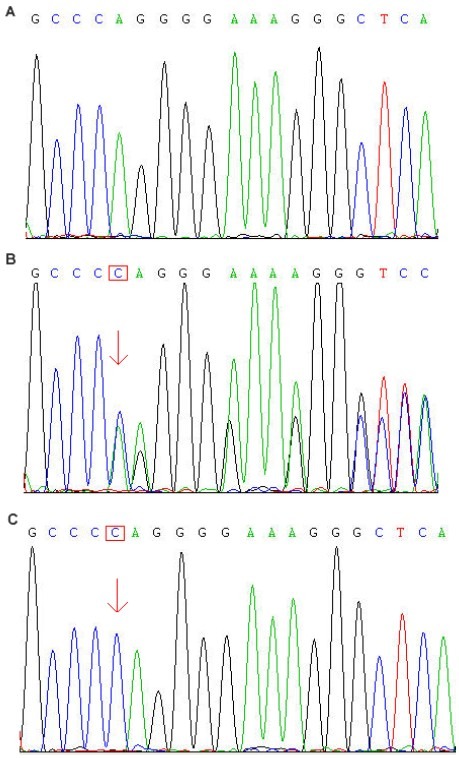
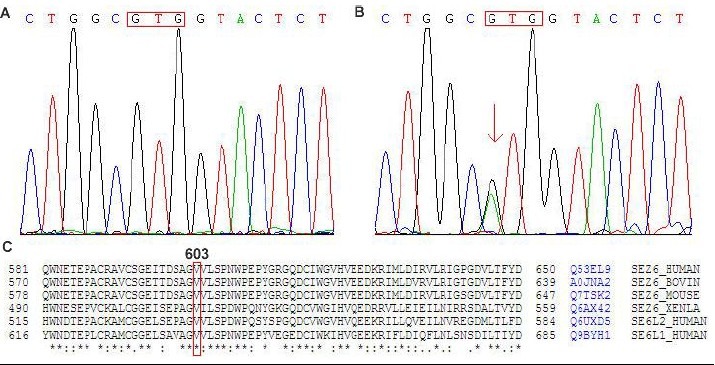
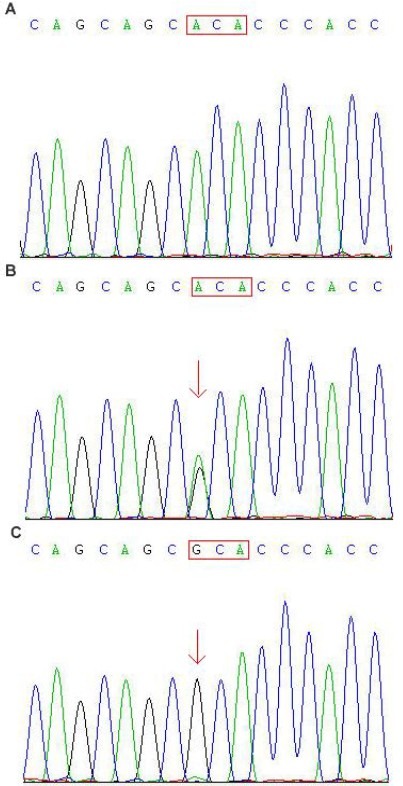
This study sought to analyze the genotype and gene mutations of human seizure-related gene 6 in 98 patients with idiopathic generalized epilepsy (non-febrile seizures), who were selected from three generations of the Chinese Han population living in Shanghai, Zhejiang Province, Wuxi of Jiangsu Province, and Jiangxi Province of Southern China. Twenty-six patients' parents were available as a first-degree relatives group and 100 biologically unrelated healthy controls were collected as the control group. Based on the age of onset and seizure type, the patients were divided into six subgroups. Polymerase chain reaction and DNA direct sequencing analysis showed that the most frequent mutations c.1249dupC (p.Gly418Argfx31) and c.1636A > G (p.Thr546Ala) were detected in some idiopathic generalized epilepsy patients and their asymptomatic first-degree relatives (30.6% vs. 19.2% and 11.2% vs. 26.9%). A novel mutation c.1807G > A (p.Val603Met) was found in a patient with late-onset idiopathic generalized epilepsy. There was no significant difference in the incidence of these three mutations among the different subgroups of idiopathic generalized epilepsy and controls. Thus, further analysis of a larger population is needed to confirm the assumption that human seizure-related gene 6 is a susceptibility gene for idiopathic generalized epilepsy with various sub-syndromes.
本研究旨在分析 98 例特发性全面性癫痫(非热性惊厥)患者中人类癫痫相关基因 6 的基因型和基因突变,这些患者均来自中国上海、浙江、江苏无锡和中国南方江西的三代汉族人群。26 例患者的父母作为一级亲属组,100 例无血缘关系的健康对照作为对照组。根据发病年龄和发作类型,将患者分为六组。聚合酶链反应和 DNA 直接测序分析显示,c.1249dupC(p.Gly418Argfx31)和 c.1636A>G(p.Thr546Ala)这两种最常见的突变在一些特发性全面性癫痫患者及其无症状一级亲属中均有检出(30.6%比 19.2%和 11.2%比 26.9%)。在一位晚发性特发性全面性癫痫患者中发现了一种新的突变 c.1807G>A(p.Val603Met)。这三种突变在特发性全面性癫痫的不同亚组和对照组中的发生率无显著差异。因此,需要进一步分析更大的人群以证实人类癫痫相关基因 6 是各种亚综合征特发性全面性癫痫的易感基因这一假设。