Santos Bruna Priscila Dos, Marinho Chiara Rachel Maciel, Marques Thalita Ewellyn Batista Sales, Angelo Layanne Kelly Gomes, Malta Maísa Vieira da Silva, Duzzioni Marcelo, Castro Olagide Wagner de, Leite João Pereira, Barbosa Fabiano Timbó, Gitaí Daniel Leite Góes
Department of Cellular and Molecular Biology, Institute of Biological Sciences and Health, Federal University of Alagoas, Maceio, Alagoas, Brazil.
Department of Pharmacology, Institute of Biological Sciences and Health, Federal University of Alagoas, Maceio, Alagoas, Brazil.
PLoS One. 2017 Jun 21;12(6):e0179629. doi: 10.1371/journal.pone.0179629. eCollection 2017.
Several genetic association investigations have been performed over the last three decades to identify variants underlying Juvenile Myoclonic Epilepsy (JME). Here, we evaluate the accumulating findings and provide an updated perspective of these studies.
A systematic literature search was conducted using the PubMed, Embase, Scopus, Lilacs, epiGAD, Google Scholar and Sigle up to February 12, 2016. The quality of the included studies was assessed by a score and classified as low and high quality. Beyond outcome measures, information was extracted on the setting for each study, characteristics of population samples and polymorphisms.
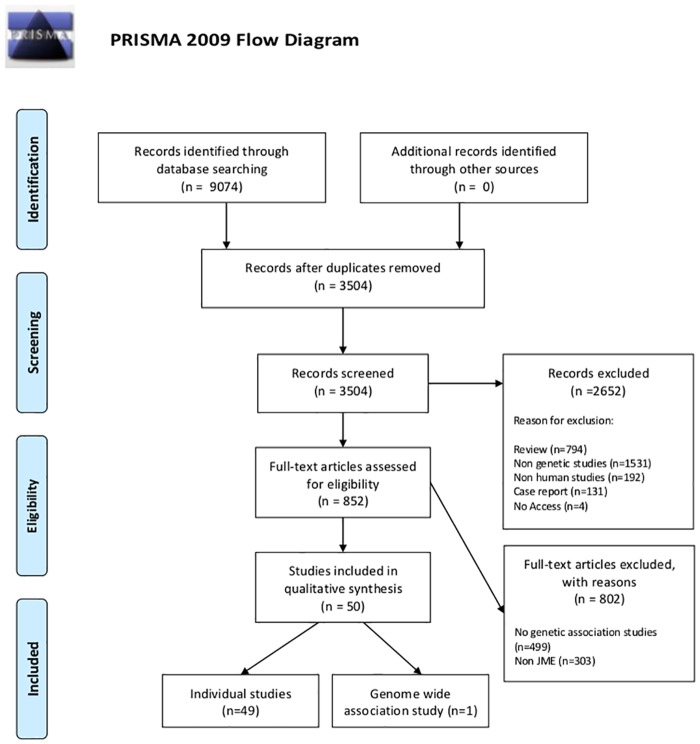
Fifty studies met eligibility criteria and were used for data extraction. With a single exception, all studies used a candidate gene approach, providing data on 229 polymorphisms in or near 55 different genes. Of variants investigating in independent data sets, only rs2029461 SNP in GRM4, rs3743123 in CX36 and rs3918149 in BRD2 showed a significant association with JME in at least two different background populations. The lack of consistent associations might be due to variations in experimental design and/or limitations of the approach.
Thus, despite intense research evidence established, specific genetic variants in JME susceptibility remain inconclusive. We discussed several issues that may compromise the quality of the results, including methodological bias, endophenotype and potential involvement of epigenetic factors.
CRD42016036063.
在过去三十年中,已经进行了多项基因关联研究,以确定青少年肌阵挛性癫痫(JME)潜在的变异基因。在此,我们评估了积累的研究结果,并提供了这些研究的最新观点。
使用PubMed、Embase、Scopus、Lilacs、epiGAD、谷歌学术和Sigle进行系统的文献检索,检索截至2016年2月12日的文献。通过评分评估纳入研究的质量,并将其分为低质量和高质量。除了结果测量外,还提取了每项研究的背景、人群样本特征和多态性信息。
五十项研究符合纳入标准并用于数据提取。除一项研究外,所有研究均采用候选基因方法,提供了55个不同基因中或其附近229个多态性的数据。在独立数据集中研究的变异中,只有GRM4基因中的rs2029461 SNP、CX36基因中的rs3743123和BRD2基因中的rs3918149在至少两个不同背景人群中显示出与JME有显著关联。缺乏一致的关联可能是由于实验设计的差异和/或方法的局限性。
因此,尽管有大量的研究证据,但JME易感性的特定基因变异仍无定论。我们讨论了几个可能影响结果质量的问题,包括方法学偏差、内表型和表观遗传因素的潜在影响。
PROSPERO注册号:CRD42016036063。