Cesa Claudia Ciceri, Barbiero Sandra Mari, Petkowicz Rosemary de Oliveira, Martins Carla Correa, Marques Renata das Virgens, Andreolla Allana Abreu Martins, Pellanda Lucia Campos
Instituto de Cardiologia, Fundacao Universitaria de Cardiologia, Avenida Princesa Isabel, 370, 3º andar, Porto Alegre, Rio Grande do Sul 90620-000, Brazil.
Instituto de Cardiologia, Fundacao Universitaria de Cardiologia, Avenida Princesa Isabel, 370, 3º andar, Porto Alegre, Rio Grande do Sul 90620-000, Brazil ; Universidade Federal de Ciencias da Saude de Porto Alegre, Avenida Osvaldo Aranha, 245, Porto Alegre, Rio Grande do Sul 90050-170, Brazil.
J Clin Med Res. 2015 May;7(5):348-55. doi: 10.14740/jocmr1700w. Epub 2015 Mar 1.
The aim of the current study was to test the effectiveness of a physical activity and exercise-based program in a clinical context to reduce cardiovascular risk factors in children and adolescents.
A randomized clinical trial was conducted in a pediatric preventive outpatient clinic. Intervention was 14 weeks of exercise for the intervention group or general health advice for the control group. The primary and the secondary outcomes were reduction of cardiovascular risk factors and the feasibility and the effectiveness of clinical advice plan to practice physical exercises at home.
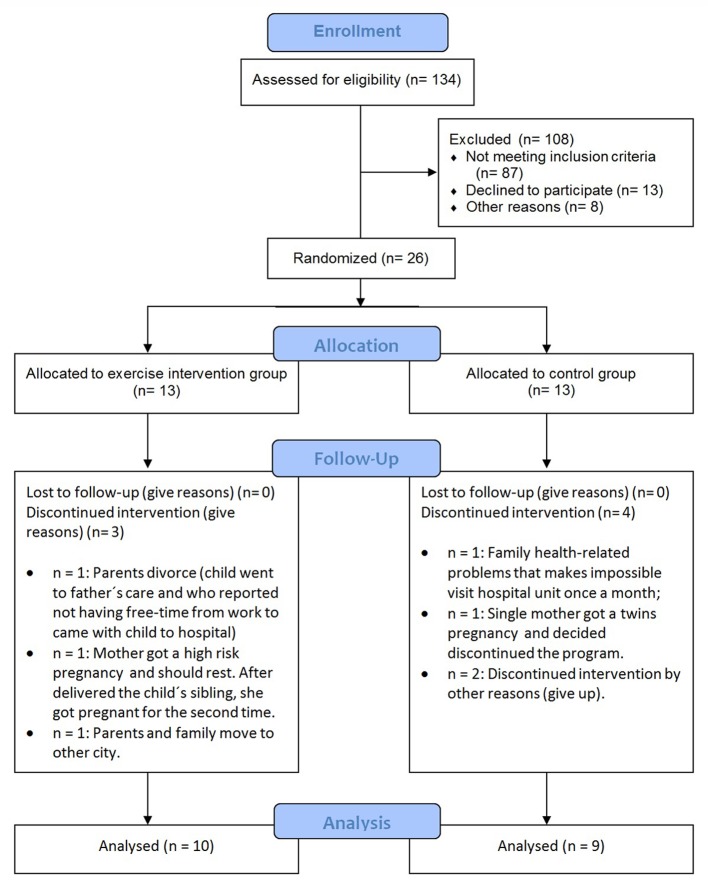
A total of 134 children were screened; 26 met eligibility criteria. Of these, 10 were allocated in the exercise intervention group and nine were included in the control group until the end of the intervention. Those patients who discontinued the intervention had the lowest scores of z-BMI (P = 0.033) and subscapular skin fold (P = 0.048). After 14 weeks of intervention, no statistical differences were found between the groups. High-density lipoprotein cholesterol (HDL-C) was higher in the exercise group, with a mild tendency to be significant (P = 0.066). Patients who adhere to treatment had diastolic blood pressure decreased from baseline to the end of the follow-up period in the control group (P = 0.013). Regardless of this result, the other comparisons within the group were not statistically different between T0 and T14.
A low-cost physical activity advice intervention presented many barriers for implementation in routine clinical care, limiting its feasibility and evaluation of effectiveness to reduce cardiovascular risk factors.
本研究的目的是在临床环境中测试一项基于体育活动和锻炼的项目对降低儿童和青少年心血管危险因素的有效性。
在一家儿科预防门诊进行了一项随机临床试验。干预措施为干预组进行14周的锻炼,对照组接受一般健康建议。主要和次要结局是心血管危险因素的降低以及在家进行体育锻炼的临床建议计划的可行性和有效性。
共筛查了134名儿童;26名符合入选标准。其中,10名被分配到运动干预组,9名被纳入对照组直至干预结束。那些中断干预的患者的z体重指数(P = 0.033)和肩胛下皮褶厚度(P = 0.048)得分最低。干预14周后,两组之间未发现统计学差异。运动组的高密度脂蛋白胆固醇(HDL-C)较高,有轻微的显著趋势(P = 0.066)。在对照组中,坚持治疗的患者从基线到随访期末舒张压下降(P = 0.013)。尽管有此结果,但组内其他比较在T0和T14之间无统计学差异。
一项低成本的体育活动建议干预在常规临床护理中实施存在许多障碍,限制了其降低心血管危险因素的可行性和有效性评估。