Hilderink Janneke, Spijker Siebe, Carlotti Françoise, Lange Lydia, Engelse Marten, van Blitterswijk Clemens, de Koning Eelco, Karperien Marcel, van Apeldoorn Aart
Department of Developmental Bioengineering, University of Twente, Enschede, The Netherlands.
Department of Nephrology, Leiden University Medical Center, Leiden, The Netherlands.
J Cell Mol Med. 2015 Aug;19(8):1836-46. doi: 10.1111/jcmm.12555. Epub 2015 Mar 17.
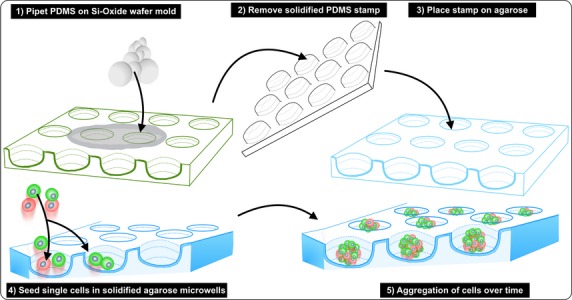
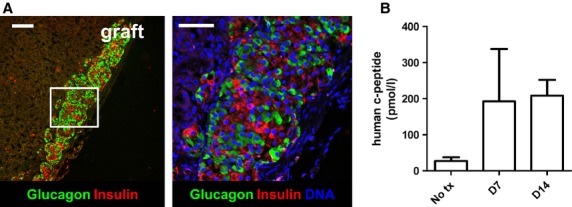
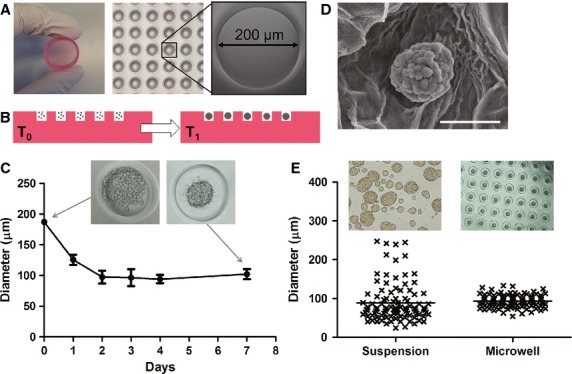
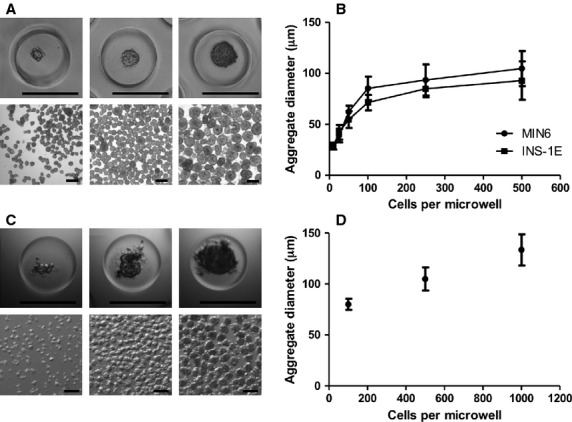
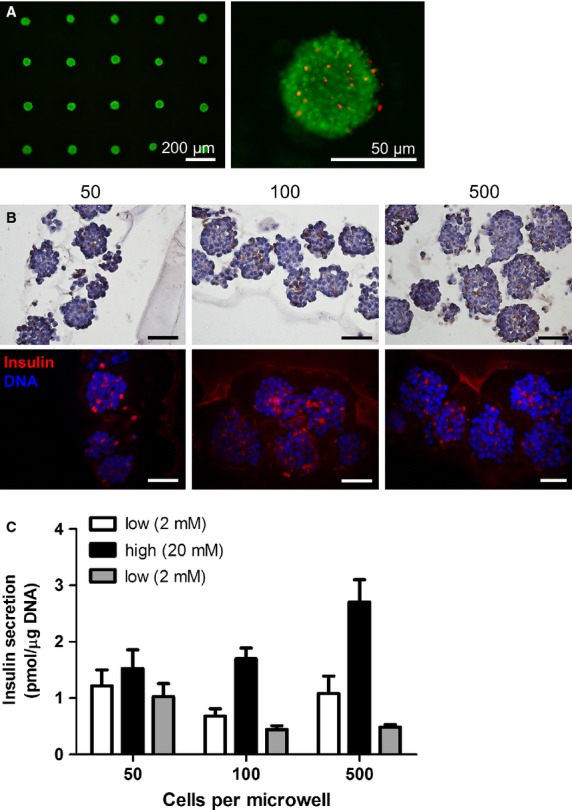
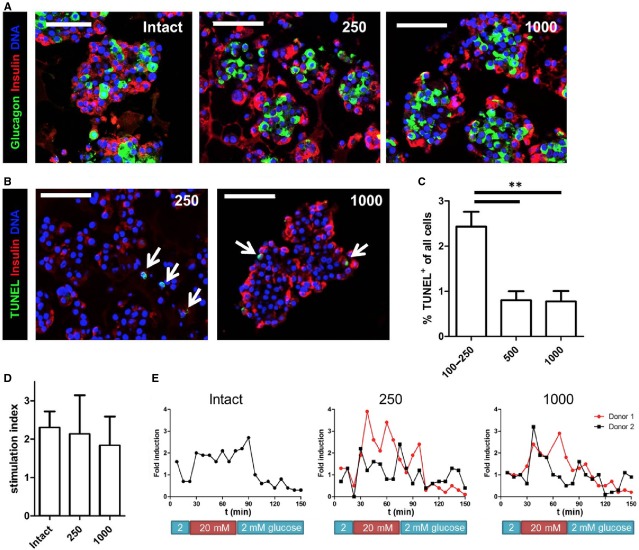
Clinical islet transplantation is a promising treatment for patients with type 1 diabetes. However, pancreatic islets vary in size and shape affecting their survival and function after transplantation because of mass transport limitations. To reduce diffusion restrictions and improve islet cell survival, the generation of islets with optimal dimensions by dispersion followed by reassembly of islet cells, can help limit the length of diffusion pathways. This study describes a microwell platform that supports the controlled and reproducible production of three-dimensional pancreatic cell clusters of human donor islets. We observed that primary human islet cell aggregates with a diameter of 100-150 μm consisting of about 1000 cells best resembled intact pancreatic islets as they showed low apoptotic cell death (<2%), comparable glucose-responsiveness and increasing PDX1, MAFA and INSULIN gene expression with increasing aggregate size. The re-associated human islet cells showed an a-typical core shell configuration with beta cells predominantly on the outside unlike human islets, which became more randomized after implantation similar to native human islets. After transplantation of these islet cell aggregates under the kidney capsule of immunodeficient mice, human C-peptide was detected in the serum indicating that beta cells retained their endocrine function similar to human islets. The agarose microwell platform was shown to be an easy and very reproducible method to aggregate pancreatic islet cells with high accuracy providing a reliable tool to study cell-cell interactions between insuloma and/or primary islet cells.
临床胰岛移植是1型糖尿病患者一种有前景的治疗方法。然而,由于传质限制,胰岛的大小和形状各不相同,这会影响其移植后的存活和功能。为了减少扩散限制并提高胰岛细胞的存活率,通过分散胰岛细胞然后重新组装来生成具有最佳尺寸的胰岛,有助于限制扩散途径的长度。本研究描述了一种微孔平台,该平台支持可控且可重复地生产人供体胰岛的三维胰腺细胞簇。我们观察到,直径为100 - 150μm、由约1000个细胞组成的原代人胰岛细胞聚集体与完整的胰腺胰岛最为相似,因为它们显示出低凋亡细胞死亡(<2%)、可比的葡萄糖反应性,并且随着聚集体大小的增加,PDX1、MAFA和胰岛素基因表达增加。重新组装的人胰岛细胞呈现出一种非典型的核壳结构,与人类胰岛不同,β细胞主要位于外部,植入后变得更加随机,类似于天然人类胰岛。将这些胰岛细胞聚集体移植到免疫缺陷小鼠的肾包膜下后,在血清中检测到了人C肽,这表明β细胞保留了与人类胰岛相似的内分泌功能。琼脂糖微孔平台被证明是一种简单且非常可重复的方法,能够高精度地聚集胰岛细胞,为研究胰岛瘤和/或原代胰岛细胞之间的细胞间相互作用提供了可靠的工具。