Guan Ge Ge, Wang Wen Bo, Lei Bing Xin, Wang Qiao Li, Wu Lin, Fu Zhen Ming, Zhou Fu Xiang, Zhou Yun Feng
Hubei Key Laboratory of Tumor Biological Behaviors, Hubei Cancer Clinical Study Center, Wuhan University, Wuhan, Hubei 430071, P.R. China.
Hubei Key Laboratory of Tumor Biological Behaviors, Hubei Cancer Clinical Study Center, Wuhan University, Wuhan, Hubei 430071, P.R. China ; Department of Radiation and Medical Oncology, Zhongnan Hospital, Wuhan University, Wuhan, Hubei 430071, P.R. China.
Oncol Lett. 2015 Apr;9(4):1567-1574. doi: 10.3892/ol.2015.2926. Epub 2015 Feb 3.
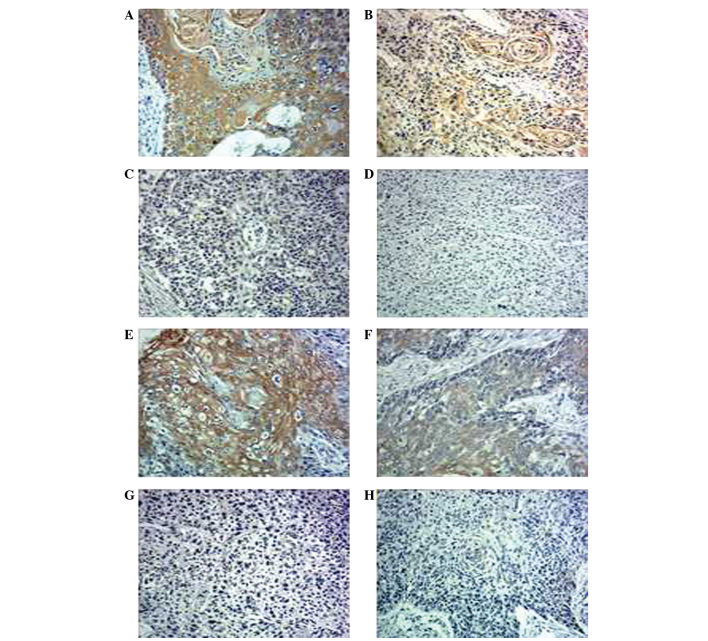
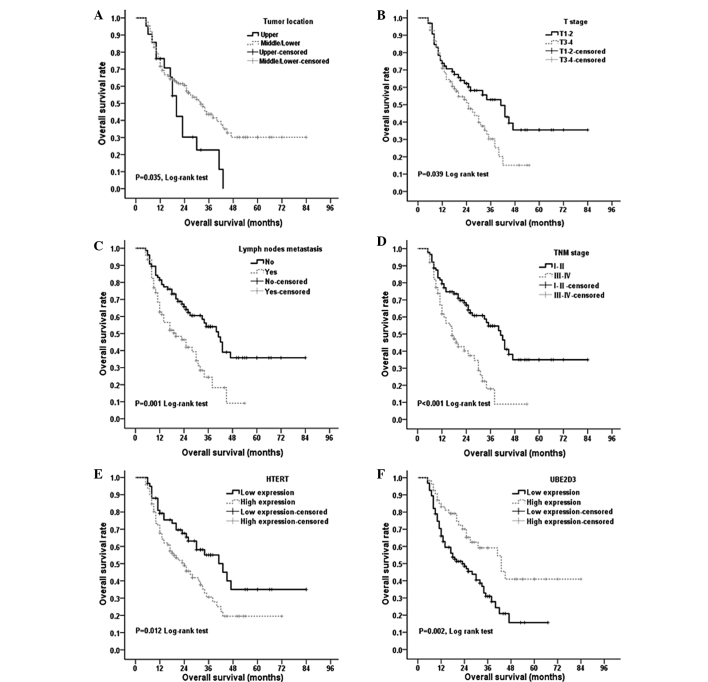
Human telomerase reverse transcriptase (hTERT) is a critical factor in unlimited cell proliferation and immortalization, with numerous studies demonstrating that high expression of hTERT is a poor prognostic factor in various types of cancer. Ubiquitin-conjugating enzyme E2D 3 (UBE2D3) is a member of the E2 family, and participates in the ubiquitin proteasome pathway to regulate basic cellular activities, such as cell cycle control, the DNA damage response, apoptosis, and tumorigenesis. Our previous study initially determined that downregulation of UBE2D3 expression increases hTERT expression and cell proliferation, however, the association between the expression of these two proteins and their functions in cancer tissues remains unknown. Therefore, the protein expression levels of hTERT and UBE2D3 were evaluated in 150 esophageal cancer and 30 adjacent healthy tissue samples by performing immunohistochemical analysis. Concurrently, the clinicopathological data of the enrolled patients were obtained to allow correlation analysis. It was identified that the expression of hTERT in the esophageal cancer tissues was significantly higher compared with that of the adjacent tissues (P=0.015), however, the expression of UBE2D3 was significantly lower in esophageal cancer tissues than the adjacent tissues (P=0.001). Additionally, the study demonstrated that hTERT was significantly upregulated in poorly-differentiated, advanced tumor-node-metastasis (TNM) stage cancer tissues (P<0.05 for all), however, UBE2D3 expression was downregulated in poorly-differentiated, lymph node invaded cancer tissues and recurrent cases. It was also identified that traditional factors, including tumor location, T stage, lymph node status, TNM stage, and molecular factors of hTERT and UBE2D3, were significantly associated with overall survival time (P<0.05 for all). Furthermore, UBE2D3, lymph node status and tumor location were independent prognostic factors for esophageal cancer in multivariate analysis. Most notably, hTERT and UBE2D3 expression were negatively correlated with each other. In conclusion, the findings of the present study indicated that hTERT and UBE2D3 proteins appear to be involved in the development of esophageal cancer, that UBE2D3 may a positive prognostic factor for esophageal cancer, and that UBE2D3 and hTERT expression levels are inversely correlated.
人端粒酶逆转录酶(hTERT)是细胞无限增殖和永生化的关键因素,众多研究表明hTERT高表达是各类癌症预后不良的因素。泛素结合酶E2D 3(UBE2D3)是E2家族成员,参与泛素蛋白酶体途径以调控基本细胞活动,如细胞周期控制、DNA损伤反应、细胞凋亡和肿瘤发生。我们之前的研究初步确定UBE2D3表达下调会增加hTERT表达和细胞增殖,然而,这两种蛋白在癌组织中的表达及其功能之间的关联尚不清楚。因此,通过免疫组化分析评估了150例食管癌组织和30例相邻健康组织样本中hTERT和UBE2D3的蛋白表达水平。同时,获取了入组患者的临床病理数据以进行相关性分析。结果发现,食管癌组织中hTERT的表达显著高于相邻组织(P = 0.015),然而,UBE2D3在食管癌组织中的表达显著低于相邻组织(P = 0.001)。此外,研究表明hTERT在低分化、晚期肿瘤-淋巴结-转移(TNM)分期的癌组织中显著上调(所有P均<0.05),然而,UBE2D3表达在低分化、有淋巴结侵犯的癌组织和复发病例中下调。还发现传统因素,包括肿瘤位置、T分期、淋巴结状态、TNM分期以及hTERT和UBE2D3的分子因素,均与总生存时间显著相关(所有P均<0.05)。此外,在多因素分析中,UBE2D3、淋巴结状态和肿瘤位置是食管癌的独立预后因素。最值得注意的是,hTERT和UBE2D3表达呈负相关。总之,本研究结果表明hTERT和UBE2D3蛋白似乎参与了食管癌的发生发展,UBE2D3可能是食管癌的一个阳性预后因素,且UBE2D3和hTERT表达水平呈负相关。