Zhang Yurong, Hu Gang, Zhang Lu, Mayo Rachel, Chen Liwei
The First Affiliated Hospital of Medical School, Xi'an Jiaotong University, Xi'an, Shaanxi, China.
Pennington Biomedical Research Center, Baton Rouge, LA, United States of America.
PLoS One. 2015 Mar 19;10(3):e0120382. doi: 10.1371/journal.pone.0120382. eCollection 2015.
The study aim was to evaluate the performance of a novel simultaneous testing model, based on the Finnish Diabetes Risk Score (FINDRISC) and HbA1c, in detecting undiagnosed diabetes and pre-diabetes in Americans.
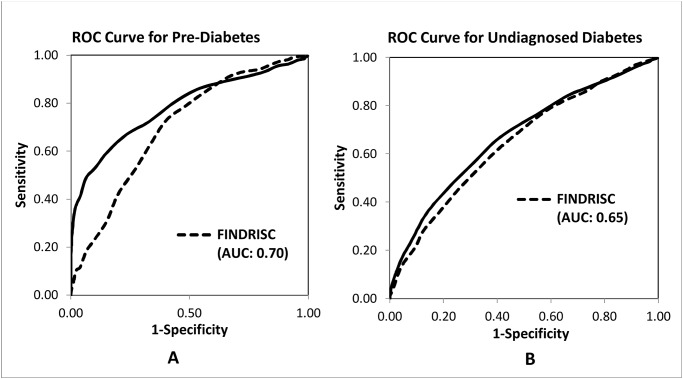
This cross-sectional analysis included 3,886 men and women (≥ 20 years) without known diabetes from the U.S. National Health and Nutrition Examination Survey (NHANES) 2005-2010. The FINDRISC was developed based on eight variables (age, BMI, waist circumference, use of antihypertensive drug, history of high blood glucose, family history of diabetes, daily physical activity and fruit & vegetable intake). The sensitivity, specificity, and the receiver operating characteristic (ROC) curve of the testing model were calculated for undiagnosed diabetes and pre-diabetes, determined by oral glucose tolerance test (OGTT).
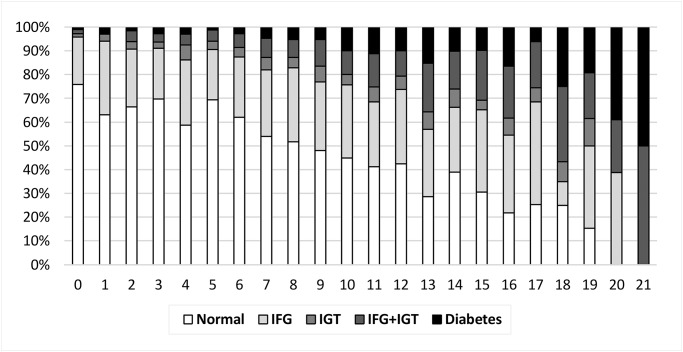
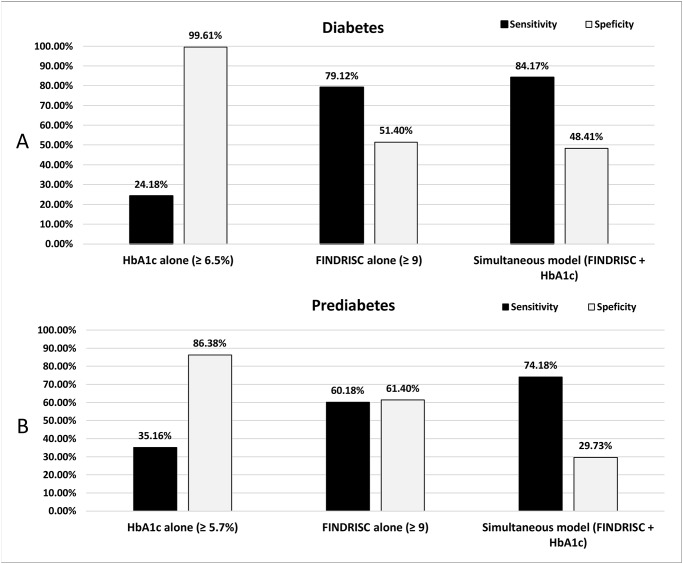
The prevalence of undiagnosed diabetes was 7.0% and 43.1% for pre-diabetes (27.7% for isolated impaired fasting glucose (IFG), 5.1% for impaired glucose tolerance (IGT), and 10.3% for having both IFG and IGT). The sensitivity and specificity of using the HbA1c alone was 24.2% and 99.6% for diabetes (cutoff of ≥6.5%), and 35.2% and 86.4% for pre-diabetes (cutoff of ≥5.7%). The sensitivity and specificity of using the FINDRISC alone (cutoff of ≥9) was 79.1% and 48.6% for diabetes and 60.2% and 61.4% for pre-diabetes. Using the simultaneous testing model with a combination of FINDRISC and HbA1c improved the sensitivity to 84.2% for diabetes and 74.2% for pre-diabetes. The specificity for the simultaneous testing model was 48.4% of diabetes and 53.0% for pre-diabetes.
This simultaneous testing model is a practical and valid tool in diabetes screening in the general U.S. population.
本研究旨在评估一种基于芬兰糖尿病风险评分(FINDRISC)和糖化血红蛋白(HbA1c)的新型联合检测模型在美国人群中检测未诊断糖尿病和糖尿病前期的性能。
这项横断面分析纳入了2005 - 2010年美国国家健康与营养检查调查(NHANES)中3886名年龄≥20岁且无糖尿病史的男性和女性。FINDRISC基于八个变量(年龄、体重指数、腰围、降压药使用情况、高血糖病史、糖尿病家族史、日常身体活动以及水果和蔬菜摄入量)开发。通过口服葡萄糖耐量试验(OGTT)确定未诊断糖尿病和糖尿病前期,计算检测模型的敏感性、特异性以及受试者工作特征(ROC)曲线。
未诊断糖尿病的患病率为7.0%,糖尿病前期为43.1%(单纯空腹血糖受损(IFG)为27.7%,糖耐量受损(IGT)为5.1%,同时存在IFG和IGT为10.3%)。单独使用HbA1c检测糖尿病的敏感性和特异性分别为24.2%和99.6%(临界值≥6.5%),检测糖尿病前期的敏感性和特异性分别为35.2%和86.4%(临界值≥5.7%)。单独使用FINDRISC(临界值≥9)检测糖尿病的敏感性和特异性分别为79.1%和48.6%,检测糖尿病前期的敏感性和特异性分别为60.2%和61.4%。使用FINDRISC和HbA1c联合检测模型可将糖尿病的敏感性提高到84.2%,糖尿病前期提高到74.2%。联合检测模型检测糖尿病的特异性为48.4%,糖尿病前期为53.0%。
这种联合检测模型是美国普通人群糖尿病筛查的一种实用且有效的工具。