Paschou Stavroula A, Ioannidis Dimitrios, Vassilatou Evangeline, Mizamtsidi Maria, Panagou Maria, Lilis Dimitrios, Tzavara Ioanna, Vryonidou Andromachi
Department of Endocrinology and Diabetes, Hellenic Red Cross Hospital, Athens, Greece.
Department of Endocrinology and Diabetes, "Amalia Fleming" Hospital, Athens, Greece.
PLoS One. 2015 Mar 19;10(3):e0122050. doi: 10.1371/journal.pone.0122050. eCollection 2015.
Several studies have demonstrated associations of birth weight with metabolic and reproductive abnormalities in adults. The aim of this study was to investigate the birth weight in women with PCOS and its correlation with clinical and biochemical characteristics of the syndrome.
We studied 288 women with PCOS according to the NIH criteria and 166 women with normal cycle and without clinical hyperandrogenism. Birth weight and anthropometric characteristics were recorded, and levels of serum androgens, SHBG, insulin and fasting glucose were measured.
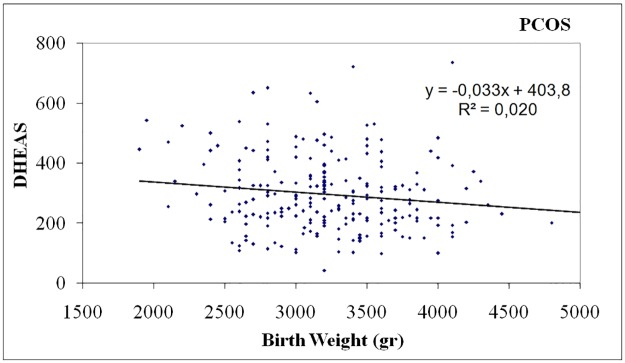
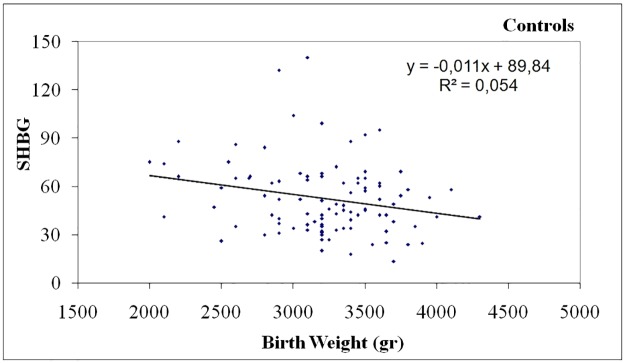
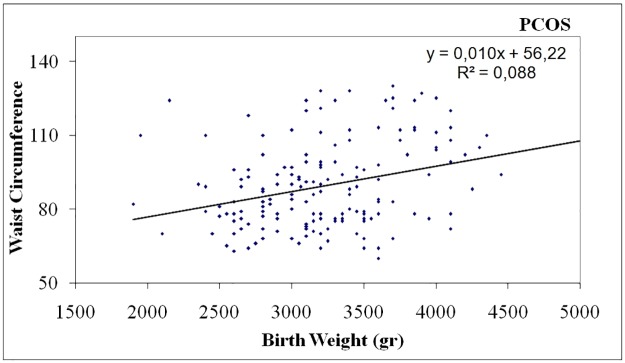
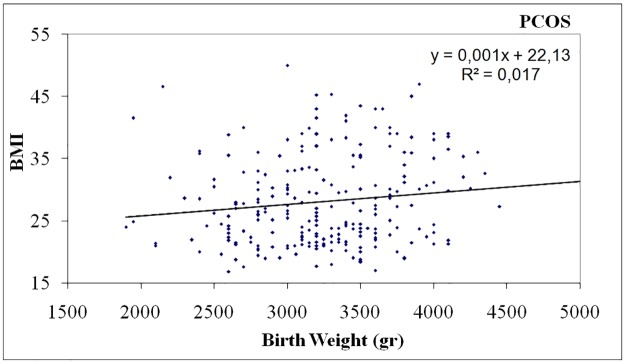
Birth weight data were available for 243/288 women with PCOS and age- and BMI-matched 101/166 controls. No differences were found (p> 0.05) in birth weight among women with PCOS and normal controls. Birth weight of PCOS women was negatively correlated with DHEAS levels (p = 0.031, r = -0.143) and positively correlated with waist circumference (p <0.001, r = 0.297) and body mass index (BMI) (p = 0.040, r = 0.132). Birth weight of controls was negatively correlated with SHBG levels (p = 0.021, r = -0.234). Women from both groups were further divided in 6 categories according to birth weight (A. <2.500 gr, B. 2.501-3.000 gr, C. 3.001-3.500 gr, D. 3.501-4.000 gr, E. 4.001-4.500 gr, F. > 4.500 gr). No statistically significant differences were observed in the distribution percentages between PCOS women and controls. (A. 7% vs 7.9%, B. 26.8% vs 20.8%, C. 39.1% vs 48.5%, D. 21.4% vs 20.8%, E. 4.9% vs 2%, F. 0.8% vs 0%), (in all comparisons, p> 0.05).
Women with PCOS do not differ from controls in birth weight distribution. However, birth weight may contribute to subtypes of the syndrome that are characterized by adrenal hyperandrogenism and central obesity.
多项研究表明出生体重与成年人的代谢及生殖异常有关。本研究旨在调查多囊卵巢综合征(PCOS)女性的出生体重及其与该综合征临床和生化特征的相关性。
我们根据美国国立卫生研究院(NIH)标准研究了288例PCOS女性以及166例月经周期正常且无临床高雄激素血症的女性。记录出生体重和人体测量特征,并测量血清雄激素、性激素结合球蛋白(SHBG)、胰岛素和空腹血糖水平。
获得了243/288例PCOS女性以及年龄和体重指数(BMI)匹配的101/166例对照的出生体重数据。PCOS女性与正常对照之间的出生体重未发现差异(p>0.05)。PCOS女性的出生体重与硫酸脱氢表雄酮(DHEAS)水平呈负相关(p = 0.031,r = -0.143),与腰围呈正相关(p <0.001,r = 0.297),与体重指数(BMI)呈正相关(p = 0.040,r = 0.132)。对照的出生体重与SHBG水平呈负相关(p = 0.021,r = -0.234)。两组女性根据出生体重进一步分为6类(A. <2500克,B. 2501 - 3000克,C. 3001 - 3500克,D. 3501 - 4000克,E. 4001 - 4500克,F. > 4500克)。PCOS女性与对照之间的分布百分比未观察到统计学显著差异。(A. 7% 对7.9%,B. 26.8% 对20.8%,C. 39.1% 对48.5%,D. 21.4% 对20.8%,E. 4.9% 对2%,F. 0.8% 对0%),(在所有比较中,p>0.05)。
PCOS女性在出生体重分布上与对照无差异。然而,出生体重可能与以肾上腺高雄激素血症和中心性肥胖为特征的综合征亚型有关。