Lagman Minette, Ly Judy, Saing Tommy, Kaur Singh Manpreet, Vera Tudela Enrique, Morris Devin, Chi Po-Ting, Ochoa Cesar, Sathananthan Airani, Venketaraman Vishwanath
Graduate College of Biomedical Sciences, Western University of Health Sciences, Pomona, California, United States of America; Department of Basic Medical Sciences, College of Osteopathic Medicine of the Pacific, Western University of Health Sciences, Pomona, California, United States of America.
Department of Basic Medical Sciences, College of Osteopathic Medicine of the Pacific, Western University of Health Sciences, Pomona, California, United States of America.
PLoS One. 2015 Mar 19;10(3):e0118436. doi: 10.1371/journal.pone.0118436. eCollection 2015.
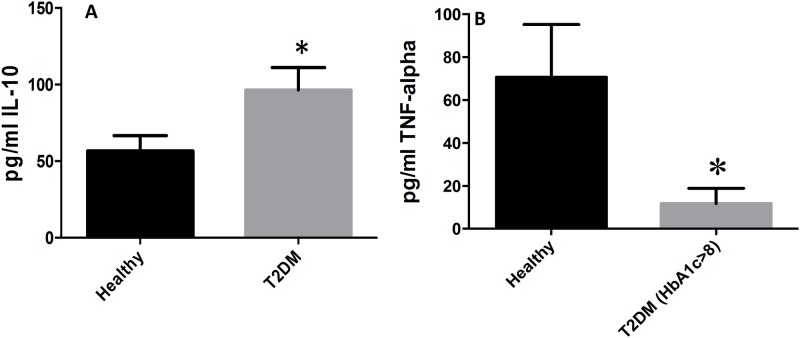
Tuberculosis (TB) remains an eminent global burden with one third of the world's population latently infected with Mycobacterium tuberculosis (M. tb). Individuals with compromised immune systems are especially vulnerable to M. tb infection. In fact, individuals with Type 2 Diabetes Mellitus (T2DM) are two to three times more susceptible to TB than those without T2DM. In this study, we report that individuals with T2DM have lower levels of glutathione (GSH) due to compromised levels of GSH synthesis and metabolism enzymes. Transforming growth factor beta (TGF-β), a cytokine that is known to decrease the expression of the catalytic subunit of glutamine-cysteine ligase (GCLC) was found in increased levels in the plasma samples from individuals with T2DM, explaining the possible underlying mechanism that is responsible for decreased levels of GSH in individuals with T2DM. Moreover, increased levels of pro-inflammatory cytokines such as interleukin-6 (IL-6) and interleukin-17 (IL-17) were observed in plasma samples isolated from individuals with T2DM. Increased levels of IL-6 and IL-17 was accompanied by enhanced production of free radicals further indicating an alternative mechanism for the decreased levels of GSH in individuals with T2DM. Augmenting the levels of GSH in macrophages isolated from individuals with T2DM resulted in improved control of M. tb infection. Furthermore, cytokines that are responsible for controlling M. tb infection at the cellular and granuloma level such as tumor necrosis factor alpha (TNF-α), interleukin-1β (IL-1β), interleukin-2 (IL-2), interferon-gamma (IFN-γ), and interleukin-12 (IL-12), were found to be compromised in plasma samples isolated from individuals with T2DM. On the other hand, interleukin-10 (IL-10), an immunosuppressive cytokine was increased in plasma samples isolated from individuals with T2DM. Overall, these findings suggest that lower levels of GSH in individuals with T2DM lead to their increased susceptibility to M. tb infection.
结核病(TB)仍是一项严峻的全球负担,全球三分之一的人口潜伏感染结核分枝杆菌(M. tb)。免疫系统受损的个体尤其易受M. tb感染。事实上,2型糖尿病(T2DM)患者感染TB的易感性是未患T2DM者的两到三倍。在本研究中,我们报告称,T2DM患者由于谷胱甘肽(GSH)合成和代谢酶水平受损,其GSH水平较低。转化生长因子β(TGF-β)是一种已知会降低谷氨酰胺-半胱氨酸连接酶(GCLC)催化亚基表达的细胞因子,在T2DM患者的血浆样本中发现其水平升高,这解释了T2DM患者GSH水平降低的潜在机制。此外,在从T2DM患者分离的血浆样本中观察到促炎细胞因子如白细胞介素-6(IL-6)和白细胞介素-17(IL-17)水平升高。IL-6和IL-17水平升高伴随着自由基产生增加,进一步表明T2DM患者GSH水平降低的另一种机制。提高从T2DM患者分离的巨噬细胞中的GSH水平可改善对M. tb感染的控制。此外,在从T2DM患者分离的血浆样本中发现,在细胞和肉芽肿水平控制M. tb感染的细胞因子如肿瘤坏死因子α(TNF-α)、白细胞介素-1β(IL-1β)、白细胞介素-2(IL-2)、干扰素-γ(IFN-γ)和白细胞介素-12(IL-12)受损。另一方面,免疫抑制细胞因子白细胞介素-10(IL-10)在从T2DM患者分离的血浆样本中升高。总体而言,这些发现表明T2DM患者较低的GSH水平导致其对M. tb感染易感性增加。