Bhandari Ramji K, vom Saal Frederick S, Tillitt Donald E
1] U. S. Geological Survey, Columbia Environmental Research Center, Columbia, MO 65201, U.S.A [2] Division of Biological Sciences, University of Missouri, Columbia, MO 65211.
Division of Biological Sciences, University of Missouri, Columbia, MO 65211.
Sci Rep. 2015 Mar 20;5:9303. doi: 10.1038/srep09303.
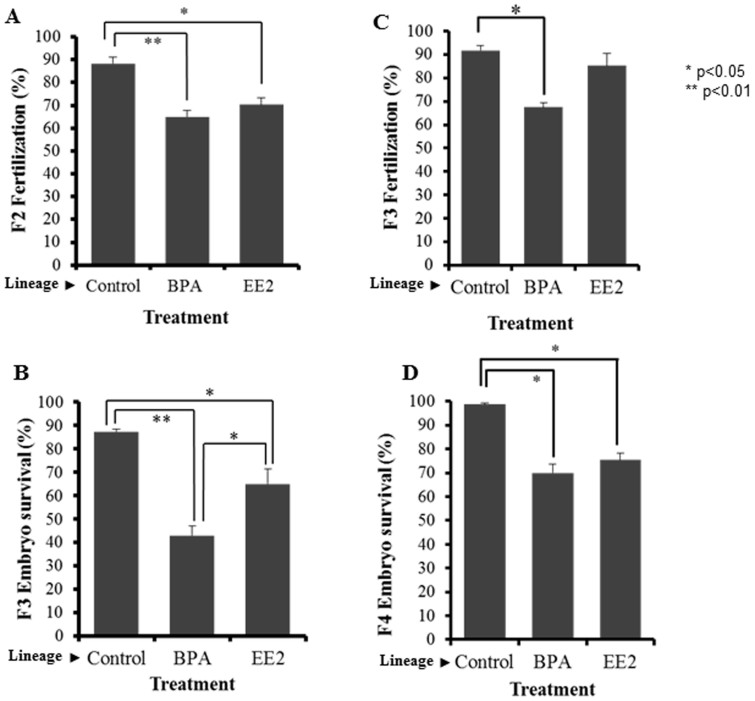
The transgenerational consequences of environmental contaminant exposures of aquatic vertebrates have the potential for broad ecological impacts, yet are largely uninvestigated. Bisphenol A (BPA) and 17α-ethinylestradiol (EE2) are two ubiquitous estrogenic chemicals present in aquatic environments throughout the United States and many other countries. Aquatic organisms, including fish, are exposed to varying concentrations of these chemicals at various stages of their life history. Here, we tested the ability of embryonic exposure to BPA or EE2 to cause adverse health outcomes at later life stages and transgenerational abnormalities in medaka fish. Exposures of F0 medaka to either BPA (100 μg/L) or EE2 (0.05 μg/L) during the first 7 days of embryonic development, when germ cells are differentiating, did not cause any apparent phenotypic abnormalities in F0 or F1 generations, but led to a significant reduction in the fertilization rate in offspring two generations later (F2) as well as a reduction of embryo survival in offspring three generations later (F3). Our present observations suggest that BPA or EE2 exposure during development induces transgenerational phenotypes of reproductive impairment and compromised embryonic survival in fish of subsequent generations. These adverse outcomes may have negative impacts on populations of fish inhabiting contaminated aquatic environments.
水生脊椎动物接触环境污染物的跨代影响可能会产生广泛的生态影响,但目前在很大程度上尚未得到研究。双酚A(BPA)和17α-乙炔雌二醇(EE2)是在美国和许多其他国家的水生环境中普遍存在的两种雌激素类化学物质。包括鱼类在内的水生生物在其生命史的各个阶段都会接触到不同浓度的这些化学物质。在此,我们测试了胚胎期接触BPA或EE2是否会在青鳉鱼的后期生命阶段导致不良健康后果以及跨代异常。在胚胎发育的前7天(此时生殖细胞正在分化),将F0代青鳉暴露于BPA(100μg/L)或EE2(0.05μg/L)中,并未在F0代或F1代中引起任何明显的表型异常,但导致两代后的后代(F2)受精率显著降低,以及三代后的后代(F3)胚胎存活率降低。我们目前的观察结果表明,发育期间接触BPA或EE2会在后代鱼类中诱导出跨代的生殖功能受损表型以及胚胎存活率下降。这些不良后果可能会对栖息在受污染水生环境中的鱼类种群产生负面影响。