Division of Medical Oncology, Department of Internal Medicine, Yonsei University College of Medicine, Seoul, Republic of Korea.
BMC Palliat Care. 2015 Mar 13;14:4. doi: 10.1186/s12904-015-0001-7. eCollection 2015.
The use of chemotherapy in advanced cancer patients has increased with the development of novel, high-efficacy anticancer therapeutic agents. In the current study, we analyzed the 10-year trends in patients receiving chemotherapy at the end of life.
We retrospectively reviewed mortality data for advanced cancer patients who died in 2000, 2005, and 2010 at a single institution. The trends of receiving palliative chemotherapy at the end of life were assessed for each year. In addition, logistic regression analysis was performed to determine the factors associated with receiving chemotherapy.
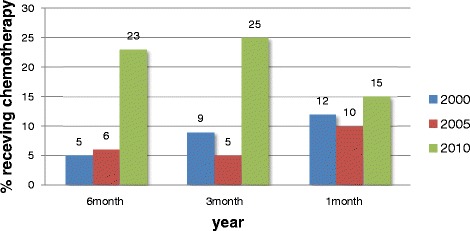
We analyzed the records of 2,345 patients who died of cancer. Patients with less responsive tumors were less likely to receive chemotherapy than patients with responsive tumors at the time of death. Patients who were ≥ 65 years were less likely to receive chemotherapy compared with patients who were < 65 years at the end of life. However, the proportion of older patients receiving chemotherapy in the last month of life increased in 2010 (44.2%) compared with 2005 (32.7%) and 2000 (25.7%). Compared with the year 2000, the likelihood of receiving chemotherapy during the last 1 month of life increased in 2005 (odds ratio [OR], 2.05; 95% confidence interval [CI], 1.60-2.62) and 2010 (OR, 4.42; 95% CI, 3.51-5.57).
The proportion of patients receiving chemotherapy at the end of life increased successively from 2000 to 2005 to 2010. Physicians should consider whether to continue chemotherapy at the end of life.
随着新型高效抗癌治疗药物的发展,晚期癌症患者化疗的应用有所增加。在本研究中,我们分析了临终时接受化疗的患者在 10 年内的趋势。
我们回顾性地审查了 2000 年、2005 年和 2010 年在一家机构死亡的晚期癌症患者的死亡率数据。评估了每年临终时接受姑息性化疗的趋势。此外,还进行了 logistic 回归分析,以确定与接受化疗相关的因素。
我们分析了 2345 例死于癌症的患者记录。在死亡时,对肿瘤反应较差的患者比反应较好的患者更不可能接受化疗。与生命末期年龄<65 岁的患者相比,年龄≥65 岁的患者更不可能接受化疗。然而,在生命最后一个月接受化疗的老年患者比例在 2010 年(44.2%)高于 2005 年(32.7%)和 2000 年(25.7%)。与 2000 年相比,2005 年(比值比[OR],2.05;95%置信区间[CI],1.60-2.62)和 2010 年(OR,4.42;95% CI,3.51-5.57)生命最后一个月接受化疗的可能性增加。
从 2000 年到 2005 年再到 2010 年,临终时接受化疗的患者比例依次增加。医生应考虑是否在生命末期继续化疗。