Hettinga Kasper A, Reina Fabiola M, Boeren Sjef, Zhang Lina, Koppelman Gerard H, Postma Dirkje S, Vervoort Jacques J M, Wijga Alet H
Dairy Science and Technology, Food Quality and Design group, Wageningen University, Wageningen, The Netherlands.
Laboratory of Biochemistry, Wageningen University, Wageningen, The Netherlands.
PLoS One. 2015 Mar 23;10(3):e0122234. doi: 10.1371/journal.pone.0122234. eCollection 2015.
Breastfeeding has been linked to a reduction in the prevalence of allergy and asthma. However, studies on this relationship vary in outcome, which may partly be related to differences in breast milk composition. In particular breast milk composition may differ between allergic and non-allergic mothers. Important components that may be involved are breast milk proteins, as these are known to regulate immune development in the newborn. The objective of this study was therefore to explore differences in the proteins of breast milk from 20 allergic and non-allergic mothers. The results from this comparison may then be used to generate hypotheses on proteins associated with allergy in their offspring.
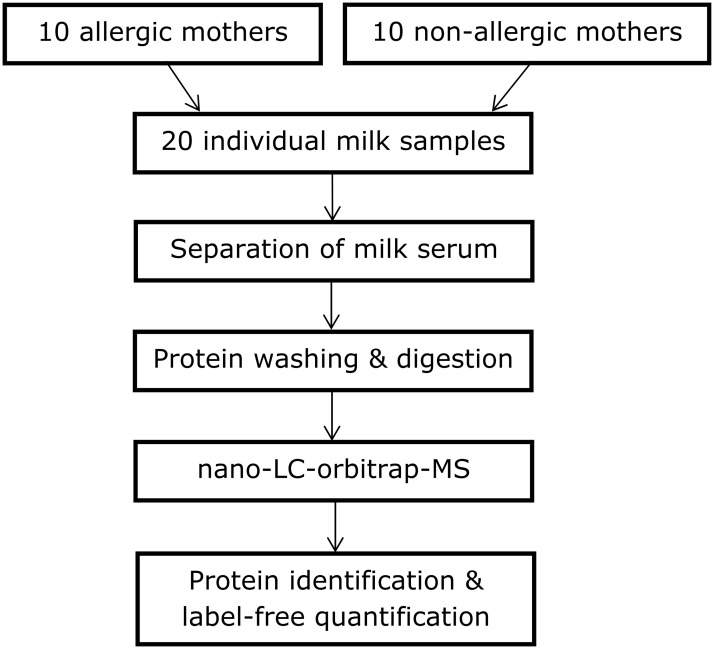
Milk samples from allergic and non-allergic mothers were obtained from the PIAMA project, a prospective birth cohort study on incidence, risk factors, and prevention of asthma and inhalant allergy. Non-targeted proteomics technology, based on liquid chromatography and mass spectrometry, was used to compare breast milk from allergic and non-allergic mothers.
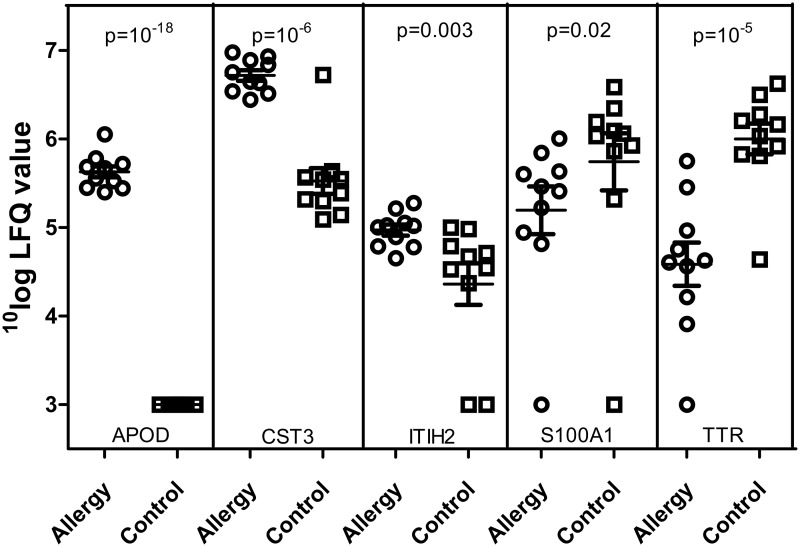
Nineteen proteins, out of a total of 364 proteins identified in both groups, differed significantly in concentration between the breast milk of allergic and non-allergic mothers. Protease inhibitors and apolipoproteins were present in much higher concentrations in breast milk of allergic than non-allergic mothers. These proteins have been suggested to be linked to allergy and asthma.
The non-targeted milk proteomic analysis employed has provided new targets for future studies on the relation between breast milk composition and allergy.
母乳喂养与过敏和哮喘患病率的降低有关。然而,关于这种关系的研究结果各不相同,这可能部分与母乳成分的差异有关。特别是,过敏母亲和非过敏母亲的母乳成分可能有所不同。可能涉及的重要成分是母乳蛋白质,因为已知这些蛋白质可调节新生儿的免疫发育。因此,本研究的目的是探讨20名过敏母亲和非过敏母亲的母乳蛋白质差异。然后,这种比较的结果可用于生成关于与其后代过敏相关蛋白质的假设。
过敏母亲和非过敏母亲的乳汁样本来自PIAMA项目,这是一项关于哮喘和吸入性过敏的发病率、危险因素及预防的前瞻性出生队列研究。基于液相色谱和质谱的非靶向蛋白质组学技术用于比较过敏母亲和非过敏母亲的母乳。
在两组共鉴定出的364种蛋白质中,有19种蛋白质在过敏母亲和非过敏母亲的母乳中的浓度存在显著差异。过敏母亲母乳中的蛋白酶抑制剂和载脂蛋白浓度远高于非过敏母亲。这些蛋白质被认为与过敏和哮喘有关。
所采用的非靶向乳汁蛋白质组分析为未来关于母乳成分与过敏关系的研究提供了新的靶点。