Thumbi S M, Njenga M Kariuki, Marsh Thomas L, Noh Susan, Otiang Elkanah, Munyua Peninah, Ochieng Linus, Ogola Eric, Yoder Jonathan, Audi Allan, Montgomery Joel M, Bigogo Godfrey, Breiman Robert F, Palmer Guy H, McElwain Terry F
Paul G. Allen School for Global Animal Health, Washington State University, Pullman, Washington, United States of America; Center for Global Health Research, Kenya Medical Research Institute, Kisumu, Kenya.
Centers for Disease Control and Prevention, Nairobi, Kenya.
PLoS One. 2015 Mar 23;10(3):e0120761. doi: 10.1371/journal.pone.0120761. eCollection 2015.
For most rural households in sub-Saharan Africa, healthy livestock play a key role in averting the burden associated with zoonotic diseases, and in meeting household nutritional and socio-economic needs. However, there is limited understanding of the complex nutritional, socio-economic, and zoonotic pathways that link livestock health to human health and welfare. Here we describe a platform for integrated human health, animal health and economic welfare analysis designed to address this challenge. We provide baseline epidemiological data on disease syndromes in humans and the animals they keep, and provide examples of relationships between human health, animal health and household socio-economic status.
We designed a study to obtain syndromic disease data in animals along with economic and behavioral information for 1500 rural households in Western Kenya already participating in a human syndromic disease surveillance study. Data collection started in February 2013, and each household is visited bi-weekly and data on four human syndromes (fever, jaundice, diarrhea and respiratory illness) and nine animal syndromes (death, respiratory, reproductive, musculoskeletal, nervous, urogenital, digestive, udder disorders, and skin disorders in cattle, sheep, goats and chickens) are collected. Additionally, data from a comprehensive socio-economic survey is collected every 3 months in each of the study households.
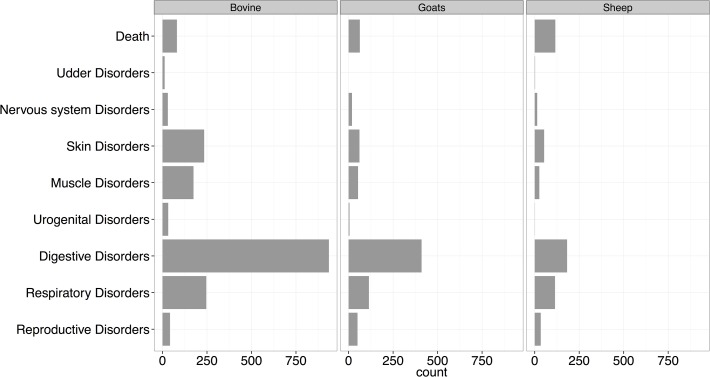
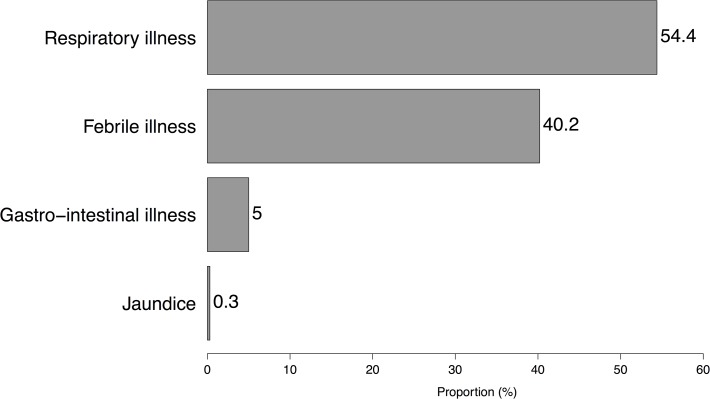
Data from the first year of study showed 93% of the households owned at least one form of livestock (55%, 19%, 41% and 88% own cattle, sheep, goats and chickens respectively). Digestive disorders, mainly diarrhea episodes, were the most common syndromes observed in cattle, goats and sheep, accounting for 56% of all livestock syndromes, followed by respiratory illnesses (18%). In humans, respiratory illnesses accounted for 54% of all illnesses reported, followed by acute febrile illnesses (40%) and diarrhea illnesses (5%). While controlling for household size, the incidence of human illness increased 1.31-fold for every 10 cases of animal illness or death observed (95% CI 1.16-1.49). Access and utilization of animal source foods such as milk and eggs were positively associated with the number of cattle and chickens owned by the household. Additionally, health care seeking was correlated with household incomes and wealth, which were in turn correlated with livestock herd size.
This study platform provides a unique longitudinal dataset that allows for the determination and quantification of linkages between human and animal health, including the impact of healthy animals on human disease averted, malnutrition, household educational attainment, and income levels.
对于撒哈拉以南非洲的大多数农村家庭而言,健康的牲畜在避免人畜共患病相关负担以及满足家庭营养和社会经济需求方面发挥着关键作用。然而,人们对将牲畜健康与人类健康及福祉联系起来的复杂营养、社会经济和人畜共患病途径的了解有限。在此,我们描述了一个旨在应对这一挑战的人类健康、动物健康和经济福利综合分析平台。我们提供了关于人类及其饲养动物疾病综合征的基线流行病学数据,并给出了人类健康、动物健康与家庭社会经济地位之间关系的示例。
我们设计了一项研究,以获取肯尼亚西部1500个已参与人类综合征疾病监测研究的农村家庭所饲养动物的综合征疾病数据以及经济和行为信息。数据收集于2013年2月开始,每个家庭每两周接受一次走访,收集关于四种人类综合征(发热、黄疸、腹泻和呼吸道疾病)以及九种动物综合征(牛、羊、山羊和鸡的死亡、呼吸道、生殖、肌肉骨骼、神经、泌尿生殖、消化、乳房疾病和皮肤病)的数据。此外,每3个月在每个研究家庭收集一次全面社会经济调查的数据。
研究第一年的数据显示,93%的家庭拥有至少一种形式的牲畜(分别有55%、19%、41%和88%的家庭拥有牛、羊、山羊和鸡)。消化系统疾病,主要是腹泻发作,是在牛、山羊和绵羊中观察到的最常见综合征,占所有牲畜综合征的56%,其次是呼吸道疾病(18%)。在人类中,呼吸道疾病占所有报告疾病的54%,其次是急性发热性疾病(40%)和腹泻疾病(5%)。在控制家庭规模的情况下,每观察到10例动物疾病或死亡,人类疾病的发病率就增加1.31倍(95%置信区间为1.16 - 1.49)。牛奶和鸡蛋等动物源性食品的获取和利用与家庭拥有的牛和鸡的数量呈正相关。此外,寻求医疗保健与家庭收入和财富相关,而家庭收入和财富又与牲畜群规模相关。
该研究平台提供了一个独特的纵向数据集,可用于确定和量化人类与动物健康之间的联系,包括健康动物对避免人类疾病、营养不良、家庭受教育程度和收入水平的影响。