Lee Chang Woo
Department of Pediatrics, Wonkwang University School of Medicine, Iksan, Korea.
Korean J Med Educ. 2013 Mar;25(1):15-21. doi: 10.3946/kjme.2013.25.1.15. Epub 2013 Mar 31.
We are entering a new era of medicine in which an equal number of men and women are becoming doctors. Many factors combine in complex and poorly understood ways to influence a medical student's career and choice of specialty. This study investigated the preferences of medical students with regard to specialty and examined differences between genders.
We administered a survey to medical students at the end of their third- or fourth-year clinical clerkships. In addition to demographic data and specialty choice, medical students selected factors that were importance to their choice of specialty.
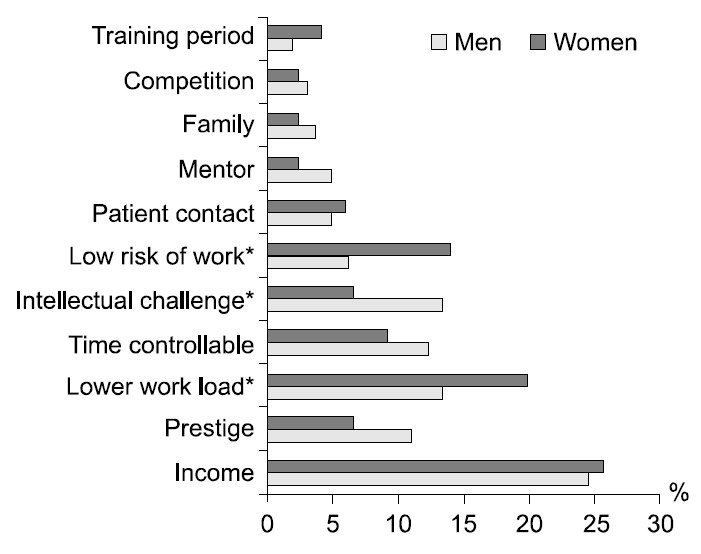
One hundred forty-one medical students completed the survey (81 males, 57%). For medical students who had chosen a specialty, the most common specialty was internal medicine (20.5%). Significant gender differences were observed in choosing orthopedic surgery and family medicine-17 male students chose orthopedic surgery (10.5%) versus 3.3% of female students (p=0.02), and 11 females (9.2%) were drawn toward family medicine compared with 4 male students (2.5%). More female medical students chose lower workloads (19.9%) and low-risk work (14%) than male students (p<0.05). Lifestyle and income have become more important to medical students regarding their choice of specialty.
There were significant gender differences concerning the choice of medical specialty. Controllable lifestyle remains an important factor for female medical students who are choosing a specialty. We must begin to make meaningful and thoughtful changes in medical center policies that affect a balance between work and home.
我们正进入医学的新时代,男女医生数量趋于相等。多种因素以复杂且鲜为人知的方式共同作用,影响医学生的职业和专业选择。本研究调查了医学生对专业的偏好,并检验了性别差异。
我们在医学生三年级或四年级临床实习结束时进行了一项调查。除人口统计学数据和专业选择外,医学生还选出了对其专业选择重要的因素。
141名医学生完成了调查(81名男性,占57%)。在已选定专业的医学生中,最常见的专业是内科(20.5%)。在选择骨科手术和家庭医学方面观察到显著的性别差异——17名男学生选择了骨科手术(占10.5%),而女学生中只有3.3%选择该专业(p = 0.02);11名女学生(占9.2%)倾向于家庭医学,而男学生中只有4名(占2.5%)选择该专业。选择较低工作量(19.9%)和低风险工作(14%)的女医学生比男医学生更多(p < 0.05)。生活方式和收入在医学生选择专业方面变得更为重要。
在医学专业选择方面存在显著的性别差异。对于选择专业的女医学生而言,可控的生活方式仍是一个重要因素。我们必须开始对影响工作与家庭平衡的医疗中心政策做出有意义且深思熟虑的改变。